
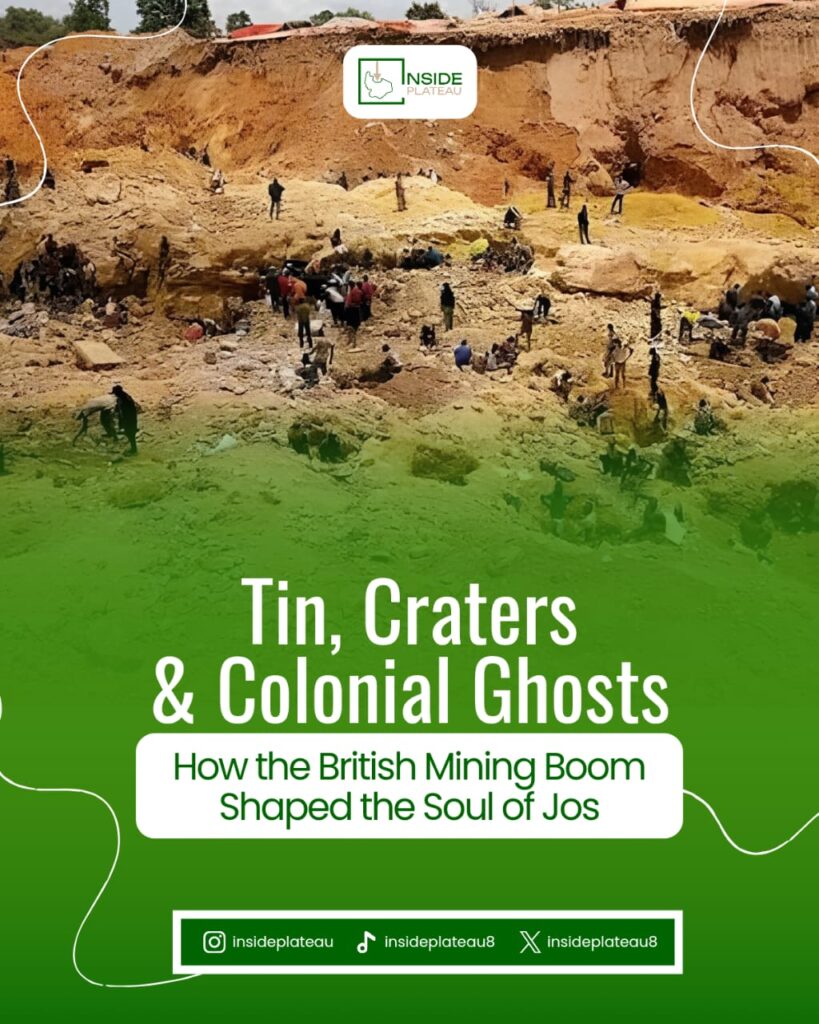
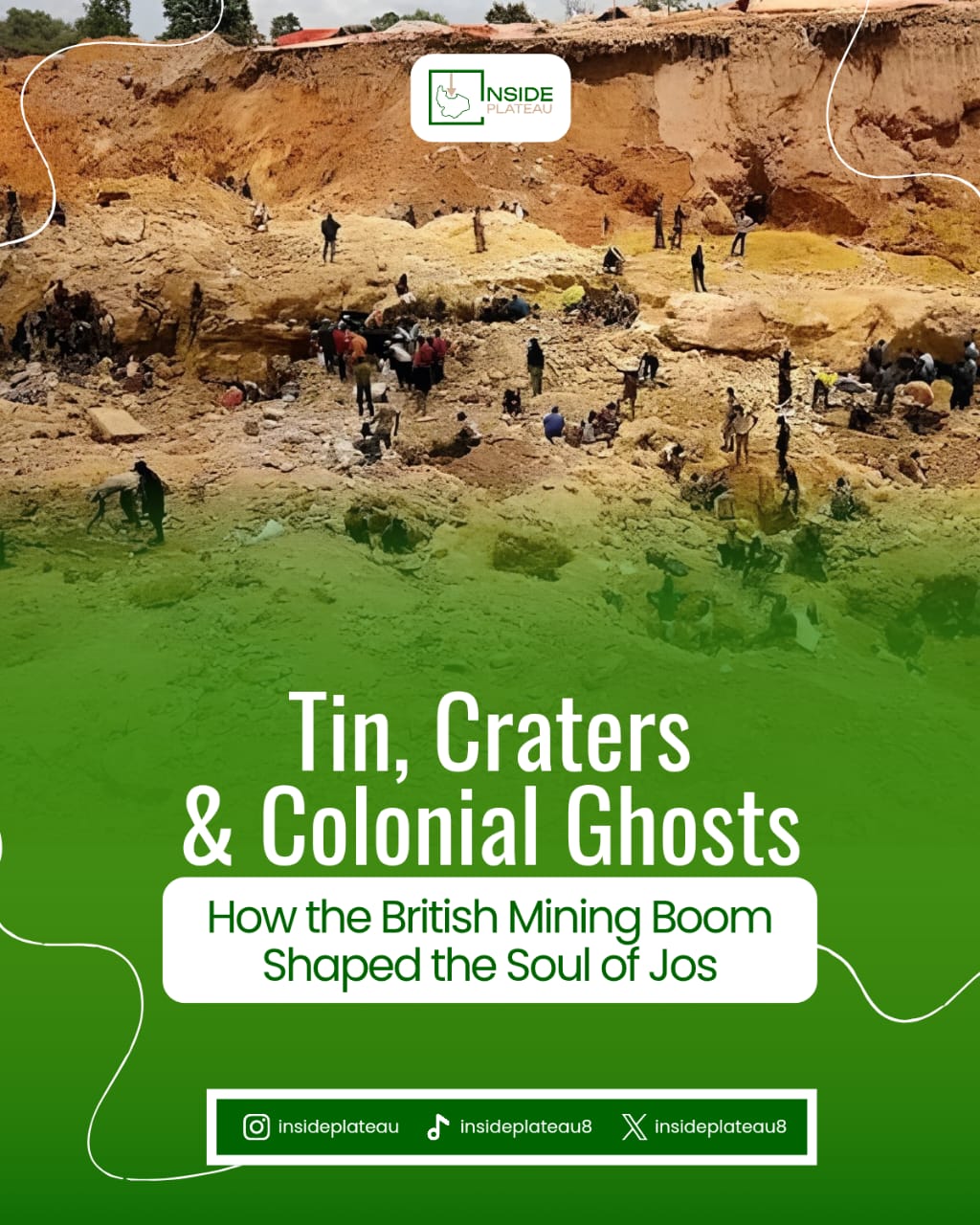
Every morning, I walk down to the lakeside near Rayfield Resort for a few quiet minutes of sun gazing and meditation. Most visitors see a calm, beautiful lake. I see something else. That lake is a crater, dug generations ago during the era of tin mining in Jos, and standing at its edge always feels like standing on something alive. It is as if the energy of the labourers who once dug there still lingers in the water. I feel proud, powerful, and connected to people I never met, who built something enormous with their hands, long before I was born.
That feeling is the real starting point of this article. Because the story of tin mining in Jos is not just a chapter in a history book. It is still sitting in our landscape, in our infrastructure, and in the quiet pride and quiet grief of people who live here today. To understand modern Jos at all, you have to understand tin mining in Jos first.
Tin Mining in Jos: Long Before the British Arrived
Tin mining in Jos did not begin with the British. Long before colonial rule, communities on the plateau were already smelting and trading tin, with early production dated to somewhere between 1700 and 1770 around the Kuza and Naraguta areas. That tin moved through Hausa and trans-Saharan trade networks decades before a single British prospector set foot on the plateau.
It is worth remembering that indigenous knowledge and indigenous labour came first. What arrived after 1900 was not the beginning of tin mining in Jos. It was its violent industrialisation.
The British Mining Boom Begins
British interest in the plateau’s tin deposits intensified through the 1800s, but commercial control is usually dated to 1902, when the Minerals Proclamation placed all mineral rights under the Crown and formal prospecting and leasing began in earnest. Within just over a decade, the scale was already enormous: by 1913, more than a hundred mining companies had been registered on the plateau.
Production climbed quickly once the British mining boom took hold. Output rose from roughly one and a half metric tons in 1914 to a peak of around 17,000 to 17,740 metric tons in 1943, at the height of the Second World War, when Nigeria briefly became the world’s sixth-largest tin producer. The Amalgamated Tin Mines of Nigeria, formed in 1939, became the largest tin-mining company in the world at the time, bringing in deep-shaft methods and heavy machinery that dug faster, deeper, and far more destructively than the manual labour that came before it. Traces of its operations still stand today around the stadium area in Bukuru.
To move that much tin out of a landlocked plateau, the British mining boom demanded serious infrastructure. Between 1914 and 1927, rail lines from Bauchi, Zaria, Port Harcourt, and Lagos were linked to Jos, built for one purpose: to evacuate tin to the coast. In 1929, the Nigeria Electricity Supply Company was established specifically to power the mines. Remarkably, it still supplies electricity to parts of Jos today, nearly a century later, a private company born entirely out of tin mining in Jos that quietly outlived the industry it was built to serve.
The Human Cost
The British mining boom did not run on machinery alone. It ran on people, and the terms were rarely fair.
The colonial administration used cash taxation, labour recruitment through local chiefs and ward heads, and outright conscription to pull workers into the mines from across Northern Nigeria and neighbouring territories. At its peak in 1943, roughly 80,000 African workers were employed across the plateau’s tin fields. By the early 1970s, a much smaller workforce of around 53,000 was still producing close to 16,000 tons of tin a year. During the war years, entire family units, including children and women, were recorded working in the mines.
Wages reflected how little this labour was valued. A 1938 British parliamentary record put unskilled wages in Nigeria’s northern provinces at just four to nine pence a day, and colonial authorities made little effort to raise them enough to attract workers voluntarily, which is part of why coercion became so central to the system in the first place.
My own family carries a smaller, gentler memory from this same era. My grandfather used to travel to Jos, not to work the mines himself, but to sell jewellery and other valuables to the miners and traders who filled the booming town. Tin mining in Jos did not just employ people underground. It built an entire town’s economy around it, pulling in traders, craftsmen, and migrants from every direction.
The Craters That Remain
Look closely at the land around Jos today, and the British mining boom is still written into the ground. Estimates suggest there are somewhere between 700 and over 1,000 abandoned mine ponds scattered across the plateau, concentrated in areas like Bukuru, Rayfield, Bitsichi, and Sabon Gida. Some are wide, glassy, and turquoise. Others run a strange emerald green or muddy ochre, coloured by decades of mineral runoff. Roughly 325 square kilometres of land, close to a fifth of the plateau’s agricultural land, was degraded by mining, and around a third of that suffers serious ongoing erosion.
Some of these ponds have quietly been given a second life, reclaimed for irrigation, dry-season farming, and fishing. Rayfield Resort itself sits around one such pond, a former crater from tin mining in Jos now filled with paddle boats and picnic families instead of pit workers. It is one of the clearest examples anywhere in Nigeria of a colonial wound being turned, deliberately or not, into something the community now enjoys.

Not every legacy is so gentle. Peer-reviewed research, including a 2015 study published in the journal Ambio, has found that mining tailings across the plateau carry significantly elevated levels of natural radioactivity compared to surrounding soil, a consequence of the columbite and monazite that came up alongside the tin. This is a serious, documented environmental legacy, not folklore, and it is a reminder that the
British mining boom left behind more than scenery. It left behind land that still needs careful, ongoing attention.
Also Read: Rayfield Jos: Inside Nigeria’s Most Exclusive Billionaire Neighborhood
An Unexpected Gift
Not everything the British mining boom unearthed was tin. In the course of open-cast digging, miners accidentally exposed the now-famous Nok culture terracotta sculptures. They dated back roughly 2,500 years, among the oldest known figurative art in West Africa. Archaeologist Bernard Fagg documented the discovery. This eventually helped establish the Jos Museum as one of the most important archaeological collections on the continent. It is a strange kind of irony: an extractive industry built purely for profit ended up handing Nigeria one of its deepest windows into its own ancient history.
Also Read: A First-Timer’s Guide to Jos: What to Do, See, and Eat When You Arrive
What We Carry Now
Ask people in Jos today what the British mining boom brought, and you will hear two answers that do not cancel each other out.
One answer is documented and difficult. Colonial rule brought coercion, unequal wages, environmental damage, and a labour system that valued output over the people producing it. The other answer is lived and personal. Plateau’s long-standing diversity, the mix of Berom, Hausa, Yoruba, Igbo, and dozens of other communities who arrived chasing the tin economy, has, over generations, become a source of real pride. Jos remains one of the few places in Nigeria where someone from elsewhere can settle and genuinely feel at home, rather than treated as an outsider. Tin mining in Jos did not only extract. In its own complicated way, it also built the cosmopolitan, tolerant character the plateau is known for today.
I feel both of these truths standing at that lakeside most mornings. Sometimes I feel a little robbed, knowing that wealth pulled from this ground helped build cities far from here, while the people who dug it kept very little for themselves. But mostly, I feel blessed. The British mining boom left us with holes in the earth. Time, and the resilience of the people who stayed, turned many of those holes into lakes, resorts, farmland, and quiet places to sit and think.
That, more than any statistic, is the real legacy of tin mining in Jos. Not just what was taken from this land, but what the people here have since made of what was left behind.