
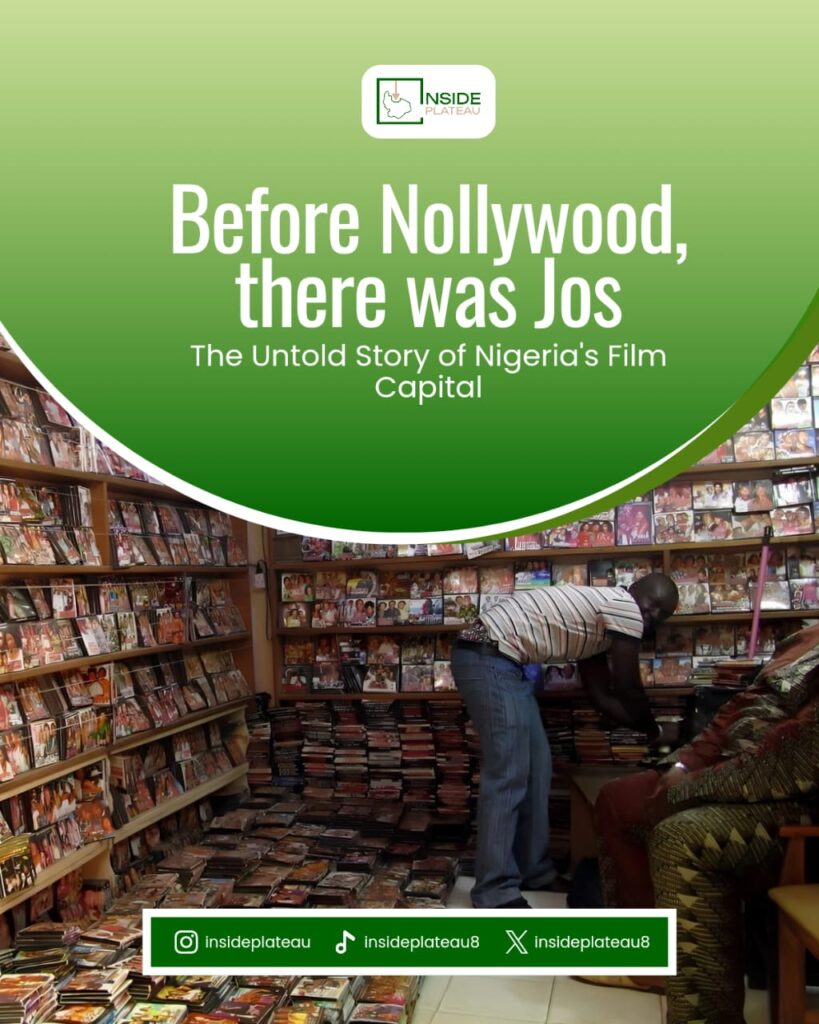
Long before Lagos became synonymous with Nollywood, there was a quieter, cooler city already doing the work. Jos was Nigeria’s Film Capital before the world knew to call it that — a place where television, film, and talent were being shaped decades before anyone coined the word “Nollywood.”
If you grew up here, you already know this. We watched dramas on PRTV before we knew what an industry was. Also, we listened to radio dramas like Talk Your Own on quiet evenings. And, we watched church dramas, music videos shot on our streets, and television productions that never once mentioned Lagos. Creativity has always been Jos’s identity. Long before Nigeria’s Film Capital became a headline, it was simply how we lived.
Nigeria’s Film Capital Had a Broadcasting Backbone
The story starts with television. NTA Jos began life as Benue-Plateau Television, first broadcasting on 15 July 1974 on channel 7, before joining the national NTA network in 1977. By the early 1980s, it reportedly had its own color processing, developing, and printing facilities — a detail that reveals something important. This wasn’t just a broadcaster. It was a production house.
That capacity turned Jos into Nigeria’s Film Capital in every sense that mattered at the time: studio production, lighting, directing, editing, sound recording, production management. Skills that had nowhere else in the country to be learned at that scale were being taught and practiced right here.
PRTV still stands today. So does NTA. Drive past either building and you’re looking at the physical bones of Nigeria’s Film Capital, still standing long after the cameras that once rolled inside them changed hands.
The Nigerian Film Institute: Where the Talent Was Built
If NTA Jos gave the city its production muscle, the Nigerian Film Institute gave it its soul.
Established from Nigeria’s 1992 National Film Policy and formally taking shape by 1995, the Nigerian Film Institute became — and remains — Nigeria’s leading film training school. It didn’t just teach one skill. It taught all of them: directing, cinematography, editing, screenwriting, sound, animation, film preservation. Students walked out able to do a bit of everything, and often, a lot of everything well.
That completeness is not a rumor. I once asked a Nigerian Film Institute graduate which part of filmmaking he was best at. He didn’t name one. He said, “Let’s shoot.” On set, he moved between lighting, acting, directing, casting, and set design without missing a beat. That is the story of nearly everyone who has passed through the Nigerian Film Institute. It is not a school that produces specialists. It produces filmmakers, full stop.
Shinning Lights From NFI Jos
The names that came out of it back this up. Kenneth Gyang, multi-award-winning director behind Netflix titles like Oloture and Blood Sisters, trained here. So did Mak ‘Kusare, a Zuma Award and ECOWAS Prize winner. Kagho Idhebor won Best Cinematographer at the 2018 Africa Movie Academy Awards. Ali Mustapha, an Al Jazeera cinematographer, took gold at the 2024 TV Film New York Festival for his war coverage. One 2018 report even claimed graduates of the Nigerian Film Institute were involved in roughly 30% of Nollywood productions in progress at any given time — a figure worth treating carefully, but one that speaks to just how deep the institute’s fingerprints run through the industry.
Before the Nigerian Film Institute, there was the Television College, now NTA College, where earlier names like Nat Dazie, Ene Onoja, Peter Igho, and Sadiq Daba trained. The pipeline from Jos to national television and film was never new. It was simply overlooked.
Why the Archive Chose Jos
Here’s a detail most people, even proud Plateau natives, don’t know. Nigeria’s national film archive didn’t end up in Jos by accident.
The National Film, Video and Sound Archive holds more than 20,000 works, some dating back to the colonial era — reels so fragile that heat and humidity can destroy them within years. Jos, sometimes nicknamed “Little London” for its cool climate, offered something Lagos never could: stable, temperate conditions that slow down film degradation. Preserving Nigeria’s cinematic memory meant preserving it somewhere the weather itself would cooperate. That’s part of why Jos holds the reels that helped restore classics like the 1976 film Shaihu Umar.
It’s a quiet fact, but it says something loud: even Nigeria’s film history needed Nigeria’s Film Capital to survive.
Also Read: Nigeria’s Best-Kept Creative Secret Is a City on a Plateau
Why Jos Lost the Spotlight
None of this lasted without cost. From 1999 onward, the industry on the Plateau went into a visible downturn. Insecurity chased away investment and confidence. Talent packed up for Lagos and Abuja, chasing money, marketers, and momentum.
The bigger shift was structural. When Nigerian filmmakers moved from expensive celluloid to affordable VHS in the early 1990s, big government facilities became less necessary. Anyone with a video camera could produce something. Lagos already had the banks, the advertisers, the actors, the television networks, the airports. Eastern marketers, especially around Onitsha and Aba, controlled the electronics and distribution networks that got films into homes nationwide.
The result was a clean, if quiet, division of labor: Jos trained the professionals. Lagos commercialized the industry. Onitsha distributed it. Nigeria’s Film Capital didn’t lose its relevance — it simply stopped being the loudest part of the story.
Add to that the decline of tin mining, which had powered Jos’s economy for decades, and structural adjustment programs that gutted public arts funding through the 1980s, and it’s easy to see why investment drifted elsewhere. Jos didn’t fail Nollywood. Nollywood simply grew up somewhere else.
- Are you looking for a Cinema in Jos? Visit https://www.meespalacecinemas.com/
Nigeria’s Film Capital, Quietly Still Working
What’s easy to miss is that Nigeria’s Film Capital never actually closed shop. It just stopped competing for attention.
In June 2026, the Nigerian Film Institute hosted a restored screening of Shaihu Umar, described as a landmark moment for Nigerian cinema preservation. Weeks later, in early July 2026, representatives from iDICE visited the Nigerian Film Institute to discuss collaboration on talent development and strengthening Nigeria’s creative economy. These aren’t nostalgia events. They are signs of an institution — and a city — still doing the work it has always done, just without the noise.
Also Read: Nigeria’s Best-Kept Creative Secret Is a City on a Plateau
Nigeria’s Film Capital Deserves a New Story
For too long, the narrative has been “Jos lost Nollywood.” That framing is wrong, and it undersells what actually happened here.
The truer story is this: Jos was Nigeria’s film classroom before Lagos became its film marketplace. That’s not a consolation prize. That’s a foundation.
There’s a real opportunity in reclaiming that story — heritage tours through NTA, PRTV, and the Nigerian Film Institute, a Jos Film Heritage Festival, documentaries and digital storytelling that put this history in front of a generation that has no idea the ground they’re standing on trained the people who built Nollywood. Add in Jos’s cool climate, its dramatic rock formations, and its scenic landscapes, and Nigeria’s Film Capital has just as much to offer modern productions as it did in 1974.
As someone writing this from Jos, I don’t feel like I’m uncovering someone else’s history. I’m telling my own. I want Plateau readers to feel pride reading this — a sense that we are, and have always been, the right people to tell our own story. And I want anyone thinking about investing in film to understand something simple: Jos has no real competition when it comes to raw filmmaking talent. We’ve just never needed to be loud about it.
Talent doesn’t need to shout to be real. Nigeria’s Film Capital has known that for fifty years.
Visit https://nfi.edu.ng/