There is a particular kind of pride that comes with being from Plateau State. It is not loud nor performative. But the quiet confidence of someone who knows exactly what they are sitting on. Rich land. Cool air that hits differently from anywhere else in Nigeria. Natural beauty that stops visitors mid-sentence. A food culture that runs deeper than most Nigerians will ever take time to understand. Rich festivals that have been celebrated for centuries. Over fifty ethnic groups, each carrying their own language, their own traditions, their own way of seeing the world.
For decades, that pride coexisted with a quiet frustration. The feeling that the rest of Nigeria was sleeping on Plateau. That investors were flying over the state on their way to Lagos and Abuja without stopping to look down. That the land was rich but the systems around it were not keeping up. That the potential everyone talked about was real but somehow still waiting.
Something is shifting. And this time, it feels different.
A Pitch, Not a Plea
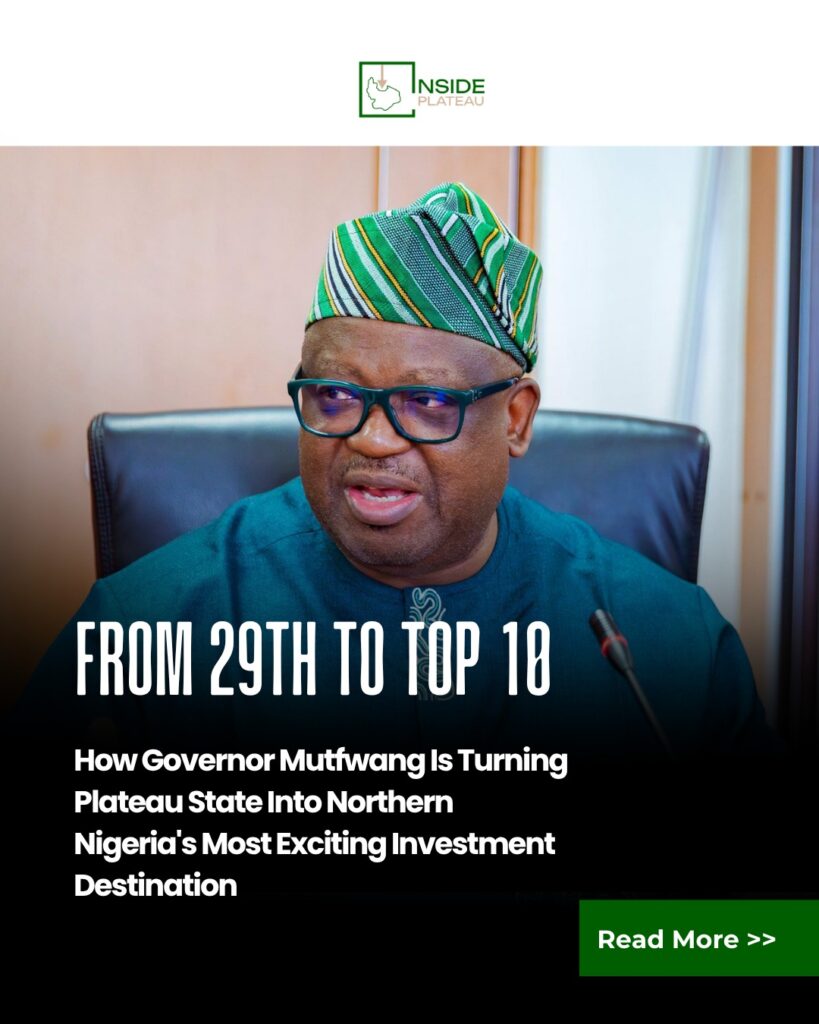
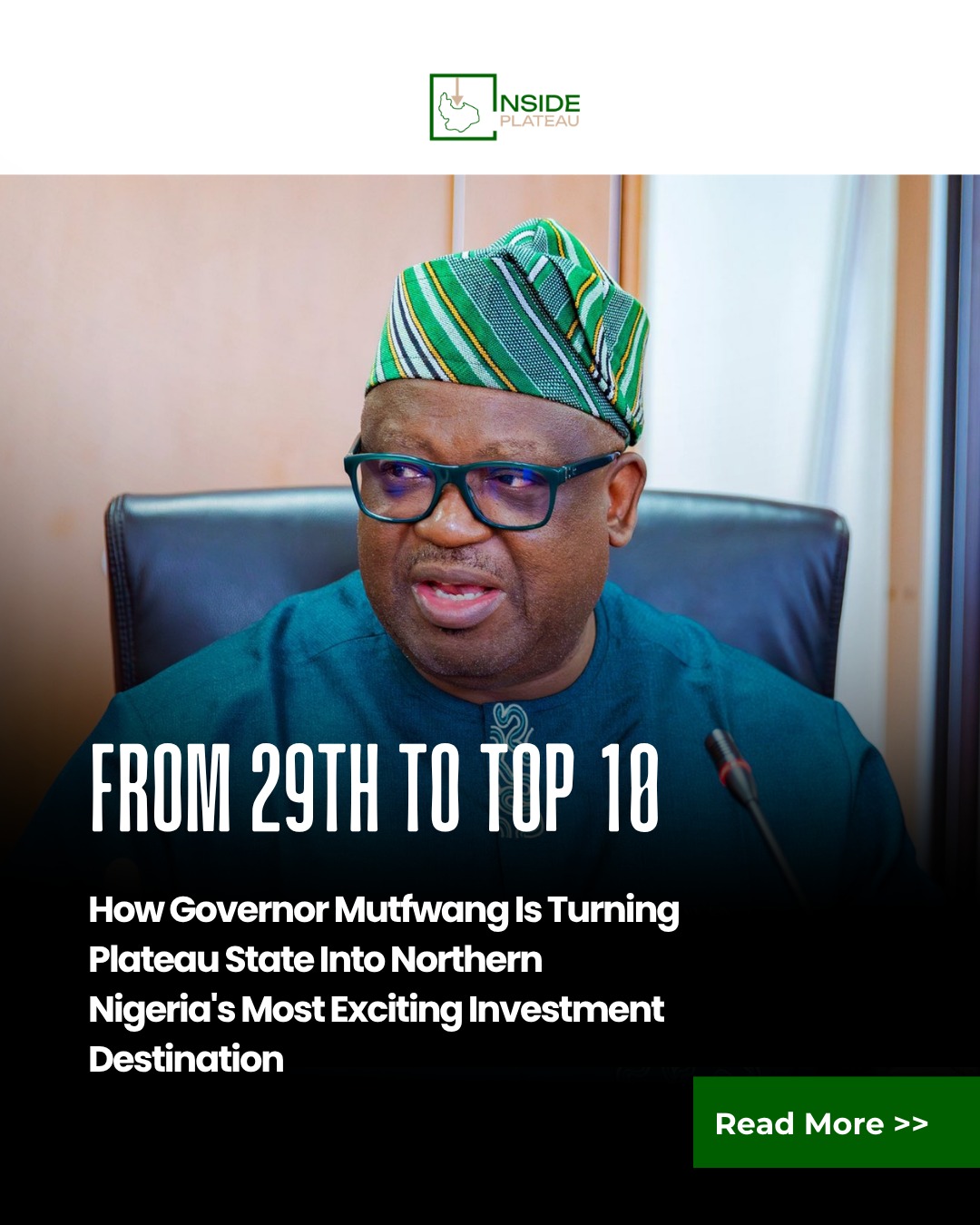
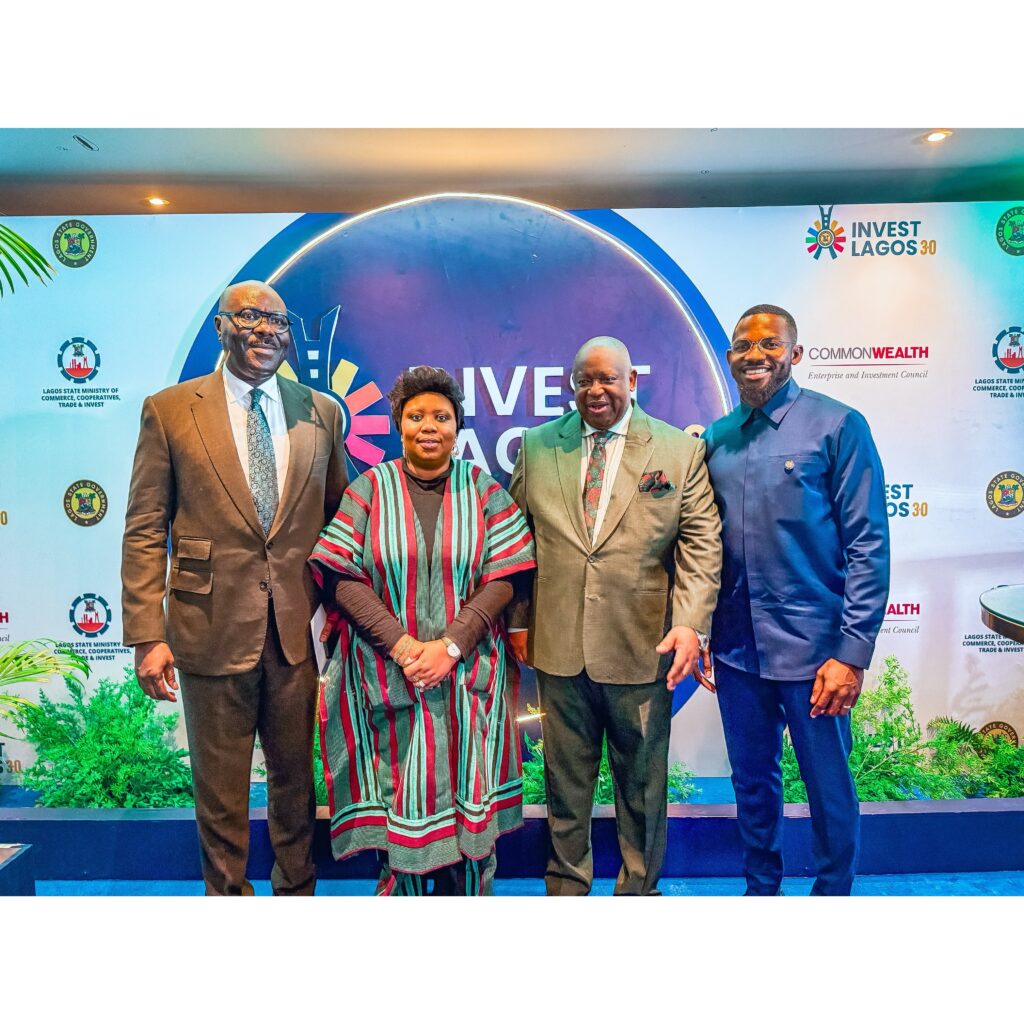
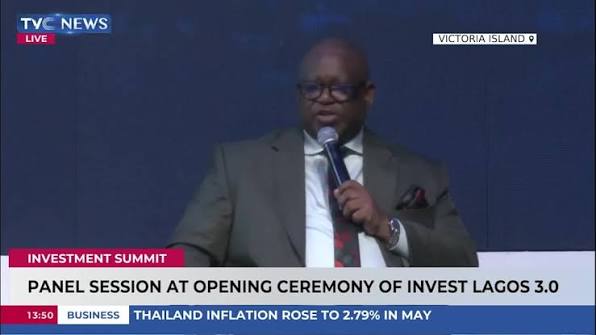
When Governor Caleb Mutfwang stood before investors, policymakers, and business leaders in Lagos recently, he did not go there to beg for attention. He went there to pitch a state that has been doing the quiet work of transforming itself. And the numbers he brought with him told a story that is hard to ignore.
Two years ago, Plateau State ranked 29th on Nigeria’s ease of doing business index. Today, it sits at 7th nationally, according to the 2025 Subnational Ease of Doing Business Report published by the Presidential Enabling Business Environment Council. That ranking measures real things. Infrastructure. Land administration. Digital service delivery. Investor support. Regulatory efficiency. Power supply. Access to skilled labour. Market access. Grievance resolution systems. Moving from 29th to 7th on a framework that rigorous is not a PR achievement. It is evidence of structural change.
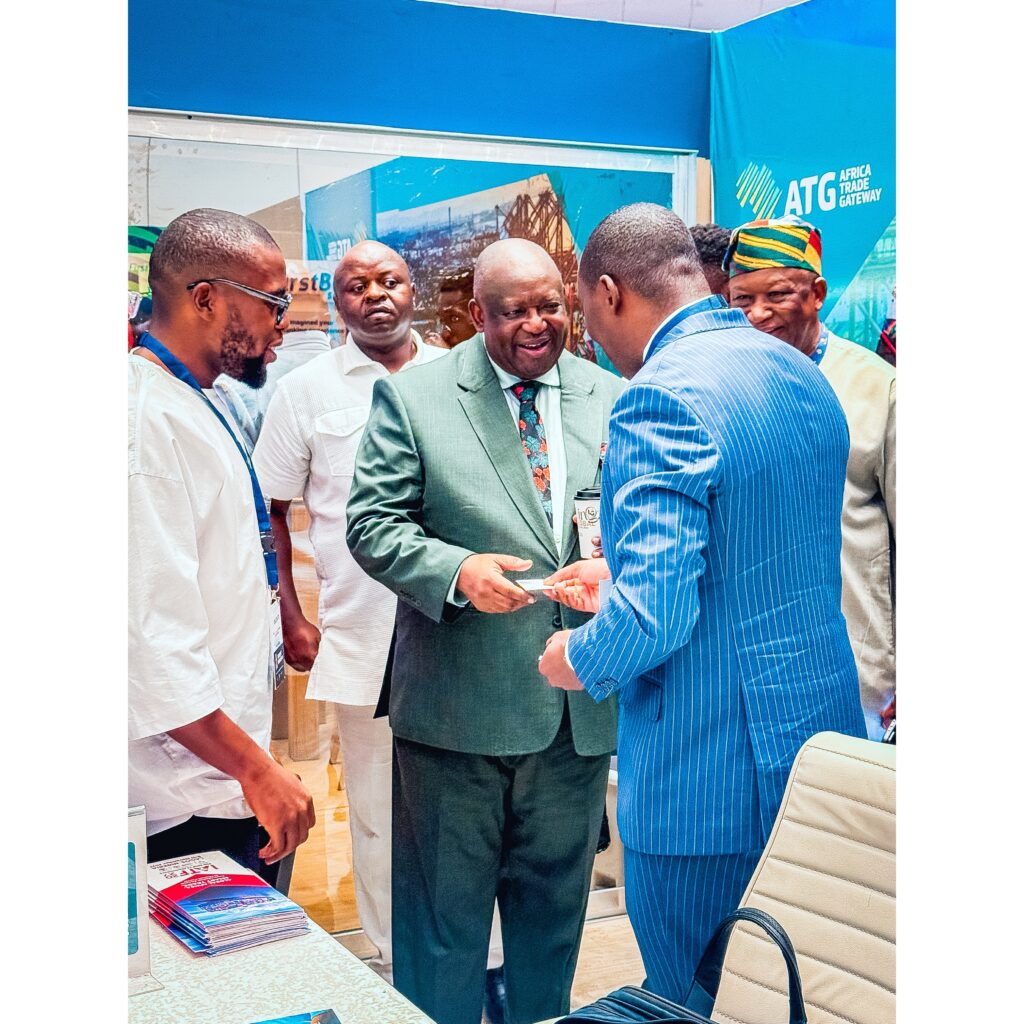
Governor Mutfwang described the invitation to speak in Lagos as validation. Not just of his administration’s work, but of Plateau State’s position as one of the emerging economies of northern Nigeria. He acknowledged the presence of Vice President Kashim Shettima and Governor Babajide Sanwo-Olu, then got straight to the point. Plateau has adopted a public-private partnership model as the engine of its development. The government is not trying to build everything itself. It is creating conditions; signing agreements, finishing what was abandoned, building the zones, then calling on the private sector to come in and move.
Also Read: https://www.investlagos.org/speakers
The three sectors at the centre of that vision are Agriculture, Tourism, and Mining. Each one sits on decades of underutilisation, and is now being approached with a level of deliberateness that Plateau has not seen before.
Agriculture: Finally Moving From the Farm Gate to the World
If you want to understand the agricultural ambition of Plateau State, start with a simple fact. The state feeds Nigeria. It feeds West Africa. It feeds neighbours like Chad and Benin. And for most of that history, it did all of that without capturing the real value of what it was producing.
Also Read: Plateau Potatoes: A Taste of Home, Pride, and Prosperity
Plateau is Nigeria’s leading producer of what is now officially being called Plateau Potatoes. The name change matters. Irish Potatoes was a colonial label. Plateau Potatoes is a brand. It is an identity. It says this product belongs here, was perfected here, and should be celebrated here. The state does not just supply potatoes. It is the backbone of Nigeria’s potato market and one of the biggest suppliers of fresh vegetables across the entire country.
Governor Mutfwang grew up understanding this. He is a son of a farmer. So, he knows what it means to watch your harvest go to waste because there is no cold storage nearby. He also knows what it means to sell your produce at a fraction of its value because you have no processing facility to add anything to it before it leaves your hands. That personal understanding is shaping policy in a way that purely technocratic governors rarely achieve.
From 7 Tons to 20: The Seed Problem
The current yield of Plateau potatoes sits at around 7 tons per hectare. The administration’s ambition is to push that to 20 tons per hectare. That is not a small target. Almost tripling yield requires getting the fundamentals right. And the fundamental that matters most is the seed.
You cannot grow a healthy crop from a weak seed. This may sound obvious but it has been ignored for too long. The administration is now investing seriously in seed multiplication and quality seedlings. The goal is to make sure farmers across Plateau are starting from the best possible position before a single potato goes into the ground.
Along with that, a tissue culture laboratory financed by the African Development Bank has been rescued and is now 95 percent complete. This laboratory was stalled for nearly seven years. Seven years of sitting there, built and unfinished, while farmers continued planting with compromised seeds and hoping for the best. Governor Mutfwang’s administration got it moving again. When it becomes fully operational, it will produce disease-free, high-quality planting material at scale. That is the kind of infrastructure that quietly changes an entire agricultural sector.
Vegetables are part of the story too. Plateau is the biggest supplier of fresh and platter vegetables across Nigeria. But freshness has a clock. And when the cold chain fails, the clock runs fast. Post-harvest losses have been bleeding Plateau farmers for years. Produce that should be reaching Lagos markets in perfect condition is arriving damaged or not arriving at all. The administration is expanding cold-chain infrastructure directly because of this. It is not glamorous work. But it is the kind of work that actually protects a farmer’s income.
The Agro-Processing Zone at Haipang
Then there is the bigger picture. The Special Agro-Industrial Processing Zone at Haipang community in Barkin Ladi Local Government Area. This is Phase Two of the African Development Bank’s Special Agro-Industrial Processing Zones programme. Plateau secured approval for Phase Two after learning from what went right and what went wrong in Phase One. The state has acquired 500 hectares of land centred around the Yakubu Gowon Airport corridor. The African Development Bank is financing this as part of a Tranche 1 package worth over $1.1 billion, covering multiple states. Plateau’s inclusion is not accidental. It is the result of demonstrated readiness.
The location of this zone is deliberate. It sits near the airport and near the planned Dry Inland Port, creating an integrated economic corridor. Agro-processing facilities. Logistics infrastructure. Export channels. All in the same ecosystem. The idea is that a farmer’s produce can move from field to facility to cargo terminal to international market without travelling across the country to do it. Groundbreaking for the state’s first mid-processing centre is set to commence. That is the moment when the vision becomes concrete and physical.
Turning Yakubu Gowon Airport Into a Cargo Hub
The Yakubu Gowon Airport is being transformed to make all of this possible. In June 2025, Plateau State signed a Memorandum of Understanding with the Federal Airports Authority of Nigeria. The terms are clear. Plateau State finances the upgrades. That means a new cargo terminal. Runway and apron expansion. Cold rooms. Warehouses. X-ray and security equipment. FAAN provides the technical oversight, expertise, and support. The airport, which has been operational since 1972, is being repositioned as an agro-cargo international hub. The target is simple. Get Plateau’s potatoes, vegetables, maize, and fruits onto international markets before post-harvest losses swallow the profit. As of May 2026, a committee has been inaugurated to accelerate implementation and submit recommendations within two months. The runway, quite literally, is being prepared.
Also Read: Our Democracy, Our Future: Significance of the Town Hall Meeting
Livestock: Turning Conflict Into Commerce
Livestock is the part of the story that carries the most political weight and the most economic promise at the same time. Plateau State is one of the best environments in Nigeria for cattle breeding. The land, the climate, the grazing conditions — everything favours it. But this sector has also been the source of the farmer-herder conflict that has cost lives, displaced communities, and frightened away investors for years.
Governor Mutfwang is approaching this with a strategy that is as much about peace as it is about profit. The administration has brokered 25 peace agreements across farming communities in Bokkos and Riyom, facilitated through dialogues by groups including the International Forum for Transitional Justice. The Plateau State Peace Building Agency has been running community dialogues, building early warning systems, and developing replicable peace models. The security initiative known as Operation Rainbow is part of the broader stabilisation effort.
The economic vision built on top of that peace work is ambitious. A new ultramodern abattoir is being built and relocated into the economic zone around the airport. The administration is developing the full livestock value chain. Feedlots. Fattening lots. Fodder production. Logistics. Processing. The targets include supplying Lagos markets and exporting processed livestock products to the Middle East. Plateau has the natural advantage. The plan now is to build the commercial infrastructure that turns that advantage into revenue.
Governor Mutfwang framed it this way. The goal is to convert conflict into economic opportunity. That sentence deserves to sit with you. It means that the same land disputes that have caused so much pain could become, with the right policies and the right infrastructure, the foundation of one of Plateau’s most productive industries. That is not naive optimism. It is a deliberate economic and political strategy.
Tourism: The Announcement Plateau Has Been Waiting to Make
Agriculture may be the foundation of Plateau’s economic transformation. But tourism is where the state has its most powerful story to tell. And it has barely started telling it.
The raw material is already there. It has always been there. The cool plateau climate that drops to temperatures the rest of Nigeria only dreams about. The dramatic rock formations of Shere Hills and Riyom. The waterfalls at Assop and Kurra that pour clean water down ancient rock faces. The Jos Wildlife Park. The museums that hold the history of the Nok civilisation, one of the oldest known terracotta-producing cultures in the world. The cultural richness of over fifty ethnic groups each with their own festivals, food, music, and traditions. The Nzem Berom festival. The Puusdung. The Nahwai. The Bit Gamai. All of these are tourism products that have not been properly packaged or sold to the world.
Governor Mutfwang described Plateau’s identity as the Home of Peace and Tourism. He pointed to the state’s favourable weather and climate as genuine competitive advantages in a tourism landscape where many Nigerian destinations struggle with heat, congestion, and a lack of natural scenery. He spoke of opportunities that exist because of those advantages. And he announced that the administration is working on feasibility studies, nearly concluded, to build capacity in health tourism in addition to the natural and physical assets the state already possesses.
Bringing Jos’s Hotels Back to Life
Governor Mutfwang is remodelling Plateau Hotel and Hill Station Hotel, two of Jos’s most iconic properties, returning them toward the world-class standard that the plateau landscape has always deserved. These are not cosmetic renovations. They are repositioning exercises. The message sent to investors and visitors is that Plateau takes hospitality seriously now; you can come here and be properly received. That the experience will match the scenery.
But for those who know Plateau deeply, the opportunity stretches much further than what any government document has yet fully captured. There are properties like the Hilltop Hotel in Pankshin and others scattered across the state that remain underused and underinvested. Each one is a conversation with the world that is not yet happening. Every time a visitor has to settle for accommodation that does not match the beauty surrounding it, Plateau loses a potential ambassador. Someone who could have gone home and told thirty people to come here and instead went home quietly disappointed.
Also Read: Hilltop Hotel Pankshin: Tourism Asset Faces Decline
The Digital Nomad Opportunity Nobody Has Named Yet
The tourism potential that excites the most is the one that has not been named officially yet. Plateau State has everything it needs to become West Africa’s destination for digital nomads. People who work online, who can live anywhere, who are actively looking for places that combine natural beauty with cool weather with a genuine local culture with relative peace and safety. Jos has all of that. The infrastructure gap is the only thing standing between this city and that conversation. Close the gap, develop the hotels, improve the internet connectivity, build the co-working spaces, and the world starts finding its way to Plateau on its own terms.
Health tourism is the newer angle. The governor is investing over two billion naira in health infrastructure upgrades. Modern equipment. Specialist recruitment. Solar-powered facilities. Improved drug supply and commodities management that has already cut costs by around 25 percent. Expansion of health insurance coverage. The goal is to first stop the flow of Nigerians going abroad for medical care they should be able to get at home. Then to position Plateau as a destination for patients from across the region and beyond, drawn by improving facilities and an environment that genuinely aids recovery.
The Partnerships That Are Making It Real
Governor Mutfwang has not been building this in isolation. He has been signing agreements and building relationships that give the vision external support and accountability.
The MoU with FAAN for the airport cargo hub is already signed. The African Development Bank relationship through the SAPZ programme brings $1.1 billion in Tranche 1 financing across multiple states, with Plateau as a key beneficiary. The administration has signed an MoU with the United Nations Development Programme for inclusive development, capacity building, and investment attraction, backed by a state commitment of ten billion naira. There is an MoU with Solutron Eastern Fibre Limited for infrastructure and fibre connectivity. A partnership with the Rural Electrification Agency is bringing solar power to rural communities that have waited far too long for reliable electricity. These are not announcements. They are signed documents with implementation timelines.
“Give Me ₦1 Billion”
At the investor forum in Lagos, the governor made a direct appeal to the people in the room. He was not shy about it, and told them that Plateau is open for business and that serious money will find a serious return on the Plateau. Governor Mutfwang backed that with a line that is hard to forget.
“Two years ago, I was looking for ₦200 million. Today, if you give me ₦1 billion, it will be spent and turned to profit on the Plateau.”
That line lands differently when you understand the context behind it. It is not bravado. It is a governor who has spent two years building the structures, signing the agreements, finishing the labs, and acquiring the land so that when capital arrives, there is somewhere for it to go and something for it to do. The infrastructure is not complete. The work is not finished. But the direction is unmistakable and the momentum is real.
What This Moment Means for Plateau People
For a person from Jos, this moment produces something close to goosebumps. The cargo airport. The processing zones. The abattoir. The hotel renovations. The tissue culture laboratory finally being completed after seven abandoned years. These are not abstract policy goals printed in a government document that nobody reads. They are physical things. Things that will change how many people are employed in this state. Change how much a potato farmer earns per season. Things that will change how a visitor feels when they arrive in Jos and the experience actually matches what they imagined.
Plateau people love progress. They love beauty. They love productivity and they love, unashamedly, bragging rights. For a long time the bragging was about what the state had naturally. The weather that makes everyone else jealous. The food that you cannot find anywhere else. The landscapes that do not need filters. Now there is something new to brag about. What is being built deliberately, chosen and invested in on purpose, being finished that should have been finished years ago.
Governor Mutfwang did not just go to Lagos to address investors. He went to tell a story. A story about a state that has stopped waiting to be discovered. A state that woke up, looked at what it was sitting on, and decided to do the hard, unglamorous, structural work of turning natural advantage into economic power.
Plateau State is open for business. And for the first time in a very long time, that sentence feels less like a hope and more like a fact that is being built, brick by brick, one agreement at a time.