Before speaking about the town hall meeting, I want to tell you about June 12, 1993. Nigerians went to the polls and gave their mandate to a man many believe should have become President. The people’s mandate was unfortunately annulled by a military government unwilling to let the people’s choice stand. The man, Chief MKO Abiola, would later die in detention. His death became one of the defining sacrifices in Nigeria’s long walk to democracy. Twenty seven years later, on the same date, Nigeria marked another Democracy Day. And in Jos, something happened that gave that date real meaning beyond a public holiday and a presidential broadcast.
At Crispan Hotel, citizens did not just celebrate democracy, but they practiced it. The Town Hall Meeting that put a sitting governor in direct conversation with the people he governs.
The Democracy Day townhall, was organised by Verified Conversations in collaboration with Inside Plateau. They event was sponsored by the Plateau State Commissioner of Information, and it carried the banner #2027Conversations. It was designed to push Nigerians toward more honest, dialogue with their leaders ahead of the next election cycle. This Town Hall Meeting was not a one-off gesture. It was a part of a larger movement to normalise the kind of accountability that Nigerian democracy has often lacked.
The Meeting was moderated by Kenzy Gopar. He opened proceedings by walking the room through the list of dignitaries in attendance. He then introducing Mr Samson Omale, the convener of the event from Verified Conversations. And those not physically present, Kenzy made it clear that the entire Town Hall Meeting was being streamed. The event was live across all social media, accessible through the Inside Plateau page. The program, was something the whole state could watch, hear and make contributions. It was not one of those closed-door briefing reserved for the privileged few in the room.
Also Read: Plateau Potatoes: A Taste of Home, Pride, and Prosperity
A Room That Reflected the State
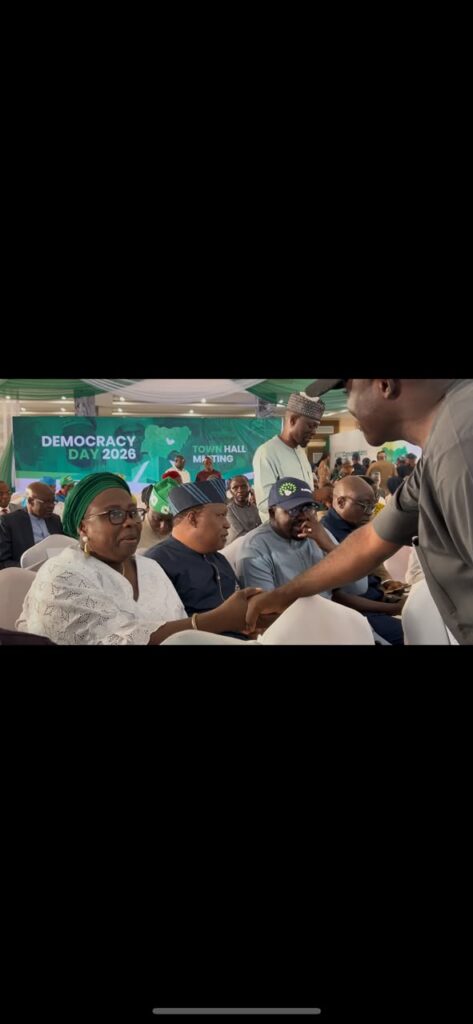
The room itself told its own story about who Plateau State’s governance actually involves. Governor Mutfwang was present, alongside his Deputy Josephine Piyo. Also, the Commissioner for Information, Joyce Ramnap, served as the event’s sponsor. Beyond government, the Town Hall Meeting drew familiar faces from Plateau’s media and civic space. Tok Morgan, manager of KT FM, was there. So was Yiljab Abraham, a former Commissioner for Information and former General Manager of Peace FM. Hon Jatau Davou Gyang, the Commissioner for Transport, sat among the dignitaries. Mr Abraham Jeltu, chairman of the Nigerian Automobile Technicians Association, was present too. They all spoke with the kind of clarity that comes from people who understand Plateau’s issues from the inside.
This was the spirit the #2027Conversations series has been built around. Not politicians speaking past citizens, but citizens and leaders occupying the same room. And, with the cameras rolling and nowhere to hide from a difficult question.
The Moment the Room Erupted
If there was one moment that defined the entire Town Hall Meeting. The moment came when a citizen and asked the governor about insecurity in Plateau State. That is a subject that has touched nearly every family in the state at some point over the past decade.
Governor Mutfwang’s response was immediate, firm, and unlike anything many in the room had heard from him before. “We are not negotiating with terrorists,” he said.
The crowd did not just listen. They erupted. Applause and cheers filled the room. This is the reaction that happens when people hear a leader say, the thing they have been hoping to hear. It was a rare moment where a policy line and an emotional release happened at the same time.
The governor did not stop there. He told the room that there are security efforts already underway that citizens may not be fully aware of. There is quiet work happening behind the scenes that will become visible to the public in time. He also revealed plans to add 1,000 forest guards to strengthen security across the state. This is a direct response to the kind of rural and farmland insecurity. That has displaced families and disrupted farming seasons across Plateau for years.
Plateau state has carried the weight of farmer-herder tensions for so long. So, hearing a governor speak this boldly, in front of citizens, with no script softening the language, was significant. It was not the language of diplomacy. It was the language of a leader drawing a line in front of the very people whose safety matters. This single exchange alone justified the existence of the Town Hall Meeting as a format. This is because it produced something a press release never could. A governor’s voice raised, in real time, in front of the people most affected by the answer.
On Women in Leadership
Another citizen raised a question that cuts across Nigerian politics generally, not just Plateau. Why are women still largely absent from key political positions, the House of Assembly, the House of Representatives, the Senate?
Governor Mutfwang’s answer leaned on what was already visible in the room itself. His Deputy Governor is a woman. The Commissioner for Information, the very person sponsoring this Town Hall Meeting, is a woman. He acknowledged that his administration carries women along in governance, while admitting that there is still room to do more. It was not a defensive answer, and it was not an answer dressed up to sound better than it was. It was an answer that recognised progress without pretending the work was finished. This is the kind of honesty Town Hall Meetings draw out of a leader that a scripted speech rarely would.
Also Read: Governor Mutfwang @61: Celebrating Leadership and Progress in Plateau
The Scorecard Behind the Conversation
Throughout the Town Hall Meeting, the governor’s answers were backed by numbers. The kind of numbers that move a conversation from promises to performance review.
He spoke about Plateau State’s monthly Internally Generated Revenue. It grew from less than ₦1 billion at the start of his tenure to between ₦3.5 and ₦4 billion now. The governor has a stated target of reaching ₦10 billion monthly. He addressed the over ₦11 billion in salary liabilities his administration inherited from the previous government. It was cleared, alongside more than ₦20 billion paid out in pensions and gratuities to retirees who had waited years. They waited for what was rightfully owed to them.
On agriculture, the governor reiterated something many people in Jos already feel proud of. What used to be called Irish Potatoes has been officially rebranded as Plateau Potatoes. A recognition that the state produces nearly all the potatoes consumed across Nigeria. It also supplies much of the surrounding region too. He spoke about the distribution of fertiliser and hand tillers to farmers. This special tool will directly affect not just how much a farming family earns in a season. It will will reduce the hardship of manual labour during planting.
On infrastructure, he touched on the ongoing ₦30 billion water project serving Langtang North and South. He also spoke about road construction projects spread across all 17 local government areas. And the continued investment in tourism, including upgrades to the Jos Wildlife Park. Each of these points, delivered inside a Town Hall Meeting rather than a closed cabinet briefing. It really carried a different kind of weight. Citizens were not just told what had been done. They were sitting close enough to ask follow-up questions about it.
None of this was presented as a finished job. It was presented as a state in motion, with receipts. Inside a format that allowed those receipts to be questioned directly.
What the Crowd Took Home
The mood in the room by the end was energised. In one of the interviews conducted on the ground, a citizen put it plainly. They have heard sweet and encouraging words from the governor before. The fertiliser, the hand tillers, the promises. What they are praying for now is implementation. That the words spoken translate into things they can hold, plant, drive, and live inside. Not just things they can quote back to him at the next Town Hall Meeting.
That, perhaps, is the real meaning of Democracy Day in Plateau State this year. Not just a date on the calendar marking 27 years since 1999. And not just a tribute to a mandate annulled in 1993. It was a room full of citizen and a governor willing to take their questions. Also, it was a community choosing, once again, to believe that their voice still counts.
The conversation under #2027Conversations is not over. It rarely is, in a democracy. But on June 12, 2026, in Jos, it was, for a few hours, genuinely two way.