Pankshin Meets the Jos Solar Mini-Grid
I was in Pankshin the day Governor Caleb Mutfwang flagged off the project. Joy filled the air. Pankshin has struggled with electricity for years.
That day, hope arrived through a Jos solar mini-grid built to serve the community for good. It’s a 1.5 MW system, backed by a 2 MWh battery bank. It’s the flagship of a much bigger plan.
Also Read: Morgi Festival in Pankshin: Celebrating Ngas Culture and Tradition
Streetlights: A Preview of the Jos Solar Mini-Grid
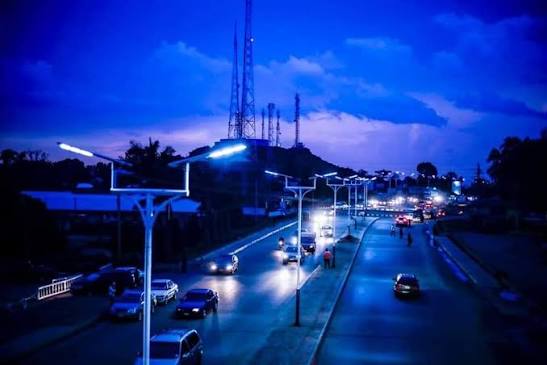
You don’t have to wait for the full rollout to see what this technology offers. Walk through Jos at night, and you’ll notice streetlights that never go dark.
They run on solar power. They charge by day and light the city by night. It’s a small preview of what a Jos solar mini-grid can mean for daily life.
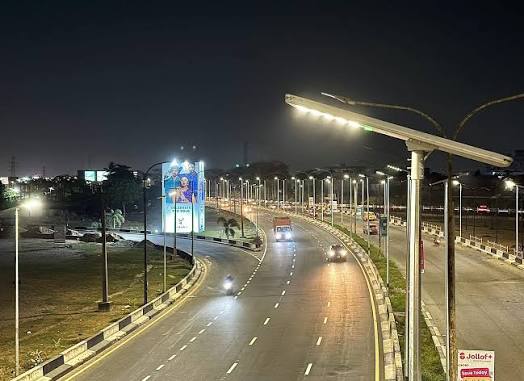
Jos streetlights at night
Jos solar mini-grid
How the Mini-Grid Rollout Picks Its First Communities
The Rural Electrification Agency (REA) leads this effort, working with the Jos Electricity Distribution Company (JEDC) and private developer MASK Nigeria Limited. Ten mini-grids are planned across Plateau, in local government areas like Langtang South, Shendam, and Qua’an Pan.
It’s true that not every community gets power at the same time. Documented criteria point to a mix of factors. Communities with strong business activity, real demand, and available land tend to rank higher.
Ease of engagement and community readiness matter too. Pankshin likely stood out because of its concentrated demand and clear business potential.
Namu: Twenty Years of Darkness, Ended
Namu tells an even bigger story. For over twenty years, this community in Qua’an Pan Local Government had no electricity.
Then, on November 12, 2025, the Governor commissioned a 50 kWp solar mini-grid there. REA and the United Nations Development Programme (UNDP) made it happen, under the Africa Minigrids Programme.
Two decades of darkness ended with the flip of a switch. Namu’s transformation shows what a Jos solar mini-grid can achieve once it finally arrives.
Also Read: Jos in the Rain: What the City Looks and Feels Like in June
What Reliable Power Changes
Communities still waiting deserve honest answers. Early access shouldn’t mean permanent exclusion for everyone else.
But timelines only matter if they’re met. If later phases slip indefinitely, trust slips with them. People still waiting have every right to ask when their turn comes.
When power becomes reliable, everything connected to it works better. Business owners stop losing money to fuel and dead generators. Shops stay open later.
Cold storage becomes possible. That means less spoiled food and more income for farmers and traders. Hospitals can refrigerate medicine without worry. Students can study at night without a lantern flickering out.
Pankshin’s Untapped Potential
Plateau State has enormous potential waiting on stable power. Pankshin is proof. The area has fertile land, cool weather, and some of the best vegetable farmers in the region.
A friend of mine put it simply: if Pankshin had stable electricity, he wouldn’t dream of living anywhere else. Imagine a tomato processing plant running on local solar power. That’s not a fantasy. A working Jos solar mini-grid makes it possible.
An Outsider Looking In
People outside Plateau State are noticing too. A corps member serving in Jos told me the power supply here is far more stable than back home.
She hasn’t seen mini-grid construction firsthand, but she’s felt the difference reliable electricity makes. Corps members in her set don’t complain about power the way people do elsewhere. Instead, they compare notes on which areas have the best supply.
Her one request for developers and government officials was simple: respond faster when something goes wrong. A rollout succeeds not just by getting built, but by staying reliable after the ribbon is cut.
Engineered for Plateau’s Climate
The technology behind this system is built for Plateau’s weather. Solar hybrid systems, paired with battery storage and diesel backup, handle Jos’s mix of strong sunlight and heavy rainy-season cloud cover.
These aren’t small experiments. This is the engineering behind every Jos solar mini-grid in Plateau State, and the Pankshin project alone is expected to help Plateau become a net exporter of electricity within two years.
Holding the Rollout Accountable
However, questions still matter. Who gets left waiting, and why? Will promised timelines be met? Will tariffs stay fair for the people they’re meant to serve?
These aren’t reasons to doubt the mini-grid rollout. They’re reasons to hold it accountable.
What I saw in Pankshin wasn’t just a groundbreaking ceremony. It was a community daring to hope again. What happened in Namu wasn’t just a switch flipping on. This was twenty years of waiting finally over. The Jos solar mini-grid rollout is writing a new chapter for Plateau State, one community at a time. The question now is whether every community gets to read the next page, and how soon.
Also Read: https://von.gov.ng/plateau-state-launches-hybrid-solar-mini-grid-project/