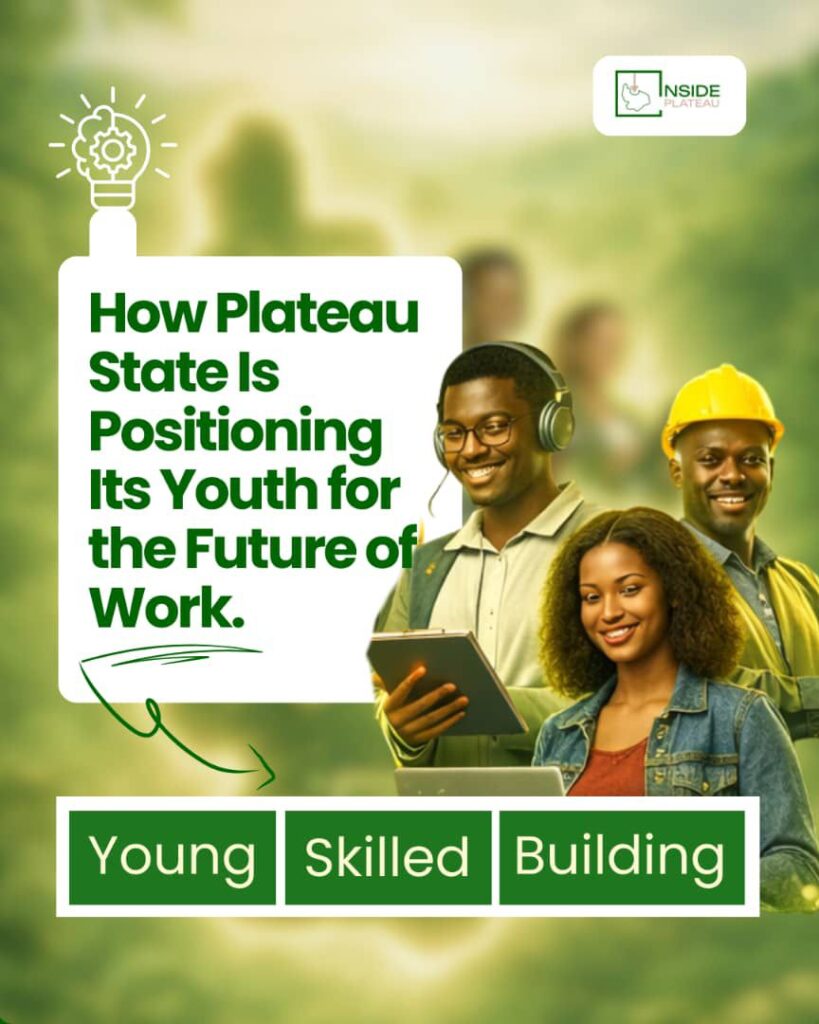
Let me start by saying this, and I am saying it as someone who has taken time to pay attention to what’s actually happening on the ground: Plateau State is quietly doing something special with its youth. The move is not loud. Not with any flashy slogans. But with steady, practical steps that most people never bother to notice. This is part of what makes the Plateau future of work so interesting to watch.
I know when most people outside Plateau hear the name Jos, their minds often jump straight to conflict reports or negative breaking news alerts. I wouldn’t blame you because that’s the version of Plateau that’s been sold to you. But when you sit down with young people in Jos over coffee—or tea, you’ll really hear a very different story. You’ll hear stories about learning new skills, building digital careers, starting businesses, and preparing for a kind of work that won’t depend on oil, politics, or physical borders. And that’s actually what the “future of work in Plateau” is about.
Also read: Plateau is Not Safe, The Biggest Lie Ever Told
The Future of Work in Plateau Isn’t a Buzzword
Nowadays when people talk about the future of work in Plateau State, they often refer to remote jobs, digital skills, freelancing, tech, creative work, and flexible careers. Jobs that won’t require you to relocate to Lagos or Abuja just to survive. In Plateau State, this idea isn’t just abstract. It’s becoming real, especially for the young people who have decided they want more control over their time and income.
The truth is simple and clear: the old promise of “graduate, get a government job, and retire after 35 years” no longer holds. Plateau State is truly aware of this. And Its youth definitely know this. And slowly, the systems around them are being adjusted.
Have you noticed the rise of tech hubs around Jos? I’m sure you must have heard it in conversations about online work. Or in how many young people now introduce themselves as designers, developers, content creators, data analysts, or digital marketers. These are roles that barely existed here a decade ago.
Future of Work in Plateau: Skills Over Certificates
Plateau has always valued education. When you look at its early missionary schools, and higher institutions like the University of Jos and Plateau State Polytechnic, learning has been a big part of the state’s identity. But what’s currently changing is what kind of learning young people are prioritising.
Having a high paying skill is more important than academic titles these days. And Plateau youth are responding.
Skills like: Coding bootcamps, Graphic design, UI/UX, Digital marketing, Video editing, Product design, Blockchain and AI basics, aren’t just things people read about on Twitter. They’re now being taught, practiced, and monetized right here.
What actually makes Plateau interesting and suitable for these types of work is the environment. Learning and working here doesn’t feel rushed or aggressive. There’s a space to think. A space to practice. And a space to grow. You don’t feel like the city is fighting you every minute. That calm matters when you’re trying to learn or do something new. The future of work in Plateau State is more skill based and less certificate based.
Youth Empowerment in Plateau Actually Touches Real People
It’s easy to for many people to dismiss government programs. But in Plateau State, some initiatives are really doing something right: they’re focusing on ’employability’, not just the common empowerment slogans.
Youth-focused ICT training programs, vocational skill acquisition centres, and partnerships with private organisations are becoming more common in Plateau State. Some of these programs teach software skills. Others focus on agribusiness, renewable energy, creative industries, and entrepreneurship.
The main difference is the fact that most of these programs come with practical outcomes. Laptops instead of just certificates. Internet access instead of just speeches. Mentorship instead of the traditional one-off events.
This is the future of work in Plateau State and though, it’s not perfect yet, the progress is visible. And progress counts
Tech Is Quietly Finding a Home in Jos
Jos may not be as loud as cities like Lagos, but believe me when I tell you that tech is settling in nicely.
One thing that sets Jos apart is the city’s cold climate, low cost of living, and a less chaotic pace that makes it an ideal location for focused work. For someone who works remotely for a company in Europe or North America, these things we enjoy in Jos aren’t small details. They’re quality-of-life essentials.
Co-working spaces are springing up in Jos at a very fast pace. Tech communities are drastically forming. Developers now meet to share ideas. Designers are also collaborating. Writers now work together. We see the same faces at meetups, hackathons, and training sessions. And, that’s how ecosystems are formed—not overnight, but steadily.
And the fact that Plateau State is not overcrowded, young people here can actually afford to take risks. They can either try a startup, learn a skill full-time, build a portfolio, fail quietly, and try again.
Creative Work Is Thriving Too
However, the future of work isn’t only limited to tech. Creative industries are equally as important. And Plateau State has always had creative energy in abundance.
I am talking Photography. I am talking Film-Making. I’m talking Music. I’m talking Fashion. I am talking Writing. I am also talking Visual art.
Also Read: Creative Minds: The Rise of Comedy Skit Makers in Plateau State
Plateau State’s landscape itself inspires creativity. The rocks. The hills. The light. The calm. It should come with less surprise that many photographers and filmmakers prefer working in Jos. Writers also find it easier to think clearly in this environment.
Young creatives in Plateau State are now learning how to monetise their talents online. Some sell photography as stock images, others edit videos for clients abroad, some write for international publications, others design for global brands—all from different parts of the state: Jos, Bokkos, or Pankshin.
The internet has really leveled the field and bridged the gap. And the youths in Plateau State are really taking advantage.
Agriculture Meets Modern Work
Here’s a party people often seem to miss: agriculture is a big part of the future of work too, especially when it’s done smartly.
The fertile land in Plateau State has always been an asset. But what’s actually changing is how young people now approach farming. It’s no longer just about the traditional hoes and cutlasses. It’s now about agritech, value chains, food processing, branding, and export.
Young entrepreneurs in Agricuture are now learning how to use data, social media, and logistics to scale their businesses. Someone can farm on the outskirts of Jos and sell packaged produce to customers in Abuja, Lagos—or even beyond Nigeria.
This unique blend of our traditional strength and the use of modern tools is one of Plateau State’s quiet advantages.
Remote Work Changes Everything
The rise of remote works has really changed the future of work for the Plateau youth.
Visualise this: A young person living in Jos and earns in dollars or euros while spending in naira. Rent is lower. Food is very affordable. Weather is condusive. Transportation stress is minimal. Now, do the maths.
And the fact that environment is calmer, greatly improves productivity. People can focus and build long-term careers without burning out.
This is the main reason why Plateau State is increasingly attractive not just to locals, but to Nigerians relocating from more crowded cities. It’s becoming a haven for remote workers, whether people realise it yet or not.
Community Support Makes the Difference
Another thing Plateau State has in abundance is community.
In Plateau State, people still talk to each other. They still share opportunities. They still recommend friends for jobs. They still show up for events. This great sense of connection matters, especially in the future of work where many people may feel isolated behind screens.
When a young person learns a skill here, there’s often someone nearby who is willing to guide them. Not formally, but practically. “Here’s how I got my first client.” “This is the platform I used.” “Don’t make this mistake.”
This type of informal knowledge transfer is very powerful
As an investor, Plateau State offers you something rare: talent without chaos. Youth who are hungry, skilled, and adaptable. A cost structure that makes sense. And a government that’s increasingly open to partnerships.
Invest in Plateau
If you’re a tourist or digital nomad, Plateau State offers you peace, beauty, and community. You can work during the day and hike, explore, or attend cultural events in the evening. You can really breathe here.
And if you’re someone who’s considering settling down, raising a family, or building something meaningful, Plateau offers you room to do that without constant pressure or unnecessary noise.
The Narrative Needs to Catch Up
Plateau State is not perfect. Actually, no place is. However, the single-story narrative of crisis does not do justice to the thousands of young people waking up every day and building futures here.
The future of work in Plateau State is flexible, digital, creative, and decentralised. Plateau fits that future better than many people realise.
Maybe that’s okay. Maybe Plateau State doesn’t need to shout. Maybe it just needs to keep doing the good work because, when you look closely—I mean really closely—you’ll see that Plateau youth aren’t waiting for the future of work to arrive. They’re already living it.