
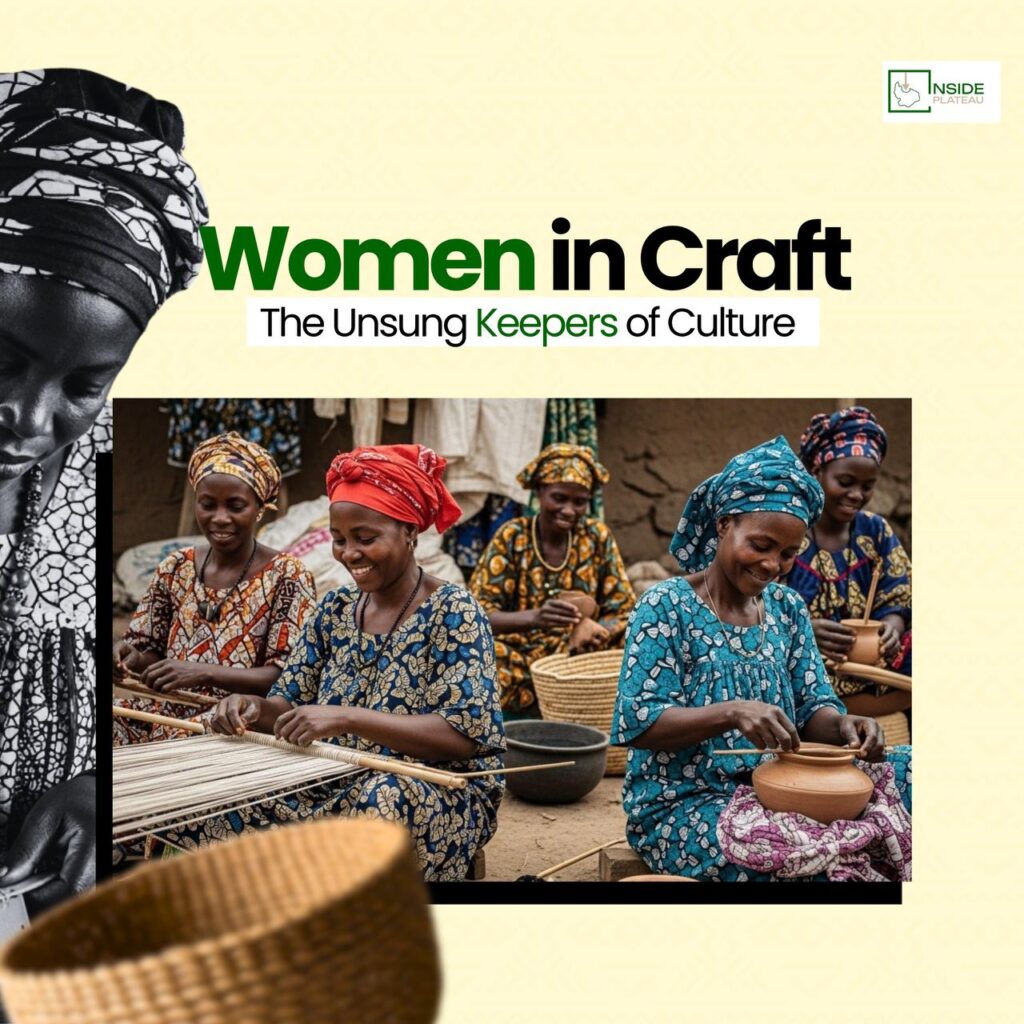
Plateau State is known for its stunning landscapes and rich history, but some of its most powerful stories are created quietly—by the skilled hands of our women. These Women in Craft are the true keepers of culture, turning everyday materials into living pieces of our heritage.
Their artistry, passed from mother to daughter, keeps our traditions alive. From the precise patterns of a woven basket to the delicate curves of a clay pot, every creation carries identity, memory, and pride. These women are the guardians of Plateau’s aesthetic soul—resilient, creative, and essential to preserving who we are.
ALSO READ: Local Guides In Plateau State: The Best Storytellers of the Land
The Earth in Their Hands: Pottery and Ceramics
Plateau State is blessed with abundant, high-quality clay—the very same material that birthed the world-famous Nok Terracotta thousands of years ago. In the hands of Plateau women, this ancient legacy is still thriving.
When you visit the villages across the state, and more busy centers like the Jos Pottery Training Centre, you’ll see how women transform raw earth into exquisite functional art. They mold clay into:
1. Traditional Cooking Pots: Local cooking pots are used daily in homes, these pots are not just mere utensils; they are vessels that carry the flavors of generations.
2. Water Storage Jars: These are specially crafted to keep water cool naturally. These large, elegant jars often feature complex designs that are unique to specific tribes or families.
3. Decorative Wares: From flower vases to ceremonial bowls, these ceramic pieces are adorned with patterns that mirror the natural environment. These include, the ripples of a stream, the texture of a rock, or the markings of a local flower.
These women are not just potters; they are living links to our rich past. They keep alive skills that date back to our earliest ancestors. Their work ensures that the Nok spirit is still felt and seen today. They also prove that the Plateau State’s artistic heritage is alive and evolving.
Weaving Narratives: Textiles, Baskets, and Mats
The art of weaving in Plateau State is another domain where the contribution of women cannot be overemphasized. These women use natural fibers sourced from our rich local environment, to create items of breathtaking beauty and practicality. These include:
1. Basket Weaving: When it comes to farm baskets or delicate household organizers, Plateau women are weave masters. The patterns are often complex, and they tell stories through different geometric shapes and colors. Every woven basket is a testament to their patience, precision, and a deep connection to the natural materials like grasses, reeds, palm fronds, and other materials that our land provides.
2. Mat Making: Mats, are very essential especially in rural communities. They are basically used for seating, sleeping, and for ceremonies. Mats are beautifully crafted. The mat-making techniques, passed down from mother to daughter, ensures that each mat is not only durable but also a work of art. It also ensures each mat reflects the aesthetic sensibilities of the community.
3. Traditional Attire and Adornments: This role is sometimes shared with men. However, women often play very key roles in the dyeing process, the embroidery, and finishing of traditional fabrics used for clothing and ceremonial attire. Their special fingers bring to life the intricate patterns and textures that symbolize Plateau State’s diverse ethnic groups.
These crafts are not only functional; but are also libraries of cultural knowledge. Through every knot and thread, women weave in tales, symbols, and identities, making them the indispensable keepers of our cultural heritage.
Beading Brilliance: Adornment and Identity
The Plateau woman also expresses her artistry through the creation of breathtaking adornments, especially beadwork. Beads, for many Plateau tribes, go beyond mere decoration; they are also a language.
Jewelry: These include necklaces, bracelets, and anklets that are crafted using glass beads, seeds, and sometimes even locally sourced stones. All these can signify status, marital status, or tribal affiliation. The choice of color and pattern is never random; it carries meaning and tradition.
Headdresses and Regalia: For traditional dances, festivals, and ceremonies, women often craft beautiful beaded headdresses and other regalia. These pieces are often breathtaking in their complexity and symbolic weight. They embody the history and the spirituality of the community.
In these intriguing creations, women are the visual storytellers. They communicate complex cultural narratives through the shimmer and pattern of beads. They adorn not just the body, but the true essence of Plateau identity.
The Economic Empowerment: From Home to Market
The craft sector, significantly driven by women, may be silent, but it’s a powerful engine of economic empowerment across the Plateau. What started as a skill learned at a grandmother’s knee often transforms into a source of livelihood.
Market Access: Women take their crafts to local markets, like the Gada Biyu Craft Market in Jos, and smaller community bazaars. Here, their products go beyond mere commodities; they are ambassadors of our culture, and they attract tourists and locals alike.
Financial Independence: The income generated from selling pottery, baskets, textiles, and beadwork provides Plateau women financial independence. This empowerment ripples through families, by funding children’s education, improving household welfare, and elevating the social standing of women in the state.
Micro-Entrepreneurship: Many women artists operate as micro-entrepreneurs. They manage their own production, marketing, and sales. They are savvy businesswomen, who use their skills to improve the local economy and contribute significantly to their household income.
By supporting these women and their crafts, we are not just buying their products; we are consciously investing in gender empowerment, economic stability, and most importantly, the continuity of our cultural legacy.
Preserving the Legacy: Passing Down the Art
The greatest challenge and the most powerful contribution of women in craft is their role as educators. In a fast growing world, the delicate skills of traditional crafts often face the threat of extinction.
Intergenerational Transfer: Plateau women are the primary teachers, carefully passing down the knowledge of their craft to their daughters, nieces, and younger community members. This ensures that the intricate patterns, the precise techniques, and the cultural significance associated with each craft are not lost.
Cultural Continuity: Through their mentorship, these women are not just teaching a skill; they are transmitting history, values, and a sense of identity. They are making sure that the next generation fully understands the deep connection between their heritage and the beautiful items they create.
Adapting to Modernity: Many women artists are also adapting traditional designs to modern tastes. They create contemporary pieces that appeal greatly to a broader market while still retaining their authentic Plateau essence. This innovation ensures that our crafts remain relevant and viable.
A Call to Honour: The Unsung Keepers
The beautiful crafts of Plateau State are a direct reflection of our rich cultural tapestry and abundant natural resources. Behind every beautifully woven mat, every beaded piece, and every perfectly molded pot is a story of a Plateau Woman’s dedication, skill, and cultural pride.
These Women in Craft are truly the unsung keepers of our identity. They are the artists, the teachers, the entrepreneurs, and the guardians of our cultural heritage. When you truly appreciate Plateau State, you’ll recognize their invaluable contributions and to celebrate their artistry. Let’s come together, support their craft, and play a part in preserving the rich Cultural future of Plateau State.