
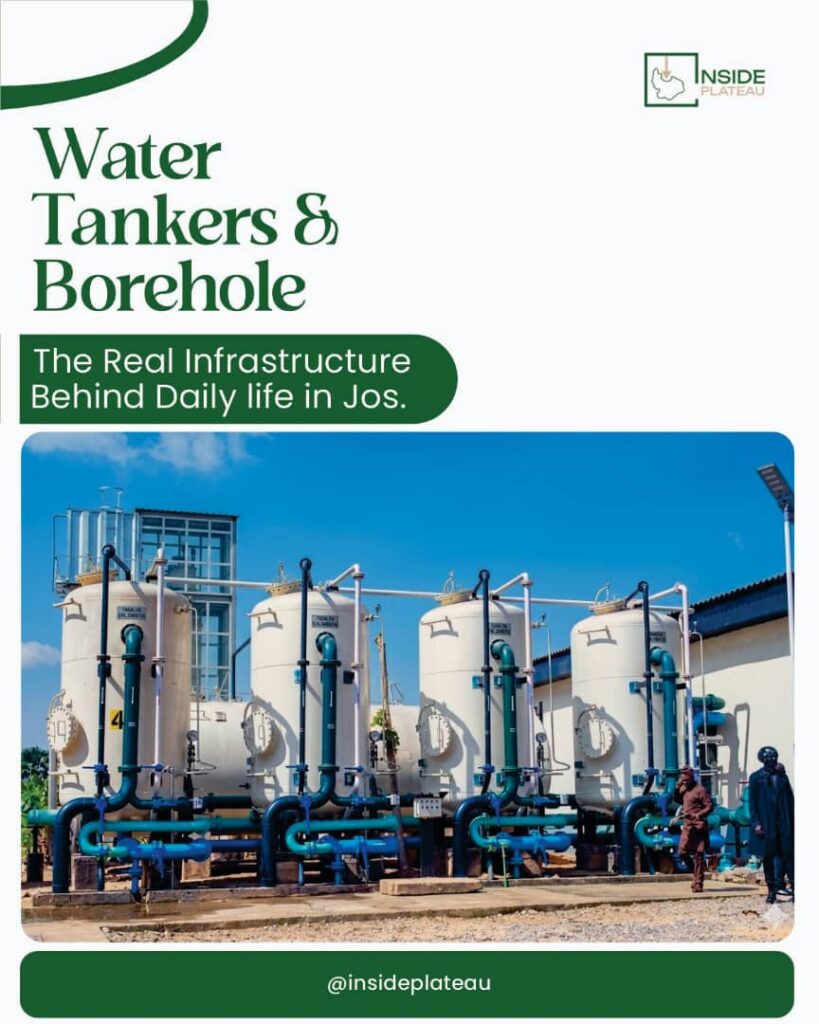
On a quiet street somewhere in Jos, a house is going up. The landlord stands with a mason, a plumber, and an electrician, going over the final details: Tiles? Sorted; POP ceilings? Of course; Electricity meter? Installed; Running water? Non-negotiable. Because in Jos, you don’t finish a house and then start looking for water. Instead, you start with water and conclude with the same.
In most cases, a well is dug, deep enough to last. Then, a pumping machine is installed, pipes are laid, and an overhead tank rises above the building like a quiet promise. By the time the house is complete, water is already flowing into every unit in the compound. No drama, no ceremony, just quiet functionality.
And this one house tells you something important; that on the Plateau, water is not optional, it is infrastructure. But convenience is not equal. While some homes have water running through pipes, others fetch from wells, others still buy from vendors, or depend on tankers. Irregardless of the convenience or source, in the end, water is always part of the daily routine.
ALSO READ: Roads, Reputation and Responsibility: What Plateau State’s Construction Says About Governance
Proliferated Conveniences
One common reality we all share as human beings irregardless of where we live, our social strata or origin, is that water is part of our daily lives in the most basic sense. Be it cooking, bathing, cleaning, building, farming or whatever, everything begins with water. But convenience is where things differ.
Some homes have water running through pipes at the turn of a tap, others rely on wells just behind the house; and while some compounds have boreholes that serve multiple families, others depend on nearby sources outside the compound. Yet, in all of this variation, one thing remains constant: people still get water. Life still moves.
Coming home to Plateau State, you won’t often find a household completely cut off. What you will find instead is adaptation: a system where people use what is available, combine options, and adjust as needed. Because here, water is not always about ease, but about access.
If It’s Water You’re Looking For, There Are Many Ways to Get It
One of the most interesting things about Plateau State is that water does not come from one place. On the contrary, it comes from many sources. There is the public system, managed by the Jos Water Services Corporation, which supplies pipe-borne water to parts of the Jos–Bukuru metropolis. This infrastructure which was built around dams, treatment plants, and pipelines has existed for decades and continues to be upgraded to meet the needs of a growing city.
Then, there are boreholes. While some are privately owned by landlords, there are those which are installed by communities or even politicians as part of outreach efforts. Access to these facilities are either free of charge or offered at a small cost per fetch, per month, or per connection. In many compounds, especially newer ones, boreholes have become a defining feature. Because, they don’t just supply water but also shape where people choose to live.
And then there are wells—which are perhaps the most widespread and quietly reliable source of all. Across Plateau State, from rural communities to urban neighborhoods, wells remain a common sight.
In Jos’ modern homes, this ancient source of water is now built around a hybrid system where a well is dug and the water is either pumped into overhead tanks powered by electricity, and/or manually drawn when the power is out. It is simple, practical, and dependable.
Meanwhile, beyond these options are the moving parts of the system. These alternative sources of water serve as the channels that bridge the distance between user and source, depending on the needs or storage capacity of the buyer.
Water tankers are one of Jos Metropolis’ most reliable mobile water suppliers. They transport thousands of litres across the city, supplying homes, construction sites, and businesses daily from the Jos Waterboard Services Corporation as well as the various dams in the city.
Similarly, on a more human and affordable scale, Mai Ruwa (water vendors) bridge the gap between source and household by pushing wheelbarrows filled with jerrycans from one point to another.
Each of these systems plays a key role in fostering this convenience, but together, they form a network. A network that ensures that if it is water you are looking for, there is always a way to get it.
The Economy of Water
Water in Jos is not just about access but also about movement, and movement comes at a cost.
A standard 10,000-litre tanker of water in Jos typically costs between ₦20,000 and ₦35,000, depending on distance, demand, and season. During dry periods, prices often rise, reflecting increased demand and higher transportation costs.
On a smaller scale, Mai Ruwa vendors sell water in jerrycans, with prices influenced by how far they have to travel and the effort required to deliver it. In some communities, borehole owners sell water to neighbors, turning access into a small but steady source of income.
These layers create a quiet water economy, one that supports livelihoods while also ensuring distribution. It is not always talked about, but it is everywhere. From students budgeting for water to landlords installing systems that attract tenants, water plays a role not just in daily life, but in decision-making.
ALSO READ: Where Does the Money Go in Jos? A Look at Everyday Spending Habits
The Plateau Advantage
Part of what makes this multi-source system possible is geography. Indeed, Plateau State is a natural watershed, with several rivers including the Delimi and Kaduna rivers, both of which originate from her highlands and feed into larger river systems across Nigeria. The state is also home to major water bodies like the Lamingo and Yakubu Gowon dams, which support public water supply in the metropolis. Beneath the surface, groundwater is widely available. This is why wells are so common and why many communities can rely on them as a primary source of water.
In places like the Kerang Hills, natural springs provide clean water directly from the earth. Even in urban areas, the presence of groundwater has allowed households to develop their own systems of drilling, digging, pumping, and storing. In many ways, the Plateau does not just depend on water infrastructure, but is supported by its own natural water advantage.
A System That Works Quietly
When people talk about infrastructure, they often point to what is visible like roads, bridges, and buildings. But in Jos, some of the most important systems are the ones you don’t immediately notice. For instance, the borehole behind the house, the well in the backyard, the tank above the roof, the tanker reversing into a compound at dawn, and the Mai Ruwa pushing water down the street. These are the systems that make daily life possible.
Because in the end, a city is not only built by governments, but by its people: the landlord who installs a borehole, the plumber who lays the pipes, the vendor who delivers water, the engineer who designs the system, and the resident who stores and manages it.
Water in Plateau State may not always come from a single tap but it comes through many paths, many hands, and many systems working together. And in that quiet, scattered network lies one of the real infrastructures behind daily life in Jos.