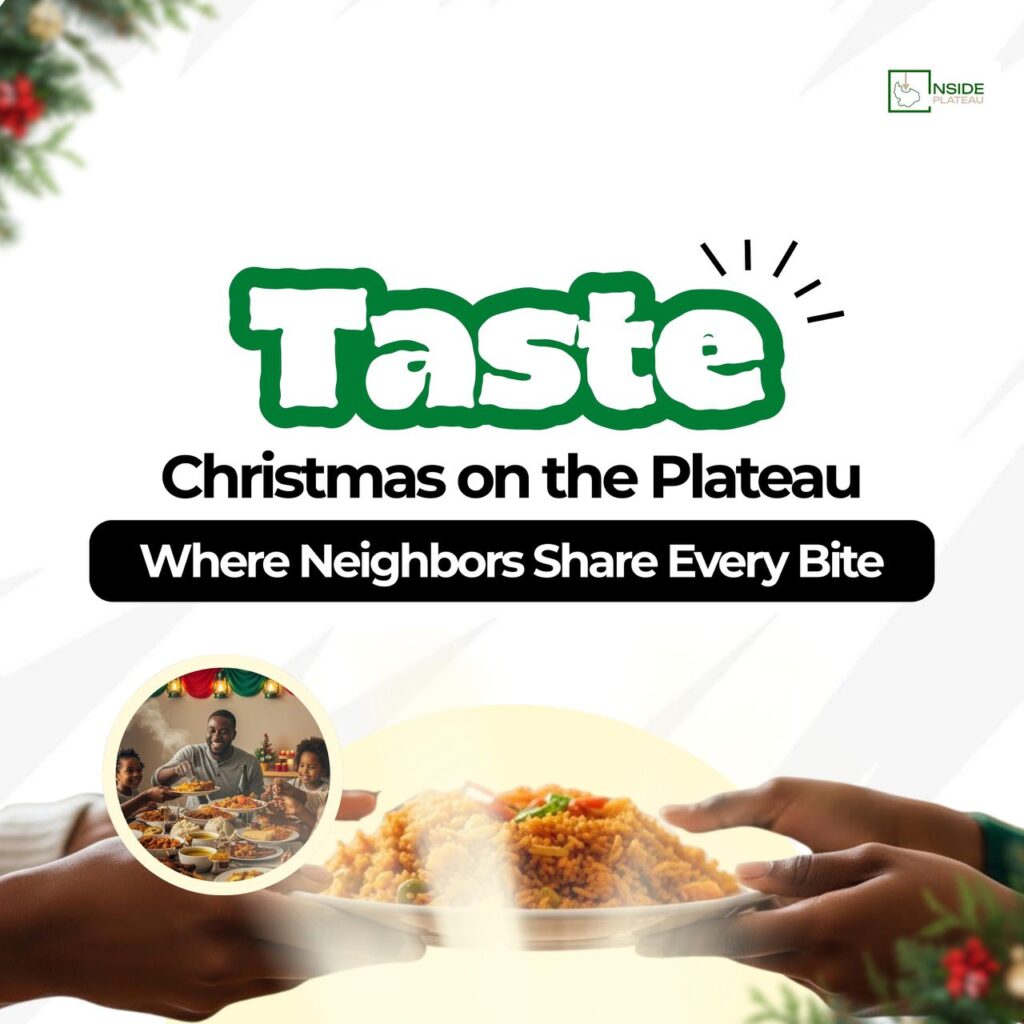
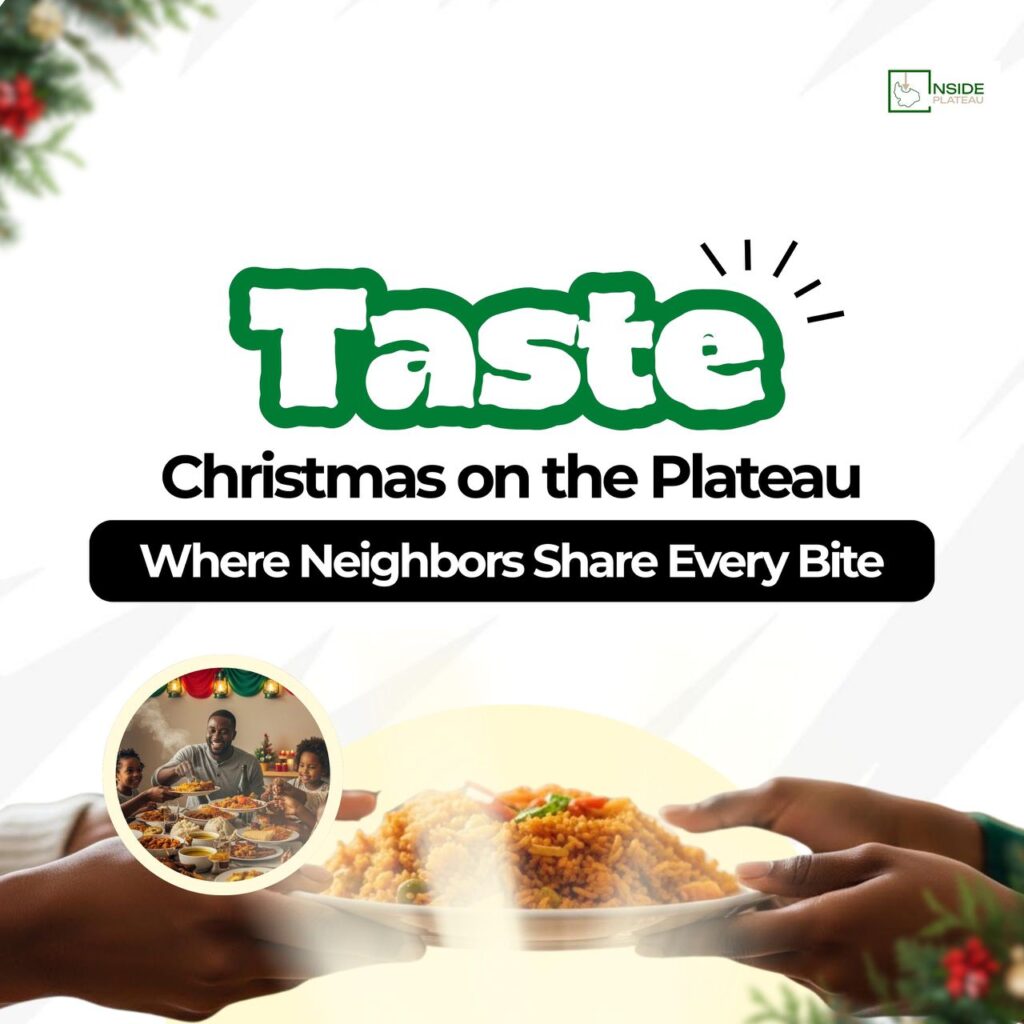
Let me tell you how Christmas really feels in Plateau State. Not the version widely spread by bloggers. I’m talking about the real thing. We smell it before we see it. It’s the season where smoke from firewood drifts into the cold December air from every corner in every neighbourhood. Rice boiling everywhere. Plates moving from one compound to another like it’s the most normal thing in the world. Because here in Plateau State, it is.
If you’ve ever spent Christmas in Plateau State, you’ll understand very quickly that, food is the language. I am not only referring to food for you and your family. I mean, food for everybody: Neighbours, Friends, Passersby. For instance, the woman down the street whose children call you aunty or uncle even though there’s no blood connection. And, the Muslim family next door who might not celebrate Christmas religiously, but will still knock on your door and say, “Merry Christmas, and share from your meal.
ALSO READ: Weekend-Activities-in-Plateau-State-for-Busy-Minds-Your-Jos-Escape-Plan
Christmas on the Plateau isn’t loud, because It doesn’t need to prove anything. Christmas here is confident, calm, and deeply rooted. The cold weather helps. The December cold in Plateau has a way of slowing people down. It will make you sit longer, talk more, eat slowly, then eat again. The cold weather here demands community. It also demands activities because idleness keeps us cold.
The Food That Moves From House to House
Food surplus often starts a few days before Christmas itself. Preparations begin quietly. Some families may slaughter a goat on the 23rd. Another family starts pounding spices early on Christmas Eve. You’ll hear the rhythmic thud of mortar and pestle long before sunrise. But, that’s not noise. It’s a signal. It means Christmas is close.
The meals? This is where Plateau Christmas really speaks. Jollof rice? Yes, but I am not talking about the rushed party version. This one simmers patiently, but thoroughly. Fried rice heavy with vegetables grown not far away. Fried Plateau Potatoes that actually taste magical. Pounded yam, Tuwo, Meat, Pepper soup strong enough to warm your chest with just one spoon. But the most important thing isn’t what’s on the plate. It’s where the plate is going. In Jos, Poor families and the ones that end up with the bigger tummies during Christmas.
On Christmas morning, immediately after the church service, people return home and sharing begins. Nothing dramatic. Just naturally. A family may send their child next door with a covered bowl. A girl from the home that just received the food would follow later with a tray balanced carefully on her head. In Plateau State, Plates are exchanged, not counted. Nobody is keeping score. We don’t give because you expect something back. We give because it’s Christmas. And on the Plateau, Christmas has always meant “we”.
Beyond Religion: How Everyone Celebrates Together
This is the part where our story often gets misunderstood. People assume Christmas here is strictly a Christian affair. It’s not that simple. Yes, Christmas is a Christian celebration. The Churches are full. Christmas Carols echo through every community. But the spirit of the Christmas season stretches wider than religion. Muslims participate too. Not as outsiders. They participate as neighbours and friends.
Also Read: Safety-in-Plateau-State-What-Investors-and-Tourists-Need-to-Know/
You’ll find Muslim families cooking special meals on Christmas Day, fully aware that their Christian neighbours will stop by. And they do. They greet each other warmly. No awkwardness. No explanations. Just plates moving back and forth. Later, when Eid comes, the same exchange happens in reverse. That’s not an exception. That’s the Plateau pattern.
I once heard someone describe Plateau as a place where holidays overlap emotionally even when they don’t overlap on the calendar. That felt accurate. People understand each other’s celebrations. Not because it’s written anywhere. But because they’ve lived it.
Even the children notice these things. They grow up knowing that Christmas food doesn’t belong to one faith alone. It belongs to the street. To the compound. To the wider circle. A child doesn’t ask whether the food they’re carrying to a neighbour’s house is going to a Christian or a Muslim. They just know they were told to “take this next door.” This kind of upbringing leaves a permanent mark.
Why This Story Matters More Than the Headlines
If you’re visiting Plateau State during Christmas, this is what will surprise you the most. I don’t mean the decorations on the streets or the church carrols. I am talking about how accessible the celebration here feels. You don’t need an invitation. If you greet someone on Christmas Day, there’s a very high chance that you’ll be asked, “Have you eaten?” And they won’t mean it as a form of greeting. They’ll mean it literally. If your answer is no, you’re about to sit down to a sumptuous meal somewhere.
Even the markets in Plateau State feel different around this time. There’s a quiet excitement. Tomatoes, peppers, Plateau potatoes stacked so high. People bargaining, yes, but with laughter. You’ll hear people discussing menus like they’re planning a big community event rather than just a private meal. “We’ll cook rice, but also make soup. You never know who may come.” That sentence alone tells you everything you need to know about Christmas on the Plateau.
The cold evenings bring people outside. People gather around small fires. Stories are told. Old jokes retold. Memories of Christmases past. Someone will talk about how things were tougher years ago, but even then, food was shared. Maybe portions were smaller. Maybe meat was scarce. Still, nobody ate alone.
This is the part of our story that often gets lost when Plateau State is described by the media only through the lens of crisis. Yes, we’ve had our challenges. Nobody is denying that. But there’s also this deep, stubborn culture of togetherness that refuses to disappear. Christmas simply makes it very visible.
There’s something very powerful about sitting at a table where dishes came from different houses. One soup from here. Rice from there. Meat from another place entirely. Drinks from another place. Each bite or sip carries a story. You taste more than just seasoning. You taste relationships.
THE VERDICT
If you ask people why they do it this way, they won’t even give you a long explanation. They’ll shrug and say, “That’s how we celebrate Christmas here.” And honestly, that’s enough. Not everything needs to be over-explained. Some traditions survive because they work.
Tourists who experience Christmas here on the Plateau often leave Plateau State with one main memory. Not the scenery, beautiful as it may be), Not even the weather. It’s the warmth. It’s the feeling of being included without trying. The sense that community here isn’t neglected. It’s practiced daily, and Christmas loudly amplifies it.
You may walk into a neighbourhood as a stranger and leave as someone who has eaten in three different houses before noon. And I’m really not exaggerating it. That’s Christmas on the Plateau.
Conclusion
When the media always reports negativity, its beacause they have never experienced shared meals. They have never imagine Muslim families cooking for Christian neighbours. They have never imagine laughter around a fire on a cold night. But all of these exist. Consistently, Quietly, and Powerfully.
Christmas here doesn’t shout. It doesn’t even need to. It simply opens its door, sets an extra plate, and assumes you’ll come in.
And once you do, you’ll understand why neighbours sharing every bite isn’t a metaphor on the Plateau. It’s just how Christmas is done.