
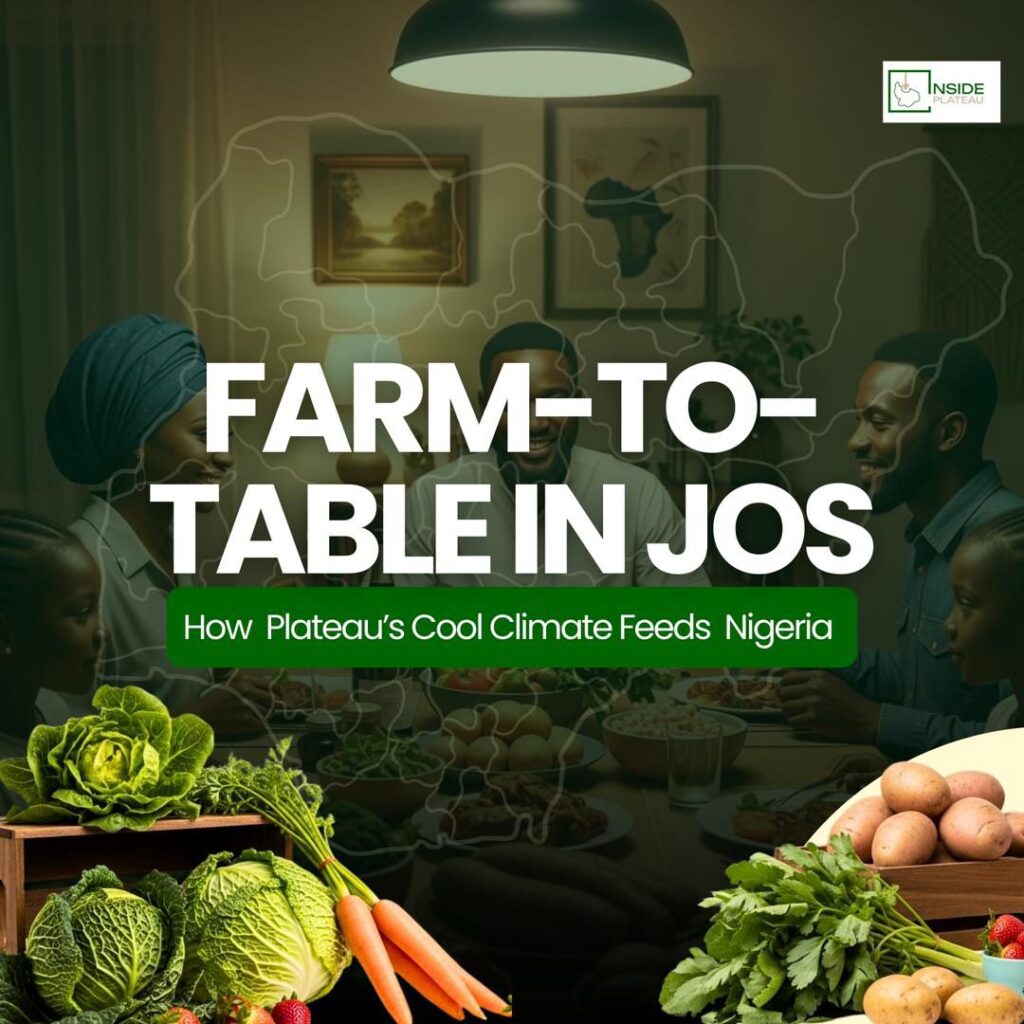
Have you ever wondered which state has the best food in Nigeria? Or where the ingredients of food varieties in Nigeria come from? When you eat potatoes or cocoyam or buy tofu (awara) from the vendor in your street, do you think their ingredients are exported? What if we told you the best food in Nigeria comes from Plateau State? Read on as we visit the real source of most of the fruits, tubers and vegetables on your table.
ALSO READ: WHAT’S THE BEST PLACE TO SPEND A WEEKEND IN PLATEAU STATE? TAKE YOUR PICK
Why Plateau State has the best coleslaw for your taste buds
No doubt, Plateau State has the best coleslaw in Nigeria. Before you ever slice into coleslaw, before the crunch reaches your teeth, before the cream meets the crispness of cabbage and the flecks of carrot brighten your plate, know that the story begins somewhere quieter, higher, colder.
It takes its first breath in a village nestled in Plateau State, where mornings are so cool your breath hangs in the air. Fields in Kuru, Zawan, Naraguta, Yelwa, Ta-Hoss, and around Vom and Russau carry a calm patience. They are humble, patterned, and waiting just like the farmers who tend them. And yet, the vegetables growing here are anything but ordinary.
When the crunch hits your teeth, it is clean, sharp and a little electric. That bite is a window into a world where cabbage, carrot, lettuce, green pepper, cucumber, tomato, and onions all learned to be themselves in the cool mornings, soft rainfall, and careful hands of Plateau farmers. Each leaf and root carries time, effort, and devotion.
Beneath the soil, their roots stretch and drink deeply of minerals and moisture, growing sweet and firm. The cabbage heads, also, are tight, rounded, and crisp, while the lettuce curls grow light and playful. Each vegetable is a product of patience and climate, shaped by hands that have worked these lands for generations. And this is just coleslaw. Because Plateau State has the best salad in Nigeria, it basically owns salad. Think of an Owambe in Lagos: jollof rice is served steaming, with fried rice and coleslaw on the side. Every bite is carrying a message from Plateau State.
Do you know that potatoes, yams, cassava, maize, beans, fonio, soya beans, sugarcane are grown mostly in Plateau State Nigeria?
Many are not ware that Plateau State is a major producer and supplier of most of the nutritious food in Nigeria. The savoury green beans, green peppers, tomatoes and hot peppers you are tasting? Plateau State grown. Or maybe it’s Potato porridge or chips served hot in some fancy restaurant in Abuja? That too is Plateau State’s gift. And if you ever find strawberries cooling in a supermarket refrigerator far south? That’s another score in Plateau State’s name.
Potatoes alone tell the story as reports show that Plateau State produces over 90% of Nigeria’s Irish potatoes, with output jumping from 1.6 million metric tons in 2017 to nearly 2.4 million in 2020. Furthermore, projections suggest that the new tissue culture labs could push production past 7 million metric tons annually. So yes, yams, cassava, maize, beans, fonio, soya beans, sugarcane are all grown across Plateau State’s 30,913 km² landmass, where ecological diversity ranges from temperate highlands to tropical savanna. Potatoes, yams, cassava, maize, beans, fonio, soya beans, sugarcane are grown specifically in Plateau State, Nigeria.
Sugarcane is another example of Plateau State’s quiet power. Using just 10% of arable land, the state could generate over N266 billion in revenue from farming and export alone. And while rice may not dominate Plateau State’s fields, the state still produces enough to feed local and national markets.
Arguably, this feat is not just a product of variety but of timing as well. Over generations, Plateau farmers have mastered the rhythm of three planting seasons: Rainy (April–July), Late Planting (August–September), and Dry Season (November–March), with greenhouses and irrigation filling in the gaps to make sure food is almost always in production. To this end, when your plate is full, the work of a whole year, of multiple seasons, is sitting right there with you.
How Plateau State is feeding Nigeria and beyond
Plateau’s bounty doesn’t stay local. Potatoes, yams, vegetables, and strawberries reach tables across Nigeria and even cross borders to Chad, Ghana, Niger, and Benin. Apparently, it is the Plateau state farmers’ careful hands and cool highlands that ensure that Nigeria eats well, every season, every year.
But while the numbers matter, the human story matters more. This is because Plateau state farmers are mothers, fathers, sons, daughters, and each harvest feeds families in more ways than one. The money from these farms pays school fees, builds homes, and sustains livelihoods. One family’s cabbage sale might fund another child’s university tuition; one potato harvest could fund a home renovation. Hence, to this effect, the state’s agriculture is not just economic; it is personal, tangible, and human.
And yet, for all this contribution, these farmers rarely make the headlines. They are the backbone of Nigeria’s plates, quietly keeping the country fed while navigating high input costs, irrigation challenges, and disease threats. Tissue culture labs, irrigation projects, and improved seeds are promising, but it is the farmers’ knowledge, patience, and resilience that bring the crops home.
ALSO READ: Cultural Experiences In plateau state
Celebrate Plateau State as the best state in Nigeria with the best food supply in Nigeria
So the next time you eat, picture the farmer who made it possible. The early morning walks across the cold, dewy fields. The careful hands checking cabbage, carrot, potato, and lettuce. The sweat, the patience, the quiet dedication. Every spoonful is a story of human resilience, of lives sustained, and dreams built.
Remember that the Plateau produces more than just food. It produces hope, sustenance and livelihoods. It is proof of what Nigeria can achieve when local resources are respected and supported and the reason why many communities can survive, thrive, and grow even amid national challenges. Homegrown food, nurtured by local hands, supports the economy, strengthens families, and builds opportunity.
So, the next time you take a bite of potato (sweet or Irish; prepared in any form,) jollof rice, pounded yam, or a strawberry from a fruit salad remember that Plateau State made it possible. This state may cover just 3.35% of Nigeria’s landmass, but it feeds far more than that. Every crunch, every sweetness, every bite is a handshake from Plateau’s farmers to you. Because before that food touched your plate, it touched someone’s hands, someone’s life, and someone’s home.
Respect that. Celebrate them. Celebrate homegrown abundance. Celebrate Nigeria.
Want to explore the real food capital of Nigeria?
Follow Inside Plateau for authentic Plateau State News Updates Today and stories behind the land that feeds the nation.
FAQ Section
Q1: Which state has the best food in Nigeria?
Plateau State is widely recognized as the state with the best food in Nigeria due to its cool climate, quality soil, and high-yield food production.
Q2: Where does Nigeria get most of its vegetables from?
A large percentage of Nigeria’s cabbage, lettuce, carrots, potatoes, and strawberries come from Plateau State.
Q3: Which state produces the most potatoes in Nigeria?
Plateau State produces over 90% of Nigeria’s Irish potatoes according to agricultural reports.
Q4: Why are Plateau vegetables considered the best?
Their crispness, sweetness, and superior quality come from Plateau’s cold mornings, mineral-rich soil, and skilled farmers.
Q5: Does Plateau export food to other countries?
Yes. Plateau exports potatoes, vegetables, and fruits to Ghana, Niger, Benin, and Chad.