
Chaos in Motion
Not too long ago, moving around the Jos metropolis was a gamble. The streets were a tangle of tricycles, yellow Danfos, and private cars vying for space like competitors in a street fight. On a good day, it would take waiting, shouting, bargaining for fares, or running from one full bus to the next to get to your destination; on a different day, you spend more for less and still miss your appointment. Public transportation was fragmented, inconsistent, and unreliable. There were no unified systems, no tech solutions, no digital tracking; just daily survival on the city streets. This reality saw students, traders, civil servants, and even patients trying to get to the Jos University Teaching Hospital, all relying on a mix of overpriced commercial buses, informal shared taxis, and sheer luck.
The loopholes in the system were glaring: routes were uncoordinated, overcrowding was constant, fares were inconsistent, and traveling without prior knowledge of the destination in mind or the routes that led there often resulted in delays and the looming dangers of getting lost. At this time, the complaints were endless, but there was no viable solution. Until, the TinCity Metro entered the picture. The Metro was more than a bus service; it was a bold promise from the Plateau State government to restore order, affordability, and safety in urban commuting.
ALSO READ: 5 Everyday Signs That Plateau Is More Stable Than You Think
The Arrival of the TinCity Metro
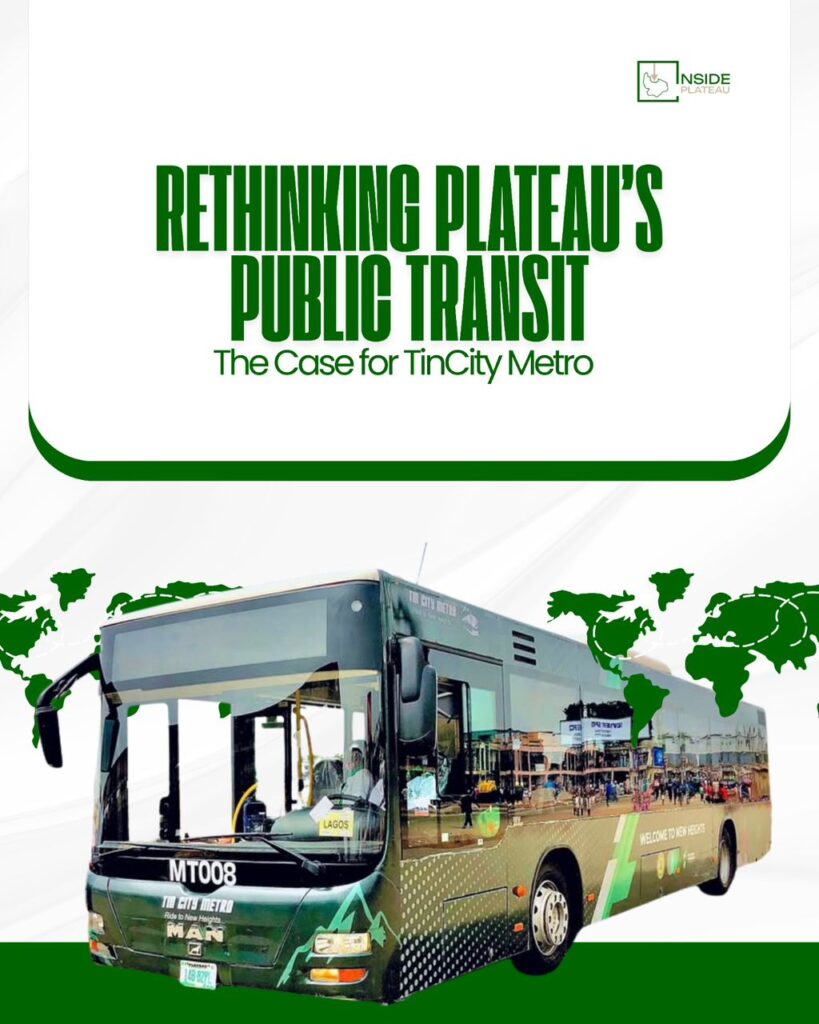
Launched under Governor Caleb Mutfwang’s administration and managed by Plateau Express Services Limited, the Metro was designed to meet the city’s most pressing needs. It introduced large, air-conditioned MAN-Diesel buses, NFC-enabled cashless travel cards, and a mobile app for real-time tracking; all features unheard of anywhere in Plateau State before. Routes were carefully mapped to connect residential neighborhoods, commercial hubs, institutional centers, and even tourist spots like the Wildlife Park.
The Metro filled gaps that previous systems couldn’t touch. It made commuting predictable, affordable, and safer. Students could get to campus without worrying about fare disputes, traders could travel more reliably, and medical patients could reach hospitals on time. Initially, the reception was overwhelmingly positive. Residents marveled at the organization, the modern fleet, and the technology. Social media was abuzz with praise, and the system became a daily lifesaver for thousands. But no system is perfect, especially one as ambitious as TinCity Metro.
Growing Pains and the Critics’ Chorus
As the years passed and ridership surged beyond 32,000 daily commuters, cracks started to appear. Some routes became overcrowded, buses arrived full at mid-route stops, and wait times stretched longer than expected. Social media complaints, newspaper critiques, and community surveys began highlighting delays, overcrowding, and frustrations from tricycle and taxi operators whose businesses were impacted by the Metro’s affordable fares. Even more interestingly are the claims by critics that ₦200 per trip was still too high for frequent riders, that the Metro couldn’t handle the state’s growing population. Furthermore, others have questioned the efficacy of the mobile app or the phased rollout of new routes. At face value, many of these complaints seem valid. After all, a commuter who waits two hours for a bus is understandably frustrated.
However, the nuance often overlooked by these critics is that these gaps are not failures of vision or intent. They are the inevitable consequences of an ambitious system operating at the edge of its current capacity. With only 30 buses serving tens of thousands of daily commuters, each vehicle is pushed beyond its limits. Even with multiple trips, some passengers will inevitably have to wait.
Moreover, the state has already responded. The launch of the Terminus-Bukuru rail shuttle has eased the load on buses, while phased fleet expansions aim to increase coverage and frequency. Ticketing and app issues from the first phase have also been addressed in Metro 2.0, allowing commuters to recharge cards virtually, track buses in real-time, and plan their journeys with much more certainty. Nonetheless, the love-hate relationship between residents and the Metro is, in many ways, proof that the system is deeply needed, widely used, and fundamentally transforming urban mobility
Beyond the Numbers
This is where we must pause and reconsider. TinCity Metro was never meant to be perfect on day one. Its purpose was, and remains, to provide safe, affordable, and organized public transport where none existed before. Reflexively, it has done exactly that. Millions of passengers have benefited, saving money, time, and stress. The Metro has reduced chaos, introduced modern technology, and provided accessibility that was previously absent.
Running a system of this scale, however, is not simple. Comparatively, Lagos BRT carries hundreds of thousands daily, but its lanes are often congested, fleets are aging, and tech integration is patchy. Sadly, both Abuja’s TFA and AUMTCO struggle with overlapping authorities and inconsistent service. TinCity Metro, by contrast, successfully launched a fully digitized, centrally managed, and strategically planned transit option, giving Plateau State the rare advantage of organization amidst chaos. Whereas global comparisons reinforce this perspective.
Cities like Bogotá, Curitiba, and Kigali offer lessons, but they operate on larger scales, with dedicated lanes, hybrid fleets, and decades of urban planning. TinCity Metro on the other hand, is young, growing, and learning from both local and international examples, evolving toward higher frequency, expanded routes, and greener solutions.
Patience, Commitment, and Growth
Perfection, as they say, takes time. Nevertheless, the Metro 2.0 demonstrates that Plateau State is committed to growth. With each improvement made, it becomes more evident that a government listening to commuters, learning from feedback, and steadily building a transit system that can scale.
Critics and dissatisfied commuters are not wrong to demand better. On the contrary, every indigene of the Plateau is a stakeholder, and their voice matter. But a more graceful response, a little more patience, and cooperation would allow the system to mature without undermining the progress already made. It must be considered that growth comes with challenges, and the Metro is showing that even ambitious public initiatives can thrive when met with support rather than cynicism.
Lessons and Comparisons
In its humble strides, the TinCity Metro is already outperforming older Nigerian systems in organization, tech adoption, and fleet modernization. Lagos BRT may have volume, Abuja TFA may have history, but Plateau has centralized control, cashless systems from day one, and a modern fleet that is well-maintained. Internationally, systems in Zürich, Singapore, Bogotá, and Curitiba showcase features like dedicated lanes, hybrid fleets, and integrated multimodal transfers, and the Metro is working toward these, step by step.
The key takeaway, therefore, are that running a modern, scalable transit system is hard, and anyone who tries it will face complaints. Consequently, the Metro’s current challenges can only be considered as growing pains, not evidence of poor planning or poor governance. Plateau State has made a good start, and with continued investment, expansion, and public cooperation, the system will only get better.
Looking Ahead
So what now? For the government and Plateau Express Services the goal should be to continue expanding fleets, improve real-time tracking, and plan new routes carefully. They should also invest in infrastructure, consider greener buses, and continue listening to commuter feedback.
For commuters and the public, embracing the Metro, cooperating with schedules and boarding rules, as well as reporting constructive feedback, and exercising patience as the system grows will not only help them make the best of this opportunity availed to them but will help unify all efforts towards constructive growth. Over time, the benefits ranging from affordable fares to safer rides, predictable travel, and a city with less chaos, will outweigh the current frustrations.
TinCity Metro is more than a bus system. It is a bold experiment in modernizing urban transport in Jos-Bukuru, a testament to vision, planning, and commitment. And while perfection will take time, the city is already moving faster, safer, and more efficiently than it ever has before.
Patience, support, and constructive engagement are what will truly unlock the Metro’s full potential. Plateau is on its way and if we all ride together, the destination is worth it.