
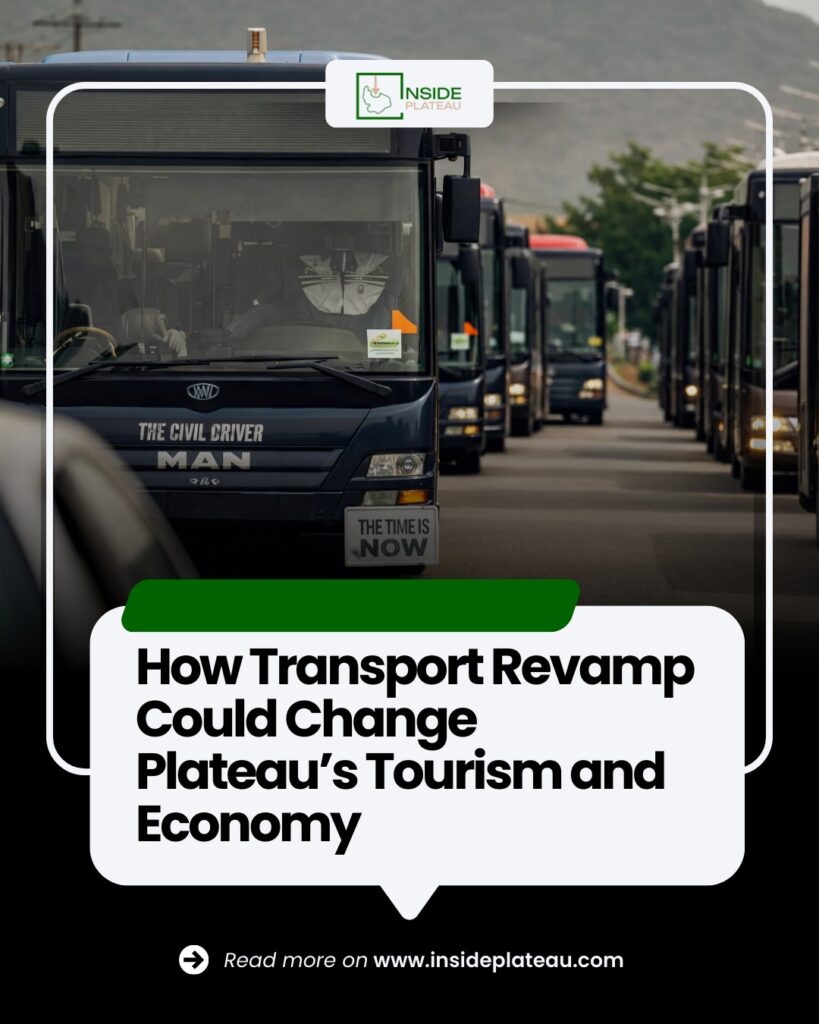
Here is a fact that people don’t always admit: A place can be as beautiful as heaven, but if moving around feels stressful, expensive, or unpredictable, tourists and investors will quietly stop coming. Even locals start losing patience. That’s why the ongoing transport revamp in Plateau State is not just another government project, but one of those changes that can actually improve how people live, how they spend, and how outsiders view the state.
It is important to note that transport is not just about buses and roads. It’s about freedom, and about opportunity. It’s about how easy it is for a farmer in Bokkos or Riyom to get goods to Jos, or how fast a visitor can go from the airport area in Heipang to the city without feeling like they’re entering a zone of potholes and confusion. And in the past few months, it has become crystal clear that the Plateau State Government is paying attention to this. Not with noise, but with action.
Transport is the First Impression of Any City
If we’ll be honest, tourism doesn’t really start when a tourist arrives at the hotel, but the moment they step into the city. The first thing they notice is movement. The roads, are they smooth? Are there taxis available? Do they have buses available? Is it safe to move around? Do people look like they’re struggling to commute?
And, even if Plateau State has the most beautiful scenery in Nigeria — which, by the way, it does — the excitement of the visitor can quickly drop if transport feels like a battle.
So when a government begins to intentionally improve the transport systems in the state, what they’re really doing is improving the state’s first impression. And as we all know, first impressions matter.
Plateau state thrives on movement; from people travelling between towns constantly, to students commuting. From traders moving goods daily to farmers bringing produce to markets. Or from workers moving from suburbs into Jos. And tourists always try to hop from one beautiful location to another.
So, a transport revamp is always a very big deal.
What the Transport Revamp Actually Means for Plateau People
Most times, when people hear the term “transport revamp,” they imagine it’s only about new vehicles. Actually, it’s deeper than that. A proper transport upgrade affects everyday life in very simple but powerful ways:
- Less Stress for Workers: If you’ve lived in Jos long enough, you already know how transport can affect your entire mood.
Imagine if you wake up by 5 a.m but still struggle to get a bus, your day is already ruined before it even begins.
However, when there are more organised transport options, workers spend less time standing by the roadside, spend less time fighting for space, and less time being late. And that alone increases productivity across the state because you can’t expect people to “work hard” when they really spend half their strength just trying to get to work.
- Better Mobility for Students: Plateau state has schools everywhere — from Jos to Mangu, Shendam, Langtang, Pankshin, Bokkos, and beyond.
Students are some of the most transport-dependent people in society. They move daily. Sometimes twice a day. And when transport is expensive or scarce, education becomes harder.
So improving transport is indirectly supporting education.
- Easier Access to Markets: Traders are another group that really benefits because the more reliable the transport system becomes, the easier it is for market women, farmers, and small-scale business owners to move goods around. And once moving goods becomes easier, prices become more stable.
So, even people who don’t “use public transport” still benefit from transport upgrades, because they buy food, vegetables, meat, grains, and everyday essentials. Transport affects pricing more than most people realise.
Tourism Depends on Movement, Not Just Beauty
Plateau state is already richly blessed. And it’s not even up for debate. We have the hills, plus the cold weather and the greenery. We also have the rock formations, rich cultural festivals, and food. We have the calm vibe that makes people feel like they can breathe again.
But, here’s the simple truth: tourism is not just about the attractions. It’s also about access.
A tourist may want to visit places like: Riyom Rock formations, Shere Hills, Wildlife Park, Jos Museum, Kurra Falls, etc. But if transport is not reliable, the tourist starts cutting down plans. So instead of visiting five places, they may end up visiting two. Instead of staying a week, they may stay for just three days. Instead of recommending Plateau State to friends, they may just say, “It’s nice, but the movement there is stressful.” That’s how tourism dies quietly.
So when Plateau begins improving transport systems, what it’s doing is expanding the tourism map. Once movement becomes easier, the tourists become more adventurous. They start exploring beyond Jos city centre.
And that is where Plateau’s real magic lives — outside the obvious spots.
Also Read: Inside Plateau’s Excitement as Schools Re-openhttps://insideplateau.com/smiles-shouts-and-school-bags-inside-plateau-students-excitement-as-schools-reopen/
A Transport-Friendly Plateau Attracts Investors Naturally
Investors are not emotional but practical people. They won’t fall in love with your scenery first. They’ll fall in love with your logistics. Before an investor sets up a factory, a farm, a warehouse, or even a hotel, they ask basic questions like
- How do staff commute?
- How do goods enter and leave the state?
- How easy is distribution?
- What is the cost of moving products?
- How reliable is mobility during peak periods?
A good transport system answers all these questions. When transport is weak, business becomes expensive. And when business becomes expensive, investors look elsewhere.
But when transport improves, business becomes smoother. And when business becomes smoother, Plateau state becomes more attractive. This is why the transport revamp is not just about convenience, but about competitiveness.
Plateau state is competing with places like Abuja, Kaduna, Nasarawa, and even Lagos in certain industries. And transport is one of the deciding factors.
Transport Revamp Makes Plateau More Livable for Remote Workers
This is one part most people ignore, but it’s very important. Remote work is fast-growing. And more Nigerians now work online, earn in dollars, and only need stable internet, electricity, and a comfortable environment.
Plateau State already has the environment. The weather alone is a major selling point. People sleep better here, think clearer, and breathe easier. It’s not overcrowded or tensed like other major cities.
However, remote workers also need mobility. They want to be able to move around freely, visit cafés, attend meetups, go to events, travel to tourist attractions during the weekends, and still get back home without drama.
Improving transport, makes Plateau state even more attractive for this category of residents. And, mind you, these are residents who spend money locally — rent, food, tourism, entertainment, transport, gadgets, and services. That’s economic growth right there. Not from oil, or government contracts. But from lifestyle migration.
And Plateau State is perfectly positioned for that, if transport continues improving.
Why the Governor’s Approach Matters
A lot of leaders like to focus on projects that look good on paper. These includes: Big buildings, huge signboards, long speeches, etc.
However, transport is one of those things that directly affects the average person. So, when a governor pays attention to transport, it usually means he’s paying attention to daily life. This is because, transportation affects the poorest citizen first.
It affects the teacher, the civil servant, the student, the market woman, the mechanic, and the small business owner. And that is why the transport revamp happening in Plateau State carries a very strong message: the government is thinking about the everyday man. Not just the elite or the visitors. The ordinary Plateau State resident.
The Festive Season Transport Support Shows Intentional Leadership
Let’s quickly talk about something Plateau State people have noticed for quite a while.
During festive periods like Christmas, New Year, Easter, and other major celebrations — transportation in Jos and other major areas tends to become more intense. More movement, more visitors, and more pressure on roads and vehicles.
And historically, one thing that has stood out is how the Plateau State Governor, Barrister Caleb Mutfwang often makes steps to augment transportation during festivities, ensuring that citizens are not stranded and that movement remains smoother.
That may sound like a small thing, but it’s actually not because festive seasons are when people travel the most. Families reunite. Visitors return from Abuja, Lagos, Port Harcourt, Kaduna, and even overseas. Hotels are filled up, events increase, weddings happen back-to-back. This makes commercial drivers to hike transportation cost.
So when the government supports transport during these periods, it is not only making life easier for the common man, but is indirectly supporting tourism, entertainment, and the local economy. This is because nobody attends an event they can’t reach. And nobody spends money in a city they can’t freely move around in.
This kind of transport revamp shows planning. It shows that the leadership of Plateau State understands the rhythm of the people. And it’s not governance by assumption, but governance by observation.
The Real Economic Impact: Jobs, Business Growth, and Daily Income
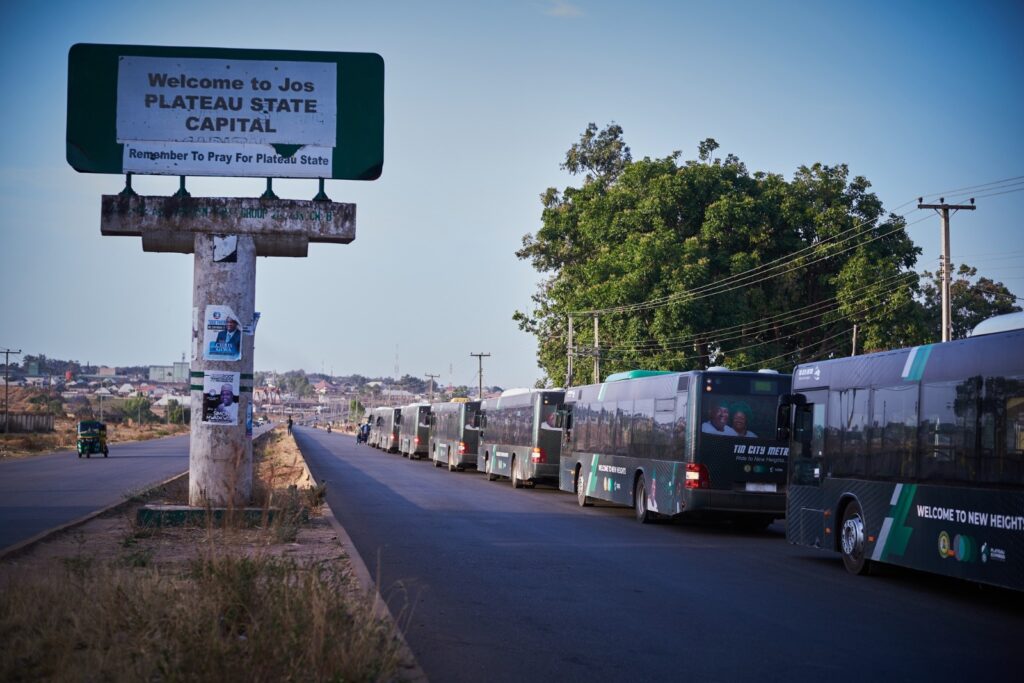
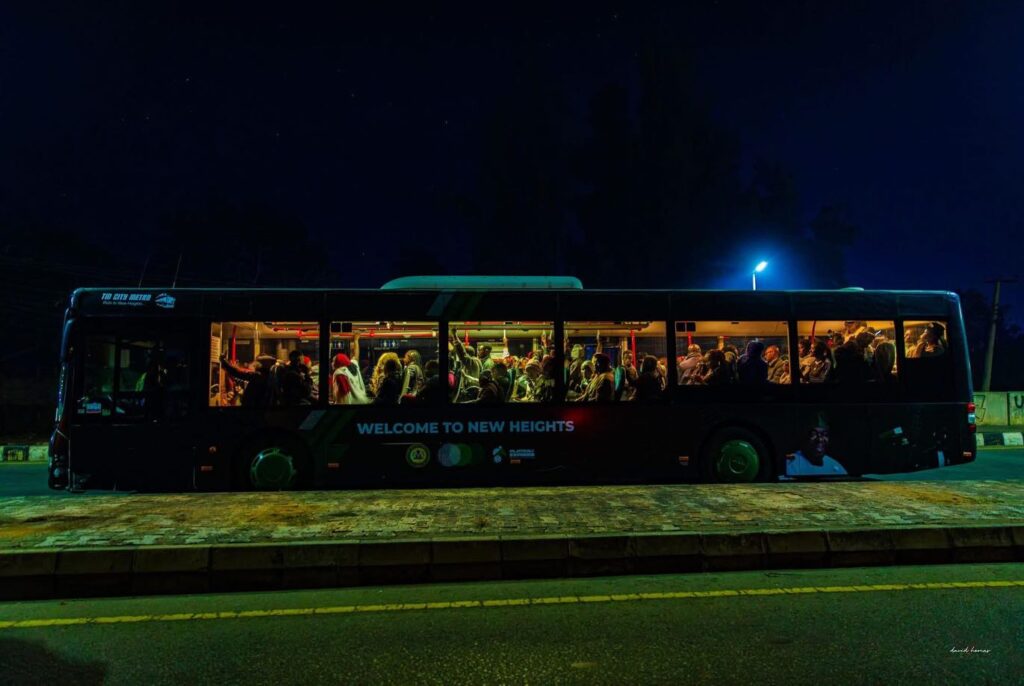
The transport revamp in Jos didn’t only help the passengers. It also created jobs.
Think about it.
When the new metro-buses were introduced, it created work opportunities for: drivers, conductors, ticketing officers, mechanics, fuel suppliers, cleaners and maintenance teams, spare parts vendors, etc.
And beyond just the direct jobs, the transport revamp also boosts small businesses. For instance:
A food vendor sells more because more people are moving.
Fashion designers get more customers because clients can reach them easier.
Event planners thrive because guests can attend events without transport fear.
Hotels record more bookings because tourists can move around.
Even photographers and videographers benefit because events increase when movement becomes easier.
So it’s right to say that transport is not just a “sector.” but an economic engine.
Safety Improves When Transport Becomes More Organized
Another thing that improves when transport systems are upgraded is safety. When there are more structured options for movement, fewer people are forced to take risky alternatives. It reduces: late-night trekking, overcrowding, unsafe bike rides in dangerous areas, transport exploitation, etc.
An organized transport system also helps reduce chaos on the road, especially in busy areas like Terminus, Farin Gada, Bukuru, Secretariat Junction, and other high-movement zones in Jos. And when a city feels safe to move around, tourism naturally grows because tourists care about safety as much as they care about beauty.
Plateau’s Tourism Potential Is Bigger than Most People Think
Sometimes people talk about Plateau State’s tourism like it’s just a few spots, but Plateau is honestly a complete tourism state.
The landscapes alone can compete with some East African countries. The culture is deep. The food is interesting. The climate is a natural advantage.
But tourism is not a one-man show.
It requires: roads, transport availability, direction signs, access routes, functional city movement,
Confidence in mobility, etc.
That’s the reason why the transport revamp is one of the smartest development angles Plateau State can push right now. This is because once movement becomes easier, Plateau becomes more accessible. And once Plateau State becomes more accessible, the economy grows without stress.
A Plateau That Moves Freely Will Grow Faster
This is the simplest way I could put these:
- When people can move freely, the economy grows.
- When goods can move freely, businesses grow.
- When tourists can move freely, tourism grows.
- When workers can move freely, productivity grows.
- And when transport becomes reliable, people start seeing the state differently. Not as a place that is “far” or “difficult to access,” but as a place that is organized, promising, and welcoming.
That’s how narratives are changed. Not through arguments, but through visible improvement.
Final Thoughts: Transport Revamp Is a Statement of People-First Governance
Plateau State is already richly blessed with natural beauty, strong culture, and a climate that makes it stand out in Nigeria. But development is not only about what you have. It’s about how easy it is to enjoy that which you have. That’s what the transport revamp in Plateau state is doing.
It reduces stress for citizens, it improves mobility, boosts business confidence, strengthens tourism access, and creates opportunities for jobs and commerce.
And most importantly, it reflects a leadership style that seems focused on the everyday needs of the people. This is because when a governor invests in transport and even takes steps to support transportation during festive seasons, it sends a very clear message: governance is not just about politics. It’s about comfort, movement, and real life.
And if this transport improvement continues with consistency, Plateau State will not only become more livable; it will become more investable, more visitable, and more profitable.
A Plateau that moves smoothly is indeed a Plateau that grows faster. And that’s the Plateau we all want to see.