
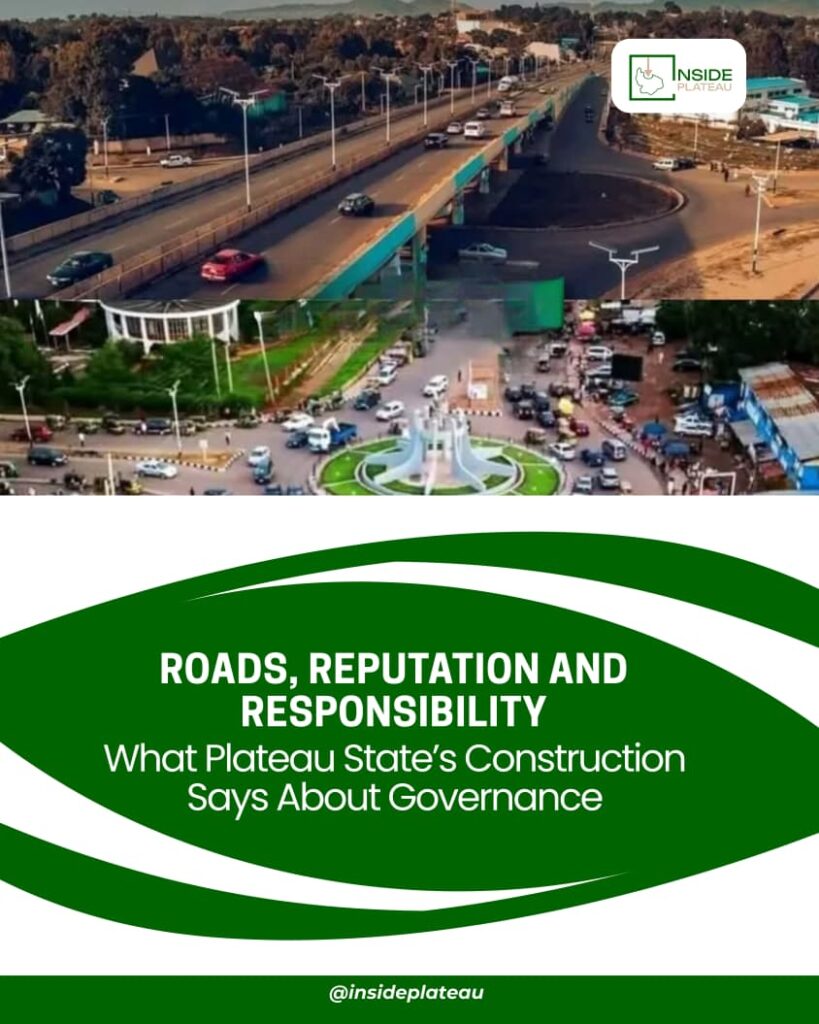
In Plateau State, road construction is becoming a visible language of governance; one that reflects coordination, responsiveness, and a growing culture of accountability under Governor Caleb Mutfwang. That shift is perhaps most visible in the recently flagged-off road network linking Jos North, Jos East, and Jos South: an ambitious urban corridor designed not just to ease movement, but to connect communities that have long functioned as separate spaces.
More than asphalt, the project reflects a deliberate governance approach that prioritizes connectivity as a tool for both economic growth and social cohesion. It is not an isolated intervention, but part of a broader pattern that has begun to redefine infrastructure delivery across the state.
Extending Development to the Margins
Moreso, beyond the Jos metropolis, this pattern becomes even more revealing. In Bassa, the ongoing construction of the Jebbu Bassa–Binchin–Buyo road stretches across nearly forty kilometres of terrain that, for years, existed at the edge of economic visibility. Roads in such places do more than shorten journeys; they redraw possibilities. They determine whether farm produce reaches markets in time, whether security response is swift or delayed, whether a community feels connected or forgotten.
What is emerging is a quiet but consequential shift in emphasis. Development is no longer confined to where it is most visible; it is extending to where it is most needed. By pushing infrastructure into rural corridors and linking them to broader economic routes, the state is beginning to treat access not as a privilege of geography, but as a function of policy.
From Isolated Projects to a Pattern of Delivery
Seen together, these efforts suggest something more structured than sporadic construction. Across both urban and rural landscapes, there is an increasing sense of continuity: projects do not simply begin; they progress, connect, and in many cases, reach completion. For a state where abandoned projects once stood as physical reminders of broken cycles, this alone marks a significant departure.
That shift becomes even clearer when placed against recent delivery patterns. Within the first eighteen months of this administration, nearly fifty previously abandoned projects were brought to completion; these were projects that had, in some cases, lingered for years without resolution. Rather than treating that as an endpoint, the focus has since expanded into a new phase: the revival of over forty additional long-abandoned road projects spread across the state’s three senatorial zones.
What emerges from this is not just activity, but sequencing. Urban renewal projects within the Jos–Bukuru metropolis, ranging from major dual carriageways to inner-city road networks, are unfolding alongside extensive rural corridors that stretch across agricultural belts and inter-local government routes. From long-distance links connecting communities like Rukuba, Miango, and Farin Lamba, to strategic access roads that open up farming clusters and local markets, the spread of intervention suggests coordination rather than coincidence.
Equally telling is the attention to maintenance and rehabilitation within the metropolis itself. Road upgrades are not limited to flagship projects; they extend into smaller but critical connectors that shape everyday movement. This layering of new construction, project revival, and ongoing maintenance points to a governance approach that is less about isolated wins and more about building a system of delivery.
In that sense, the emerging pattern is not defined by the number of roads alone, but by the consistency with which they are being addressed. It reflects a shift from fragmented execution to something more deliberate where infrastructure is approached not as a series of announcements, but as a continuous process.
The Farin Gada Transformation
Perhaps nowhere is this contrast more striking than in areas like Farin Gada. For years, the road stood as a critical but overstretched artery within the Jos metropolis; too narrow to accommodate the volume and diversity of traffic it carried each day. Yet, it served as a convergence point for movement across different layers of society: vegetable traders and buyers navigating the busy Farin Gada market, students and other members of the University of Jos community commuting on foot and by vehicle, and heavy-duty trucks and lorries transporting goods through the corridor to other parts of the state.
This constant pressure on an already limited road created a fragile environment where congestion was not occasional, but expected. During the rainy season, the situation worsened significantly. Untarred stretches gave way to mud, while deep potholes turned routine journeys into calculated risks. Traffic delays stretched unpredictably, and over time, the road became associated not just with inconvenience, but with danger. Unfortunately, accidents became more frequent, and for many commuters, navigating the route required a mix of patience, caution, and resignation.
What makes this history significant is not just the condition itself, but its persistence. For years, these challenges remained largely unaddressed, reinforcing a cycle where critical infrastructure struggled to keep pace with its importance. The recent transformation of the Farin Gada corridor, therefore, represents more than physical reconstruction. It marks a break from that cycle. It reflects a shift from prolonged neglect to deliberate intervention; one that acknowledges both the strategic value of the road and the lived realities of those who depend on it daily.
ALSO READ: What Visitors Notice About Jos That Plateau Residents Don’t
Reputation Built on Everyday Experience
As Governor Caleb Mutfwang recently noted, “Infrastructure remains a critical driver of economic growth and social progress… roads serve as lifelines, connecting communities, facilitating commerce, improving access to essential services, and strengthening social cohesion.”
That framing helps to explain the pattern that is beginning to take shape across Plateau State. Infrastructure at this scale does not organize itself. It requires alignment between vision and execution, between planning tables and construction sites, between budgetary intention and on-ground delivery. From here, the conversation naturally begins to move beyond roads and toward reputation.
Reputation, after all, is not built in press briefings or policy documents. It is built in daily experience. It is in the commuter who notices that a once-dreaded stretch now feels predictable. It is in the trader who arrives earlier, with less damage to goods and less uncertainty about the journey. It is in the quiet recalibration of expectations, when people begin to assume that projects might actually be completed. These are subtle shifts, but they carry weight. Over time, they accumulate into something more powerful than announcements; they become belief.
Advocacy and Strategic Engagement Beyond State Lines
Yet, if roads are shaping perception, they are also revealing something deeper: responsibility. Infrastructure at this scale does not organize itself. It requires alignment between vision and execution, between planning tables and construction sites, between budgetary intention and on-ground delivery. The decision to revisit abandoned projects, to initiate new ones, and to sustain both simultaneously suggests a governance approach that is less about isolated wins and more about systemic follow-through.
Sustaining the Momentum
Even in engagements beyond the state’s direct control, this pattern holds. The push for the dualization of the Akwanga–Jos road—a critical federal corridor—signals an understanding that governance is not limited to what is built internally, but extends to what is pursued externally. It reflects a willingness to engage, to advocate, and to position the state within broader national infrastructure priorities.
Taken together, these actions begin to form a narrative that is not of perfection, but of direction. But, of course, progress in infrastructure is never self-sustaining. Roads, like institutions, require maintenance, oversight, and consistency. Hence, the real test of this emerging pattern will lie not just in what is built, but in what is preserved. Transparency in timelines, adherence to quality standards, and continued responsiveness to public need will determine whether this moment becomes a lasting shift or a temporary peak.
A Standard in the Making
But for now, the signals are difficult to ignore. Across Plateau State, roads are beginning to do more than carry vehicles; they are carrying meaning. They are reflecting choices, priorities, and a growing alignment between governance and everyday experience. They are, in many ways, becoming the most visible measure of how leadership is felt on the ground. And if this trajectory holds, they may well come to define something even more enduring: a standard by which governance is not just promised, but seen, tested, and trusted, one stretch at a time.