
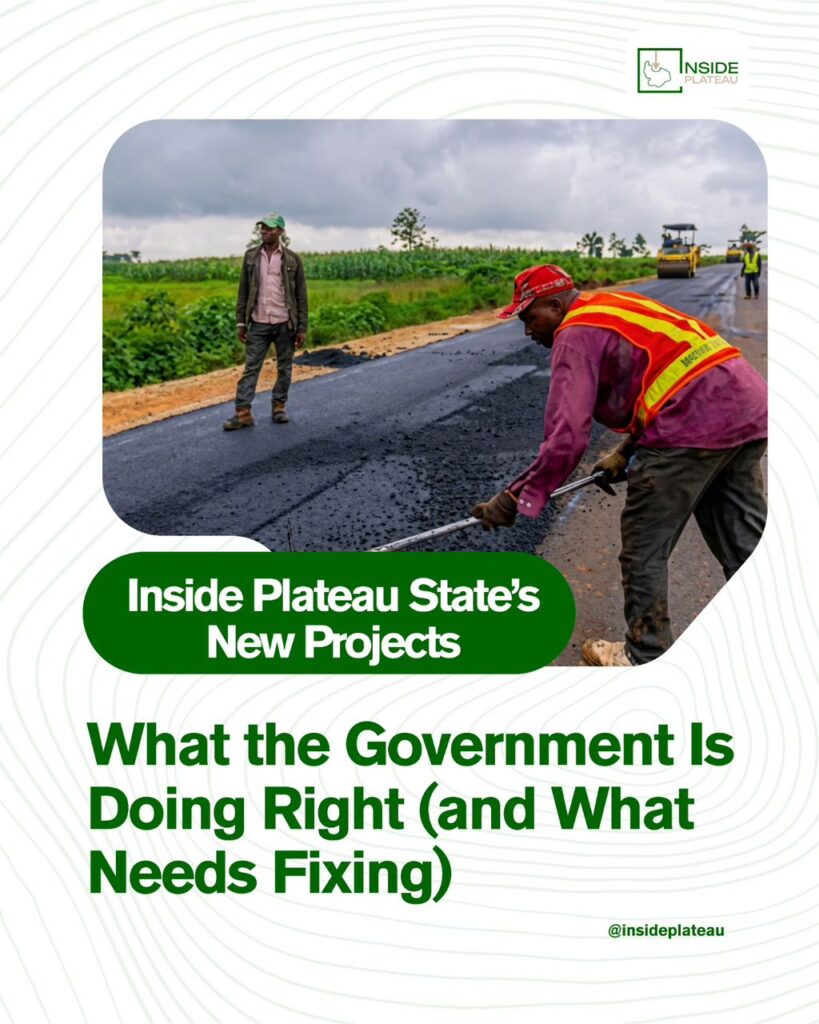
Today, I want us to talk about Plateau State’s new projects, because honestly — there’s a lot more happening in the state than most of the noise mainstream media made you believe.
You mostly see headlines about violence, insecurity, and social strife. But when you take time to look at the new projects in Plateau State being executed since Governor Caleb Manasseh Mutfwang took office, a different picture starts to emerge — one of genuine investments, practical infrastructure moves, and a people-first mindset that does not always get the spotlight.
Plateau State’s New Projects: Transport Revamp
One of the best parts of the Plateau State’s new project story is the revamp of the transportation system. Do you recall the old Plateau Express Service? After many years of neglect, it was really a ghost of its former self. Governor Mutfwang decided to breathe life back into it, and this is not small talk.
Also Read: How Transport Revamp Changes Tourism and Economy in Plateau How Transport Revamp Changes Tourism and Economy in Plateau
The rebranded fleet — nicknamed Tin City Metro 2.0 — started with 15 state-of-the-art buses and recently added another 15, bringing the total now to 30. That’s 30 brand-new, 80-seater buses purchased using Plateau State funds. These buses serve daily commuters, and reduces travel costs dramatically (by up to ₦2,000 per trip. And it eases the chronic strain on urban mobility caused by the removal of fuel subsidies.
Here’s the thing: This Plateau State’s new project didn’t just move people from point A to point B. It did it in a way that really made everyday life easier. With smart ticketing apps, QR payments, GPS tracking, and expanded routes — that’s exactly what’s happening. For anyone who’s watched similar urban transit rollouts in other cities, this isn’t just talk — it’s real transportation planning
Plateau State’s New Projects: Roads (From Metropolis to Rural Paths)
Another strong pillar of New Projects in Plateau State is the effort to fix, expand, and build roads — from the city centers out to the rural communities.
There’s a 2 billion naira counterpart funding that the governor released under the Rural Access and Agricultural Marketing Project (RAAMP) for more than 331 kilometres of rural roads. That’s not a typo — three hundred and thirty-one kilometres across multiple local government areas.
This project is doing something powerful: it’s connecting isolated towns and villages to markets, schools, healthcare, and opportunities. That’s not just paving — it’s unlocking economic access for farmers and traders. It’s not splashy. Its vulnerability reduced.
Within Jos and Bukuru, various key roads — like the Utonkon Bridge and other connecting routes — have been opened up or completed, reducing congestion and generating real economic activity.
So yes, Plateau State’s new project story includes a transportation boost that’s actually felt on the ground.
Plateau State’s new projects 3: Healthcare
Now, let’s shift our attention to Government Projects in Plateau State that affect the health sector.
Firstly, at the Plateau State Specialist Hospital in Jos, the government opened a modern laboratory, a new paediatric ward, and a supporting administrative complex, heavily equipped with world-class medical gear. This is aimed at drastically improving healthcare delivery.
Secondly, commissioners in the health sector attest that general hospitals across all 17 local government areas have received massive upgrades. That means have real access to improved medical services.
Thirdly, when we go deeper and there are even safe delivery kits distributed to rural clinics to help reduce maternal mortality — an area that matters to everyone who’s seen how loss affects a family.
That’s the kind of new project in Plateau State that quietly saves lives.
New Project 4: Sports (Closing the Gap between Now and Legacy Aspirations)
When we talk about the New Projects in Plateau State and particularly sports, it’s not just cheering on our local teams — although, it matters too.
There are ongoing plans to upgrade the Rwang Pam Township Stadium to CAF standards and complete the long-abandoned Zaria Road Stadium through public-private partnerships. Should those succeed, it opens the door for Plateau United to host more matches and bring economic activity around match days.
New Project 5: Markets & Commerce (Rebuilding Business Foundations)
The silence around market infrastructure can distort how outsiders view a place. But when you walk through Jos South, you’ll find modern marketplaces and stabilized trade routes. These projects are aimed at easing commerce and giving traders dignity and a safe space.
Even outside the state capital, strategic market hubs tied to agri-logistics centers are popping up. This is evident in Mangu, Shendam, and Bassa, where farmers now aggregate produce and access storage — another ripple of economic growth.
That’s exactly the kind of new project that changes rural livelihoods.
New Project 6: Education (Capacity + Opportunity)
The narrative around Plateau State’s education was that schools exist, but they often struggle. That narrative is gradually changing.
At the Plateau State Polytechnic in Barkin Ladi, a new administrative block is built. Also, the refurbishment of Joshua Dariye Hall tell a bigger story — one about institutions that were lagging now catching up. And there’s an outright promise by the government to upgrade the polytechnic into a university of science and technology.
However, this isn’t just aesthetic renovation. This is about turning an academic institution into a generator of research, skills, and future talent — a dependable pipeline for jobs and innovation.
Project 7: Quality of Life and Governance (The Quiet Wins)
When we zoom out from the individual Government Projects in Plateau State, there’s still another reality that’s quite easy to miss on the front pages:
- Salaries and pensions that were stalled have now been fully regularized.
- The civil service is being rebuilt (meaning services improve).
- Water systems are being upgraded in multiple LGAs.
- Environmental sanitation initiatives are back in action — streets cleaner, waste better managed.
These aren’t headline-grabbing demolitions or giant billboards. But they’re projects — quietly improving everyday life.
That’s why when you talk to someone who lives here, the Plateau State’s new project conversation isn’t theoretical. It’s lived experience.
What Still Needs Fixing
If we’re being honest, nothing is really perfect. And highlighting progress doesn’t mean glossing over gaps. The following aspects still need fixing:
1. Rural hospital networks still need stronger personnel retention and equipment. Some general hospitals are improved, but capacity constraints remain outside major towns.
2. Forgotten Government projects and recreational centers needs to be revisited. Places like Hill-Top Hotel in Pankshin needs to be restored back to its glory days.
3. Security challenges still slow things down. There has to be a deeper synergy between development and community safety.
If these areas are addressed with the same urgency we’ve seen in transportation and road works, Plateau State’s new project story will only grow stronger.
Bottom line?
Honestly speaking, there is a real, measurable story of progress here. The New Projects in Plateau State aren’t “audio projects”, they’re the metro-buses on the road, the new hospital wards saving lives, they are markets buzzing with trade, and schools preparing for the next generation.
And while there’s still more that can always be accomplished, this is a narrative worth telling — whether to a regular tourist or a global investor.