
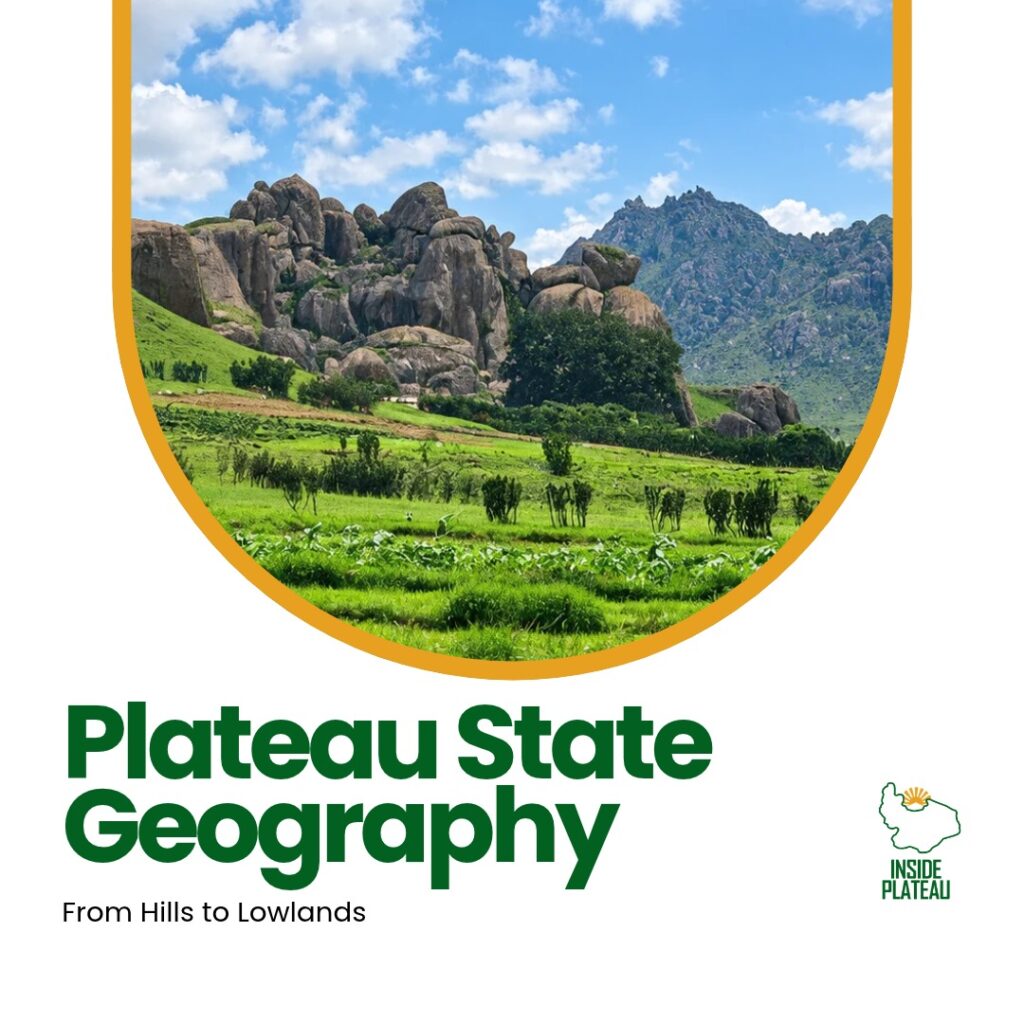
The journey through Plateau State feels different as the road winds toward Jos. The air grows cooler, the land begins to rise, and rocky hills appear across stretches of grassland. But travel farther south, and the scenery gradually changes. The highlands give way to lower, warmer terrain, revealing a state whose landscape is far more varied than its name might suggest.
Understanding Plateau State geography means looking beyond its famous hills. The land influences the weather, supports different kinds of farming, feeds rivers and creates some of the state’s most recognisable natural attractions.
A Landscape Shaped by Height
Located in north-central Nigeria, Plateau State takes its name from the Jos Plateau, an elevated region that dominates much of its northern and central landscape. According to the Plateau State Government’s investors’ guide, the terrain rises from around 200 metres above sea level in parts of the southern plains to an average of about 1,200 metres on the Jos Plateau.
This difference in elevation helps explain the variety across the state. Some areas are characterised by rolling grasslands and broad valleys, while others feature steep slopes, exposed rock formations and elevated ridges.
The hills in Plateau State are not simply scattered features on an otherwise flat landscape. They are part of a geological history consisting of ancient rocks, volcanic activity, weathering and erosion. Over time, these processes shaped the terrain that residents and visitors recognise today.
Hills, Rocks and the Stories They Tell
Few places illustrate the character of the highlands better than Shere Hills, whose peaks rise to approximately 1,829 metres above sea level. Its rugged ridges and elevated viewpoints make it one of the best-known natural landmarks around Jos.
Elsewhere, Riyom Rock stands out for its distinctive arrangement of granite boulders, while Wase Rock rises dramatically above the surrounding plains. These formations give Plateau State’s mountains and rocky outcrops an instantly recognisable character.
The state’s natural features extend beyond hills and rocks. Assop Falls and Kurra Falls offer contrasting landscapes shaped by flowing water, while the Kerang area in Mangu is known for its volcanic landscape and natural springs. Together, these places show how varied the natural features of Plateau are.

Why the Weather Feels Different
One of the most noticeable effects of the high elevation is the weather. Although Plateau State lies within Nigeria’s tropical zone, its elevated areas experience cooler conditions than many lower-lying parts of the country.
The Plateau State Government’s guide describes the Jos Plateau as having a near-temperate climate, while the lower parts of the state are generally hotter and more humid. It also identifies December to February as the colder Harmattan period and March and April as typically warmer months.
This variation in Plateau State climate affects daily life and agriculture. The cooler highlands support the cultivation of crops such as Plateau potatoes and vegetables, while different conditions in the lower areas influence the kinds of crops grown there.
The landscape also contributes to the state’s water systems. The Jos Plateau serves as a source region for several rivers, including the Kaduna and Gongola, connecting its elevated terrain to communities and ecosystems well beyond the highlands.
From Natural Landscape to Tourism
For visitors, geography is one of Plateau State’s greatest attractions. A trip can include mountain scenery, unusual rock formations, waterfalls, lakes and open grasslands, often within the same wider region.
These places offer more than opportunities for photographs. They create possibilities for hiking, sightseeing, picnics, nature exploration and local tourism businesses. The state’s official tourism platform highlights destinations including Wase Rock, Shere Hills, Riyom Rock and Assop Falls.
The landscape also gives each destination its own character. A rocky viewpoint offers a different experience from a waterfall or a quiet stretch of countryside. Together, these places help explain why tourism in Plateau State is closely tied to its physical environment.
Yet appreciating the scenery also means recognising the need to protect it. Environmental pressures, including erosion, deforestation and the effects of poorly managed mining, can damage landscapes and water systems. Preserving these natural assets is important not only for tourism but also for the communities that depend on the land.

One State, Many Landscapes
Plateau State is often introduced through its cool weather and spectacular hills, but its geography tells a broader story. The highlands, valleys and southern lowlands form a connected environment that influences farming, water, settlement and travel.
To understand Plateau State is to understand the relationship between its land and its people. From the heights around Jos to the warmer plains farther south, each change in elevation reveals another part of what makes the state distinctive.
Its beauty lies not in one mountain or viewpoint, but in the variety of landscapes that come together to make Plateau State what it is.