
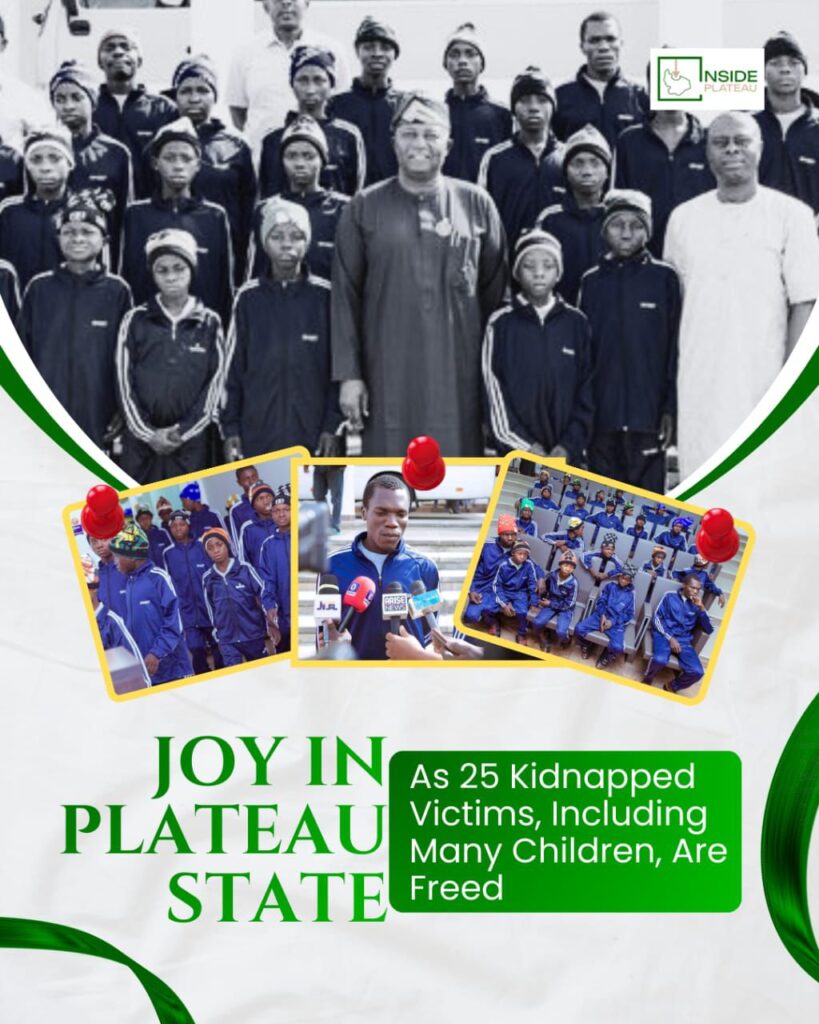
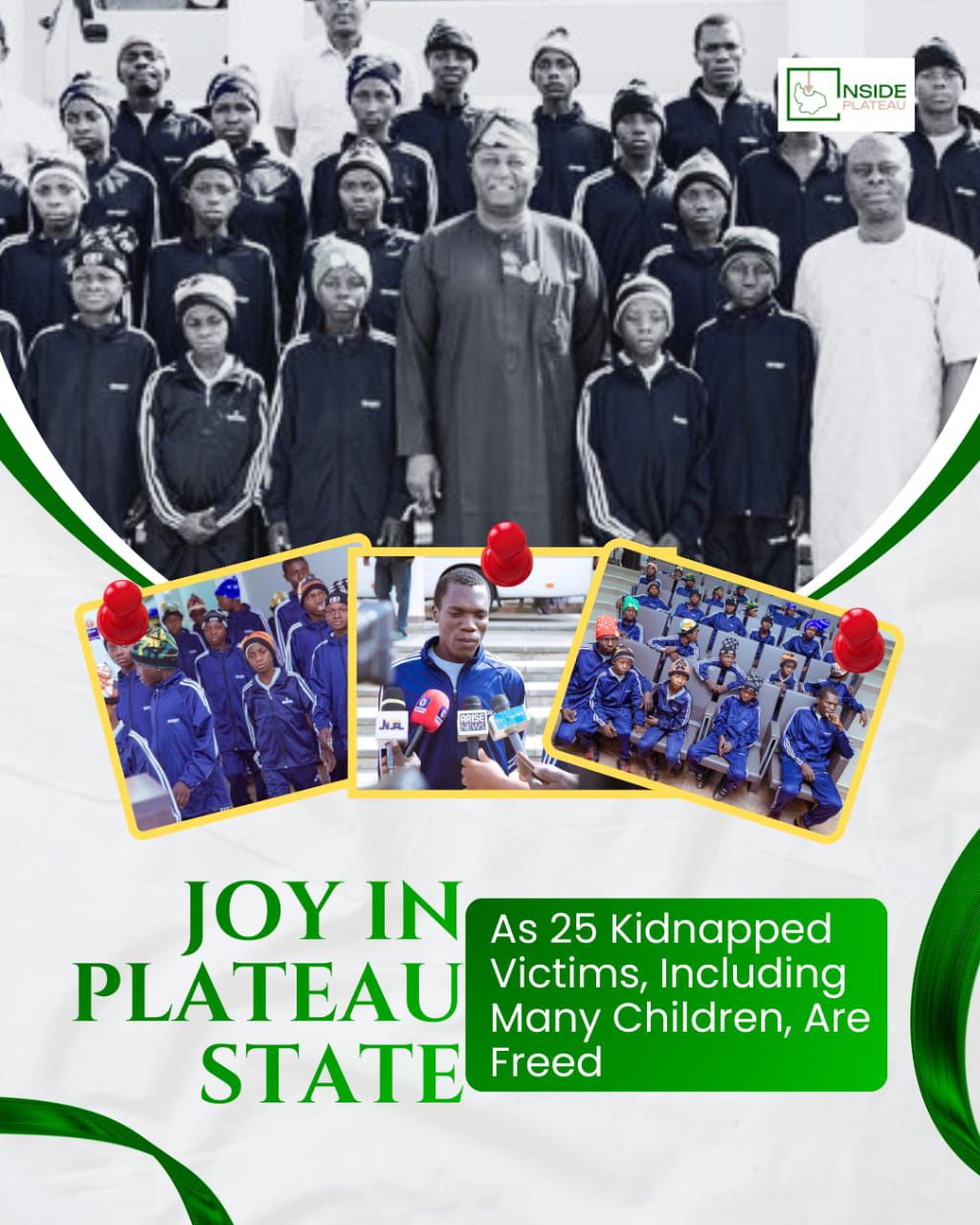
There are times when a place breathes again. You can almost feel it. That collective sigh relief after days of worrying, complaints, prayers, anger, and fear. Plateau State experienced one of those moments recently, when kidnap victims were finally brought home. As total of twenty-five Kidnapped victims were rescued alive, safe, and back in the arms of their families and loved ones.
If you’ve lived in Plateau State long enough, you’ll know what that means. It’s not just about numbers. It’s not a headline you should scroll past. It is actually twenty-five empty seats that are no longer empty. It is mothers who can sleep again after painful sleepless. It is fathers who can finally stop pacing at night. It is children who get another chance at being children.
However, the irony remains that outside Plateau, this kind of story rarely gets the attention it deserves, because the dominant narrative about Plateau State has been painfully one-sided for years: Crisis, attacks, fear. As if that’s all that the only thing that happens here. As if resilience, progress, competence, and compassion don’t exist within these borders.
But this story on 25 rescued kidnap victims? Is one that truly matters.
Read Also:Governor Caleb Mutfwang’s Defection and the Question Plateau Must Answer: Party or Performance? https://insideplateau.com/governor-mutfwang-defection-party-or-performance/
The True Story on the 25 Kidnap Victims
On the fateful Sunday evening, of December 21, 2025, around 7:00 p.m., a group of travelers set out along the Zak–Sabon Layi Road in Bashar District of Wase Local Government Area. They were on tricycles, heading for a Maulud celebration. Nothing unusual. Just people moving, living their lives, marking a religious moment.
Then the roadblock appeared. The kidnappers didn’t storm in with chaos. They didn’t make any announcements. They disguised themselves as vigilante operatives and mounted a fake security checkpoint. A routine “search.” Something many rural travelers in Nigeria are sadly used to experiencing. And that’s the scary part. Evil often succeeds by disguising as the normal.
After stopping the tricycles, the kidnap victims away to an unknown location. Twenty-five people in total: Six females, nineteen males, majority of them children. That’s when fear settled in because anyone who understands kidnapping cases in Nigeria knows this truth: once victims disappear into the bush, outcomes are mostly unpredictable. Negotiations drag, trauma deepens, and lives hang in the balance. But this time, the story took a different turn.
Pressure, Coordination, and a Refusal to Give Up
What followed wasn’t noise or unnecessary preformative statements. It was pressure. Silent, sustained, professional pressure.
The Plateau State Government, worked closely with the Department of State Services (DSS) and other security agencies, and went to work. Not the kind of work that trends only online. The kind that happens in strategy rooms, on field operations, and through intelligence gathering that doesn’t make the headlines until the job is done.
On Friday, January 9, 2026, the kidnap victims were rescued alive, safe, no ransom drama dominating the story. No political chest-thumping. Just results. The State Government and the security agencies really delivered.
When the Secretary to the Government of the State, Arc. Samuel Nanchang Jatau, briefed news men during the handover ceremony, his tone was very significant. He didn’t pretend the incident wasn’t painful. He expressed regret. But he also did something important. He acknowledged the competence of our security agencies. He thanked God. And he publicly commended the DSS for what he described as painstaking and professional efforts.
That combination matters. Because it tells you this wasn’t luck.It was work.
Why This Rescue Is Bigger Than One Incident
Let’s be honest. Kidnapping is not unique to Plateau State. It’s a national challenge. Anyone pretending otherwise isn’t paying attention to what’s happening across Nigeria. But here’s where Plateau’s story deserves a different lens.
The rescue of the kidnap victims sends a clear message: when the Plateau State Government says it prioritizes lives and property, it’s not just a slogan. It’s an operational stance.
View it from this perspective. If Plateau State was truly unsafe in the way some narratives suggest, would you see this level of coordination? Would you see victims rescued and reunited with their families within weeks? Would you see the state leadership standing openly with security agencies, reinforcing support rather than shifting blame? Probably Not
What we are witnessing is a system that, while it may not be perfect, it is responsive. This is a government that understands the emotional weight of insecurity and treats it as urgent, not abstract. And this changes the bigger picture.
Read Also: Plateau State Positioning Its Youth for the Future of Work https://insideplateau.com/plateau-is-positioning-its-youth-for-the-future-of-work
The Human Side We Don’t Talk About Enough
One thing that Arc. Jatau laid emphasis on during the handover stood out. The emphasised on the government’s commitment to supporting the kidnap victims psychologically through the Wase Local Government Council. This act is deeper than most people realise. This is because kidnapping doesn’t end when someone is freed. The fear lingers. The nightmares linger. Especially for children.
Anyone who has spoken to Kidnap victims knows this as true. Loud noises often trigger panic. Even silence can feel dangerous. And trust usually takes time to rebuild.
By acknowledging this and showing massive support, the Plateau State Government is saying something very important: “We see you beyond the rescue.” This is leadership rooted in empathy, not optics.
Governor Mutfwang’s Broader Vision
This incident of the 25 kidnap victims clearly fits into a wider pattern under the administration of His Excellency, Barr. Caleb Manasseh Mutfwang. Right from the onset, the message has been crystal clear and consistent: Plateau State must be peaceful, safe, and inclusive. Not just for a particular group. But for everyone. Regardless of ones ethnic group or religion.
That vision isn’t just mere theory. It speaks up loudly in how crises are being handled, how security agencies are supported, and how victims are treated afterwards. And when you’re thinking long-term, I mean investors, tourists, remote workers, or families looking for a place to settle, this consistency is very critical.
People don’t expect perfection. They expect seriousness. They expect effort. They expect a government that responds when things go wrong. This rescue mission of the 25 kidnap victims is proof of that seriousness and strong effort.
Plateau State Is Beyond Its Challenges
Here’s the uncomfortable truth: every region has its challenges. But every region should not be defined by them. Plateau State remains one of Nigeria’s most liveable places in the country. The climate alone tells a different story. The culture, the people, the growing creative and digital communities, the agricultural potential, the tourism sites—none of these disappear because of the existence of criminals.
If anything, it’s moments like this rescue that highlights the resilience of the state.This is because progress is not the absence of problems. Progress is how problems are being confronted. And Plateau confronted this one head-on.
A Message to Investors and Visitors Watching From Afar
If you’re reading this from outside Plateau State—maybe Lagos, Abuja, or even outside Nigeria—it’s very important to read between the lines. Plateau State is not a state in denial. It’s a state that is actively strengthening its security response, It’s a state that supports its people, and refuses to let criminals define its identity.
This really matters if you’re considering investing, visiting, relocating, or even working remotely from Plateau. Safety isn’t just about not having incidents. It’s about how quickly and effectively systems respond when incidents occur. And in this case, the response worked.
The Quiet Strength of Collaboration
One thing that isn’t talked about much is how collaboration actually saves lives. The DSS didn’t act alone. The state government didn’t act alone. Local structures were crucial. Intelligence was crucial. Political will was also very crucial. All parties played vital roles in rescuing and re-uniting the kidnap victims with their families.
This wasn’t chaos. It was coordination. And coordination is a big sign of maturity in governance
Ending Where It Matters Most
At the end of everything, this story comes back to families. Twenty-five people kidnapped people are now re-united with their families. The children are laughing again. While the parents are holding their sons and daughters tighter.
Plateau State didn’t just rescue the kidnap victims. It restored lost hope. And this is the part of the story that deserves to travel far beyond our borders. This is because Plateau is not just a place of crisis headlines. It is a place of courage, competence, compassion, and quiet victories.
It is said that sometimes, joy arrives quietly. This time aroundd, it arrived with twenty-five lives restored. And that is worth telling.