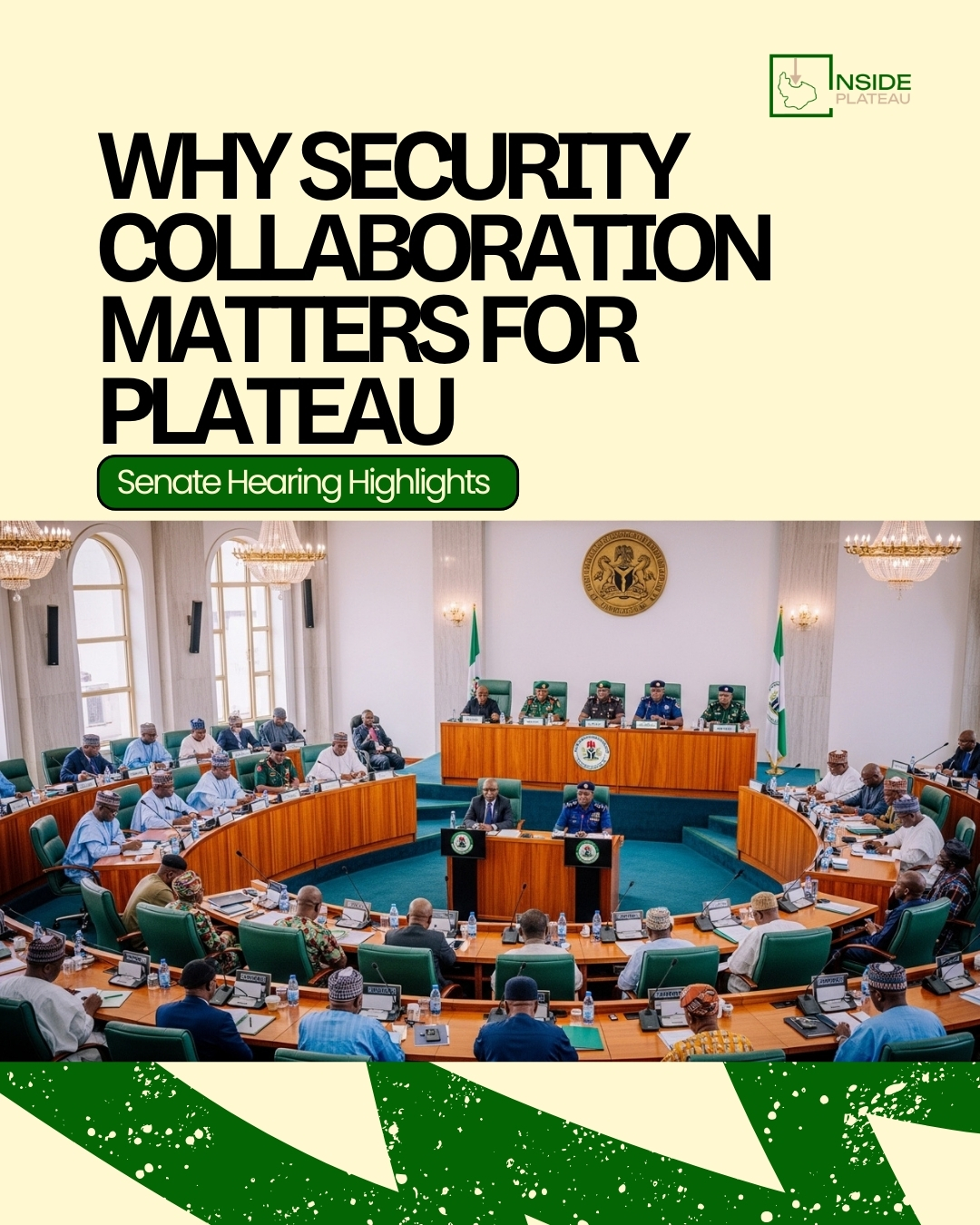
Security Collaboration is not a new phrase in Nigeria’s security conversations, but for Plateau State, it really carries weight. Anyone paying attention knows that the security challenges we experience don’t come from one direction or fit into one box. They stretch across communities, local governments, and even state borders. That’s why the recent Senate hearing calling for stronger Security Collaboration matters far more than the headline suggests.
At the recent hearing, the lawmakers stressed what security professionals have agreed on long ago: agencies working alone cannot outpace coordinated and mobile threats. The position of the senate was clear— Collaboration between the military, police, intelligence services, and state-level actors is non-negotiable if lives are to be protected and stability restored. For Plateau State, this isn’t theory. It’s lived experience.
Why Security Collaboration Fits Plateau State’s Reality
Plateau State’s large terrain and diversity makes Collaboration between all agencies unavoidable. Incidents in the rural communities can quickly escalate, pulling in numerous security formations. Criminal groups usually exploit the little gaps between jurisdictions. They move freely where agencies fail to share information. When Collaboration is weak, gaps widen.
However, when Security Collaboration works—when intelligence is shared early, or when patrols are duly coordinated, and when response roles are clearly defined—outcomes change. This is why Plateau state’s peace strategies continuously point toward joint operations and shared command structures. It’s not about who leads. It’s about who connects.
Peace in Plateau is Practical, not Abstract
Sometimes people talk about peace like it’s a mere slogan. In Plateau State, peace is highly functional. It decides whether farmers return to their lands or farm without fear. It also decides whether traders open their shops without fear. Also, it decides if families move freely between towns and villages.
Effective Plateau peace strategies are built on trust and visibility, and both rely heavily on Security Collaboration. Communities are more willing to cooperate or share information when they see the security agencies working together rather than competing for relevance. And without strong Collaboration, even the best-designed Plateau peace strategies struggle to take root.
This is why security in plateau state needs to be treated as a shared responsibility. The federal forces may have the capacity, but local actors have the context. Security Collaboration brings those two together.
Also Read: How Plateau State Diaspora is Shaping Global Impact. https://insideplateau.com/how-plateau-state-diaspora-is-shaping-global-impact/
The Economic Angle we Overlook
We tend to forget the fact that Security Collaboration directly influences our economic confidence. Plateau State’s economy—agriculture, tourism, mining, and small businesses—relies heavily on predictability. You can’t plan big harvests or attract investors when insecurity reigns.
When security in plateau state is improved through visible Security Collaboration, the risk drops. Transport routes reopen. Markets are being stabilize. Investors begin to pause less and plan more. This is the reason why Plateau peace strategies are inseparable from economic planning. No serious development survives without Security Collaboration backing it up.
Why the Senate Hearing Actually Matters
It’s truly easy to be cynical about hearings and resolutions. But Senate oversight affects funding priorities, operational mandates, and inter-agency coordination. By emphasizing on Security Collaboration, the Senate reinforced a framework that our security leadership already understands but sometimes struggles to implement.
For Plateau State, this national backing strengthens the ongoing Plateau peace strategies and gives institutional weight to calls for better coordination. It also reinforces the idea that security in plateau state cannot be treated as an isolated issue—it is part of a broader national security fabric.
Security Collaboration at this level encourages consistency between Abuja and the states. It also reduces rivalry and clarifies responsibility. And most importantly, it improves response time when it matters most.
Collaboration is Necessary, not Optional
If we are being honest, Security Collaboration alone will not solve every challenge Plateau State is facing. However, without it, progress will always be very fragile. The recent Senate hearing is a reminder that peace is built through systems, not speeches.
Strong security in plateau state depends on how well our security agencies work together. Sustainable Plateau peace strategies depend on how deeply collaboration is embedded. And the future of Plateau’s economy depends on whether Security Collaboration becomes the norm rather than the exception.
For a state with Plateau’s complexity and potential, embracing Security Collaboration isn’t just welcome. It’s long overdue.