
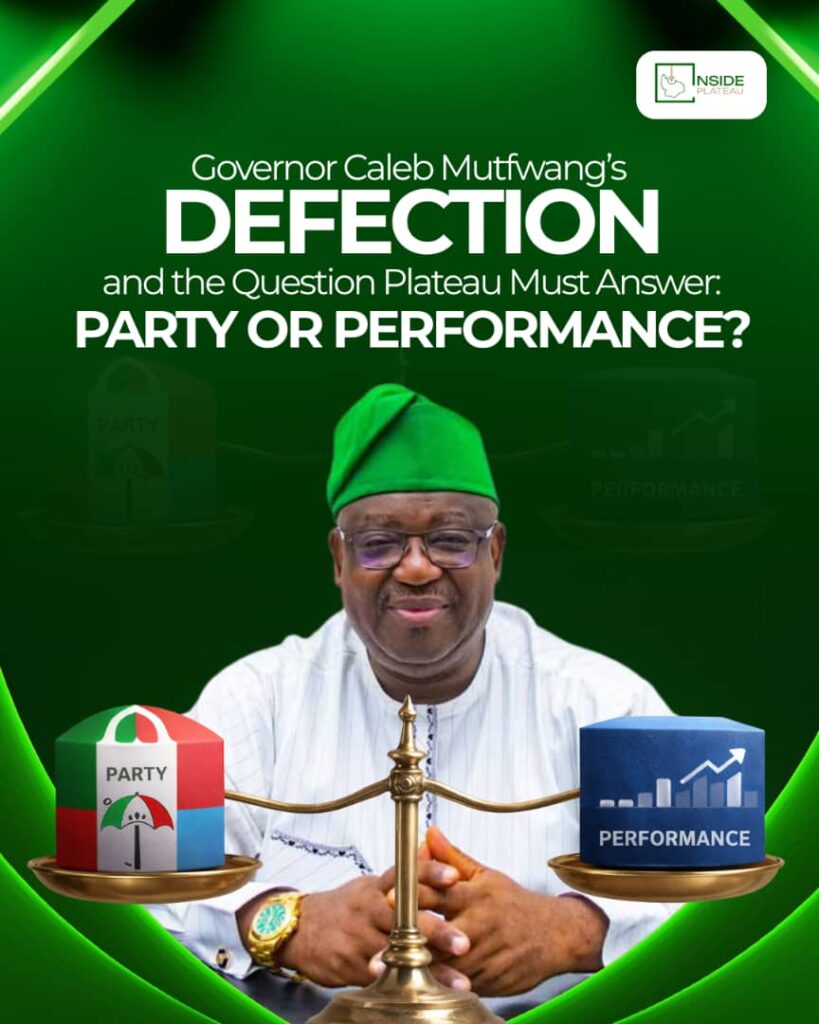
The news did not arrive with sirens or flying banners. It slipped in quietly as a rumour, then a line in a headline, a forwarded message, a screenshot in a WhatsApp group, and soon, it was a conversation on almost every mature lips. In no distant time at all, the reaction across Plateau State became anything but quiet.
First, there was disbelief in the air as many thought it couldn’t be true. Then, anger followed at the confirmation. Next were the shrugs of indifference, long voice notes and comments conveying insults and careful defenses alike. The news? Governor Caleb Mutfwang had defected.
In that moment of realization, Plateau people were no longer arguing about parties; they were arguing about trust, loyalty, sacrifice, and whether Nigerian politics ever truly gives room for sincerity. And in such reasoning, these emotions are valid. Because their perceptions are not rooted in foolishness, but in lived experiences.
From the time of his election, up until now, a lot of us supported Mutfwang not just because of a party symbol, but because he felt like our own: calm, deliberate, not loud or reckless. So, when the news of his defection broke, it hit deeper than the usual political headline. It felt personal. And maybe that is why this conversation deserves more than shouting or instant judgment. Maybe it deserves a pause, a second look, and a more honest reasoning.
Why It Felt Like Betrayal and Why That Feeling Is Valid
Let us not pretend we do not understand the pain; because many Plateau people stood by the PDP when it wasn’t fashionable. They defended the mandate through court cases, and believed the party represented a different path from what we had known before. To this faction, Governor Mutfwang’s defection felt like walking away after the storm had passed.
And yet, there are others who saw it as confirmation of a pattern we all hate: politicians switching sides whenever it suits them and loyalty treated like a campaign slogan rather than a value. Again, we dare say that these feelings are not irrational, but come from a painful reality we have come to know as a people.
Plateau people, like Nigeria as a whole, have seen instability, broken promises, and political games cost the state dearly in the past. So, when a similar trend starts to unfold, suspicion becomes a defense mechanism for survival. However, after the first wave of emotion passes, another question quietly begins to form: Could there be more to this decision than ambition?
Looking at the Man, Not Just the Move
Whatever anyone thinks of party politics, one thing is difficult to dismiss: Governor Mutfwang has worked.
He did not walk into office on smooth ground. On the contrary, his emergence came through a tense post-election season, prolonged court battles, and a state still adjusting to economic shocks at the national level. Notwithstanding, in the heat of these circumstances, he settled into a quieter rhythm with a focus on practical relief and steady rebuilding.
Consequently, Plateau residents have felt his impact not through speeches, but through daily life. One of such efforts is visible in the TinCity Metro Bus scheme which came at a time when fuel subsidy removal had made movement painfully expensive. By keeping transport at ₦200 per trip, we see a governor trying to cushion real hardship rather than simply managing headlines. In the same vein, the revival of the Jos train service carried a simpler message of intentional modesty.
Then, there were the abandoned projects many had already forgotten. The structure opposite Lamingo Dam being revived for hospitality use; the ongoing renovation of Rwang Pam Stadium; the renewed attention to Terminus Market; as well as the intended completion of Jos International Stadium project. These are not overnight miracles, but they reflect a mindset: Recover what Plateau already owns and make it useful again.
What stands out in all of this is not perfection, but the consistency invested into each project. So far, Governor Mutfwang has built a pattern of engaging youth, inviting business owners to the table, opening conversations on tourism, and pushing Plateau’s “open for business” vision beyond slogans.
Perhaps, this is why today’s anger feels complicated. Because people are not only reacting to a party logo. They are reacting to a governor whose leadership, so far, has felt closer to the people than to politics. And that is exactly why many are now torn between disappointment and curiosity, between feeling betrayed and wondering if there is more to this decision than meets the eye. And that is where the conversation begins to shift.
If his performance so far has been driven more by who he is than where he comes from politically, then perhaps his decision deserves at least a fair hearing.
The PDP Question We Don’t Like Talking About
This part of the conversation is uncomfortable, but in all sincerity, it does matter.
It is now no news that for the longest time, PDP has been in prolonged crisis ranging from leadership disputes, court cases, parallel executives, and unresolved congresses. These are not rumours; they are on record. And from the history of Nigerian politics, party crises do not remain in party offices, but spill into elections.
We have seen it happen before, and Zamfara State, for instance, still stings from its effect. In 2019, APC won everything on paper (governor, House of Representatives, and even National Assembly seats) only for the courts to later rule that the party never conducted valid primaries. Overnight, those victories vanished. Power changed hands without voters returning to the polls, and this still stands as a brutal reminder that in our system, popularity alone does not protect a mandate.
Similarly, the PDP itself has lived this story. After the 2023 elections, several PDP victories across the country were overturned, not because voters changed their minds about their selected candidates, but because courts ruled that internal party processes were flawed. From disputed primaries to parallel congresses, several candidates in the National Assembly and state-level races watched their mandates evaporate on the grounds of technicalities.
So, imagine this scenario for a moment: What if Governor Mutfwang stayed in the PDP, then the crisis worsened, and by the time primaries arrived, the party could not legally produce candidates? What if Plateau entered 2027 with its sitting governor stranded; not because he was rejected by the people, but because he was trapped in by party confusion?
Now, you see what is at stake? When leaders begin to calculate risk, when they start thinking beyond applause at rallies and into courtrooms and party crises, it is not always because they love power more than people. Sometimes, it is the fear of watching years of work collapse on a technicality. You may still disagree with the choice, but it helps to understand the pressure behind it.
About Timing: Was It Too Early or Just in Time?
Another question people ask is: Why now? Customarily, in Nigerian elections, serious groundwork begins long before campaign posters appear. This is because party primaries happen months ahead of the general election, and aspirants must already be recognised members long before then.
Waiting too long is not bravery. Sometimes, it is gambling. If Mutfwang delayed until the PDP crisis became legally fatal, he might have lost the chance to make any decision at all. Hence, from this angle of perception, this move begins to look less like panic and more like calculation; not just for himself, but for continuity in governance.
Was His Performance Sponsored by Party or Personality?
So, how do we appraise his performance thus far, as a Governor? This is a fair question, and we should ask it honestly. Were the roads repaired because of PDP ideology? Was the calmer tone of governance a party directive? Was the renewed engagement with communities dictated from Abuja?
In totality, Plateau people know the answer.
Governance under Mutfwang has felt personal; shaped by his temperament, his background in local administration, and his cautious approach. And summatively, this suggests an answer to the question on our minds: Indeed, his performance is not tied to party identity.
Now, when you think about it in this light, then maybe the fear that everything changes because the party changed is overstated.
Beyond 2027 Why Continuity Matters
A deeper analysis would suggest that a lot of the things this administration started in it’s first tenure cannot realistically be completed in one term. Projects involving infrastructure, security reforms, institutional rebuilding are long-term journeys that would require a longer, more persistent push from its visionary pioneer.
To this end, whether one likes it or not, it can be argued that a second term would give room to consolidate what has already begun. Hence, cutting that short because of party implosion would not punish the politician alone, but also stagnates a state still healing.
This is not a call to clap, a demand for silence, or propaganda in favour of the sitting government. It is simply a plea for measured judgment. A call to consider that: You do not have to love defection to understand it; neither do you have to abandon skepticism to make way for a benefit of doubt.
If Governor Mutfwang fails, Plateau people will remember, and no article can save him. But, if he continues on the path he started (steady, deliberate, and people-focused) then perhaps this moment will be remembered not as betrayal, but as a difficult choice made under pressure.
In the end, the real question remains the same: Do we judge our leaders by the party they stand on or by the work that they leave behind? And maybe, just maybe, that question deserves more thought than anger.