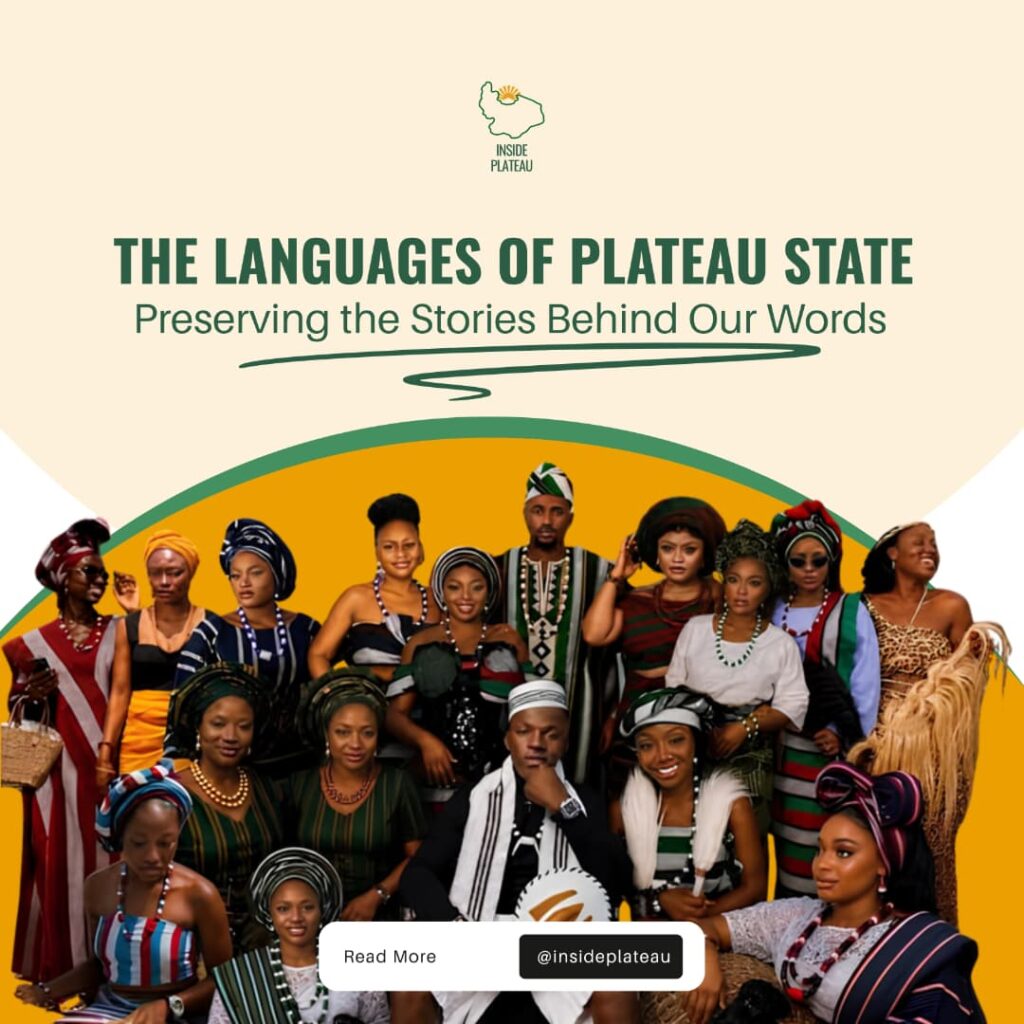
Travel across Plateau State, and you never have to go far to hear a different language. Berom, Afizere, Anaguta, Tarok, Ngas, Mupun, Mwaghavul, Goemai, Kofyar and many more are spoken in communities that have called the Plateau home for generations. With more than 40 ethno-linguistic groups, it is one of Nigeria’s most linguistically diverse states.
That diversity is more than a fun fact. Each language carries a history, a way of describing the land, and words with no neat English equivalent. They hold songs, proverbs, jokes, greetings and stories handed down from one generation to the next.
A State of Many Languages
Geography is part of the story. The languages of Plateau State belong to several language groups, reflecting a long history of communities living side by side. Around Jos and central Plateau, Berom, Afizere and Anaguta are closely tied to the communities that shaped the state capital and its surroundings.
Further south, Tarok is prominent around Langtang and Wase. It belongs to the Tarok branch of the wider Plateau language family and has long served as a lingua franca in parts of southern Plateau. Elsewhere, Ngas, Mupun, Mwaghavul and Goemai add more layers to the patchwork.
The result is not one Plateau language but many distinct voices. Add speakers from other parts of Nigeria, plus Hausa for everyday communication and commerce and English as the official language, and the variety grows even wider. You can walk through Jos, drive into a rural community, cross into another part of the state and hear entirely different traditions within a short distance. That is language diversity in Nigeria at its most vivid.
More Than Words
It is easy to treat language as a tool for communication, but it also shows how a community understands its world. Names of places, foods, plants and natural features carry memories of where people came from and how they lived with their surroundings. Proverbs preserve lessons, songs preserve history, and storytelling keeps family memory alive. Every elder who tells a story in their mother tongue is passing on a whole library. Lose the words, and you lose far more than vocabulary.
That is why indigenous languages in Plateau State are central to the state’s cultural heritage. They are living records of the people who speak them. Yet like many Nigerian indigenous languages, some are used less and less in daily life. Younger people move between their mother tongues, English and Hausa, depending on where they are and who they’re talking to.
That doesn’t mean the languages of Plateau State will vanish tomorrow. But it raises a real question: what do we stand to lose when we let our indigenous languages fade away?
Where Translation Comes In
This is where translation becomes more than swapping words. It can carry stories beyond the people who first told them, letting traditional knowledge, songs and oral histories travel between generations without one language replacing another.
That idea is especially timely on International Translation Day, marked every September 30. On this day, the United Nations highlights the role of language professionals in dialogue, understanding, and safeguarding cultural heritage. For a place as multilingual as Plateau, the message hits close to home.
Language preservation in Nigeria doesn’t mean rejecting English, Hausa or the opportunities that come with them. It means making room for indigenous languages to live alongside them. Technology can help. Digital dictionaries, recorded oral histories, subtitled videos, and translated stories give younger speakers fresh ways to engage with languages they may rarely hear in formal settings. Documenting a language today, even informally, gives tomorrow’s speakers something to build on.
The goal isn’t to freeze these languages in the past. Languages change, borrow and pick up new expressions, and each generation makes them its own. The goal is to make sure they have a future.
Keeping the Voices Alive
The languages of Plateau State reflect the people who speak them. They show that indigenous culture in Plateau State is not uniform but made up of many communities and identities that grew alongside one another.
On International Translation Day, it is worth remembering that translation doesn’t mean leaving one language behind for another. At its best, it builds a bridge, so one person’s words and worldview can be understood by someone else. That, perhaps, is what preserving the languages of Plateau State is really about: making sure future generations don’t lose access to the stories inside those words.
Because when a language survives, more than words survive with it. A way of seeing the world does too.