
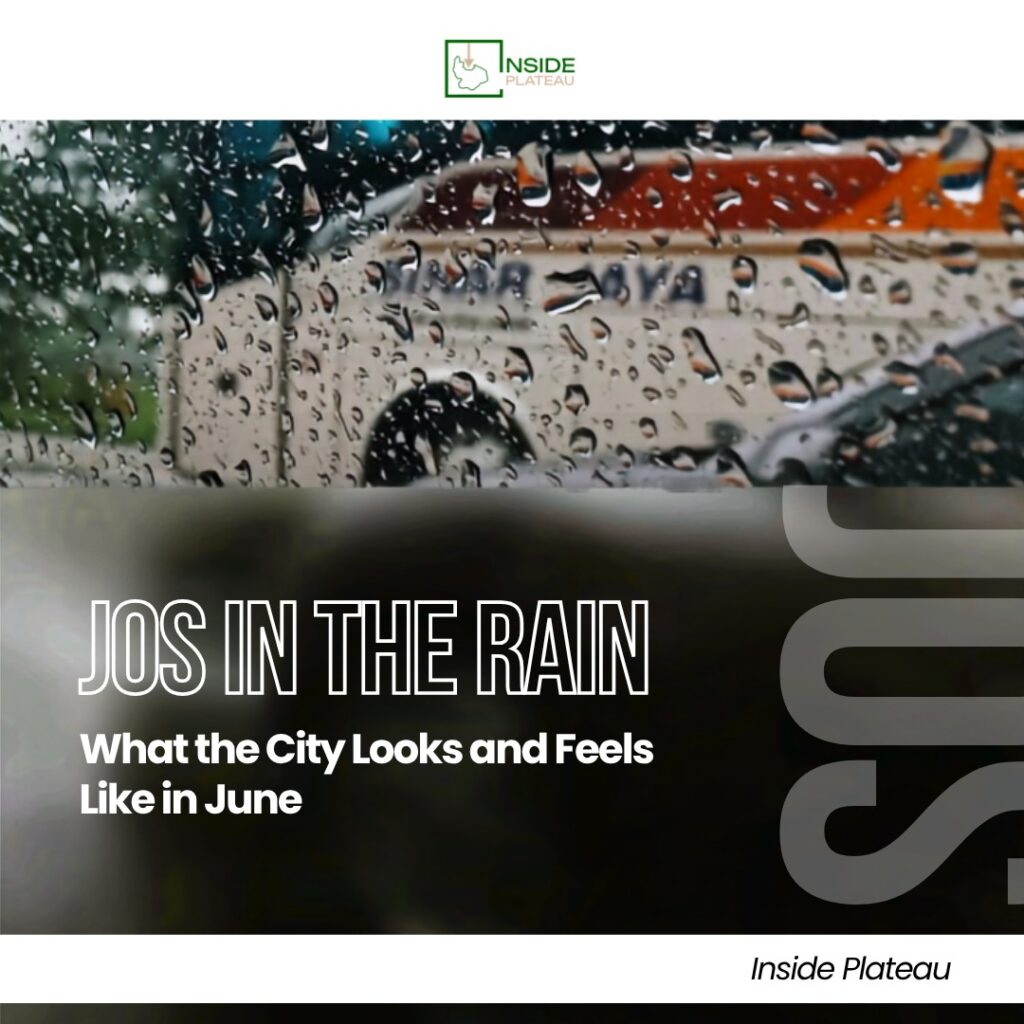
There is a phrase people say in Jos when the rain starts falling. Weather for two. It means the cold has arrived, and you should not be facing it alone. Find your partner, hot tea, or a bowl of masa from the nearest spot. The rain in Jos does not just change the weather. It changes the mood of an entire city.
June is the month that reminds you why Jos is unlike anywhere else in Nigeria.
The city sits at over 1,200 metres above sea level on the Jos Plateau, high enough that the air behaves differently here. While Lagos is sweltering through 31-degree heat and Kano is pushing close to 38 degrees, Jos in June barely touches 28. Nights drop to 18 or 19 degrees. The humidity sits somewhere between 74 and 82 percent, but it does not feel suffocating the way coastal humidity does. It feels like a city permanently wrapped in a cool, invisible blanket. The British colonials who arrived here in the early twentieth century during the tin mining era were so struck by the climate that they nicknamed Jos “Little London.” It was the kind of place that made them feel, briefly, like they were not in the tropics at all.
That reputation has never left.
The Chameleon Weather
The most important thing to understand about Jos in June is that the weather does not warn you properly. It is a chameleon, and it has no loyalty.
Last week, at 4pm, the sky over Jos was bright and clear. Workers finishing the day looked out of their office windows and saw sunshine. By five minutes to five, the sky had turned. Then by 5pm, the rain was falling hard enough that nobody was leaving. And by 7pm, when it finally stopped, the city was dark and people were going home two hours later than they planned.
This is Jos in June. You can wake up to sunshine so generous it almost feels like December harmattan brightness, and be soaked by afternoon. The sky can go from blue to black in the time it takes to decide whether to carry a jacket.
Jos people know this. They have lived it long enough to build it into their daily rituals. Nobody steps out in June without a cardigan, a hoodie, or a jacket, even when the morning sun is doing its best to convince them otherwise. The experienced Jos resident treats every bright morning with quiet suspicion. The sky here has a sense of humour, and it is not always kind.
This is also why you will not find serious outdoor events scheduled in Jos during this period. Not if the organisers know what they are doing. The rain does not negotiate. It does not check your programme. It simply arrives, and when it does, whatever was supposed to happen outside does not happen.
What the Rain Feels Like When It Arrives
For someone experiencing Jos in June for the first time, like a corps member arriving fresh from Lagos, the first encounter with the rain is rarely gentle.
One such experience happened at the Federal Lowcost axis. A group of friends heading out to watch a match were caught midway, the rain starting without ceremony. They found a shade and waited for nearly an hour. By the time it became clear the rain was not stopping, and the night was getting late, they made the decision most Jos people eventually make at least once. They entered the rain, ran, danced, laughed, and caught a cold each the next morning.
That story captures something true about what Jos rain does to people. It is inconvenient, sometimes dramatically so. But it is also oddly joyful. The rain here does not feel hostile. It feels like weather that has character.
Part of that is the sound. In Jos, rain on a zinc roof or in a compound does not sound like punishment. It sounds like a lullaby. Heavy, rhythmic, consistent. The kind of sound that makes your body slow down, your eyes heavy, and your bed feel like the only reasonable place to be. Ask anyone who grew up in Jos why they struggle to sleep in quieter, hotter cities, and they will tell you. They are waiting for a sound that only the Jos rain makes.
The air plays a role too. Before the rain arrives, the atmosphere shifts. The air that is already calm and soothing in Jos — cleaner than Lagos, cooler than Abuja, with none of the dry harshness of Kano — becomes something else entirely. After the rain falls, stepping outside is like walking into a room where someone has set the air conditioning to perfect. Visitors describe it as a natural AC. For Jos residents, it is simply Tuesday.
The City That Comes Alive When It Rains
While some cities slow to a halt when rain falls, Jos does something more interesting. Certain parts of it come alive.
The mai-sayi spots — the roadside tea sellers scattered across the city — become the most important social infrastructure in Jos the moment the sky turns dark. Hot tea, kunun tamba, tom brown, coffee. These spots, which do decent business on ordinary days, become gathering places when the rain falls. People who were heading somewhere stop. They pull their jackets tighter, order a cup, and wait together.
The bars fill up too. There is a widely held belief in Jos that alcohol keeps you warm in the cold, and whether or not the science supports it, the culture certainly does. When it rains in Jos, bars do not lose customers. They gain them. The city retreats indoors, and indoors gets warmer and louder.
Food follows the same logic. Suya, always popular in Jos, becomes even more so when temperatures drop. The smoke and the heat from a suya spot on a rainy evening is practically magnetic. Pepper soup. Noodles. Hot tea and masa. The things being sold and eaten in June Jos are all hot, all comforting, and all suited to weather that demands you take care of yourself. Street food vendors who understand this season know exactly what to cook and when.
Also Read: From Farm to Fortune: Sweet Potatoes (Bokology) Becoming Plateau State’s Most Profitable Tuber
The Kindness the Rain Brings Out
There is something the rain does to people in Jos that is harder to quantify but easy to notice once you have been here long enough.
A corps member new to the city, stepping into a keke on a rainy afternoon, discovered this unexpectedly. The keke driver was supposed to drop her at a junction. Standard route, standard fare. But when the rain started falling properly, the driver did not stop at the junction. He took her all the way to her office gate. No extra charge. No negotiation. Just a quiet decision that the weather was bad and she should not have to walk in it.
That is Jos in June. The cold that makes everyone reach for a jacket also, somehow, makes people reach for each other a little more. Weather for two is not just a phrase about romantic warmth. It is about the small ways a city looks after itself when the sky turns cold.
The Body Remembers
One thing that does not get said enough about Jos weather is what it does to the people who grow up in it. The body adapts. Over years of June mornings and rainy evenings, a Jos person’s internal thermostat recalibrates. What feels cold to a visitor from Lagos feels normal, even pleasant, to someone who has lived here long enough.
Also Read: Chasing the Sunrise: Hiking Trails in Plateau
This is why Jos people often struggle when they move elsewhere. Not because other cities are worse necessarily, but because the body keeps waiting for something it has been trained to expect. The cool air. The lullaby rain. The smell of the plateau after a downpour. These are not just weather conditions. They are part of how a Jos person understands comfort.
The corps member who described the air as “natural AC” was not exaggerating. She arrived from Lagos, where June means heat layered on top of rain layered on top of more heat, and found herself in a city where the rain actually brings relief. Where the cold is the kind you want to sit inside and appreciate rather than escape.
What June Looks Like Here
June is also when Jos becomes visually dramatic in a way that dry season never allows. The hills around the city, Shere Hills, the rock formations at Riyom, the landscape visible from almost every high point in Jos, go from their dry season dusty palette to something that looks almost too green to be in Nigeria. The rains coax out colours. Flowers bloom. The plateau grasses fill in. Waterfalls at Assop and Kurra swell and run stronger.
The city itself looks cleaned. Jos roads, mostly tarred and equipped with reasonably functional drainage, handle the rain better than most Nigerian cities of comparable size. Flooding is not a defining feature of the city centre the way it is in Lagos or parts of Abuja. The plateau’s own geography helps. Water runs off the high ground rather than sitting on it. Local governments in the lower parts of the state, places like Shendam, see more flooding challenges, but the city of Jos moves through its rainy season without the kind of waterlogged chaos that makes June miserable in coastal cities.
An Honest Invitation
If you have never experienced Jos in June, this article cannot fully prepare you. Some things require presence. The specific weight of the cold at 6am when the rain fell all night. The way a cup of hot tea tastes when the temperature outside is 19 degrees and you are watching the plateau mist roll in over the hills. The sound of the city going quiet under heavy rain, then slowly filling back up with voices and music from the bars and the mai-sayi spots as it eases off.
What it can tell you is this. Jos in June is not Jos in spite of the rain. It is Jos because of it. The weather shapes the food, the social culture, the architecture of daily life, the kindness of strangers in kekes, the phrases people say when they look at the sky. It is a city that has made peace with being rained on, and found, in that peace, a version of itself that is warmer than the temperature suggests.
Come with a jacket. Come with an appetite. And if you can, come with someone. The weather will take care of the rest.
Also Read: https://www.accuweather.com/en/ng/jos/255089/weather-forecast/255089