
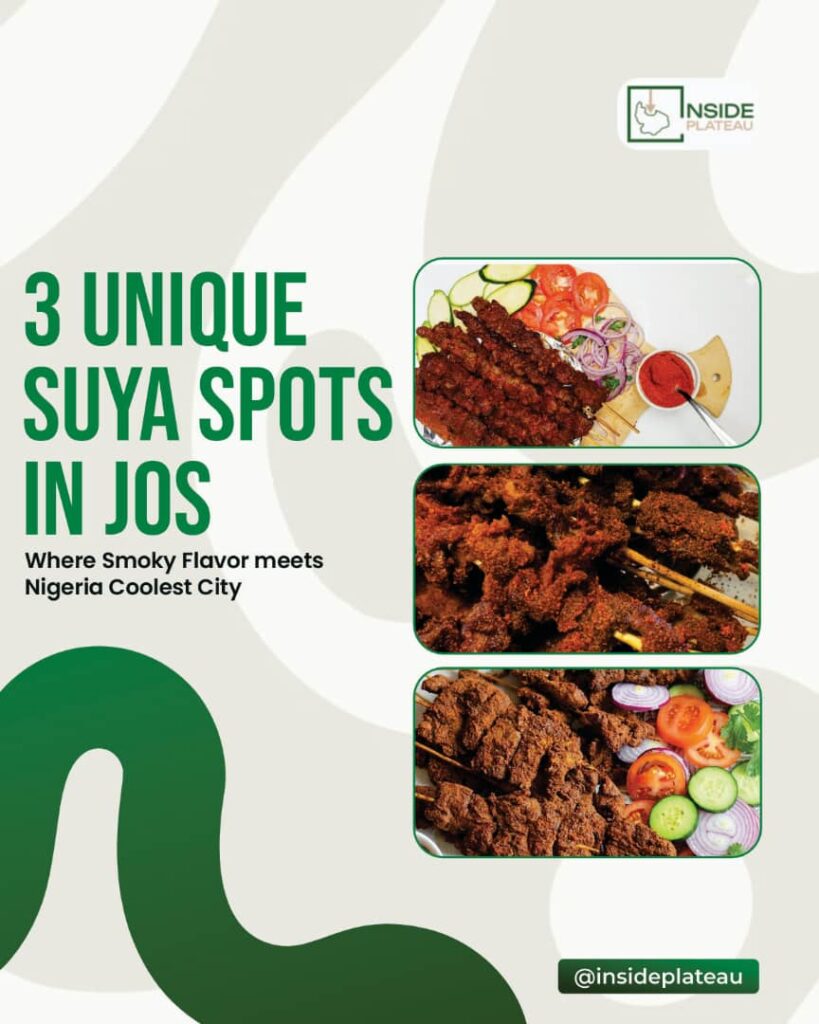
There’s something about suya nights in Jos that feels different from anywhere else in Nigeria. Perhaps it’s the Plateau chill that descends after sunset, turning every outdoor meal into a communion between hot meat and cold air. Perhaps it’s the way smoke curls upward from glowing charcoal grills, thicker and more visible in the cool evening atmosphere. Or perhaps it’s simply that in Jos, suya has evolved beyond street food into a form of social architecture—the scaffolding around which friendships are built and nights are remembered.
You’ll smell it before you see it. That distinctive aroma of charred meat, ground peanuts, and ginger threading through the evening air always arrives first. Then you’ll spot the orange glow of charcoal, the silhouette of a mallam turning skewers with practiced precision, and the small crowd gathered in that universal posture of waiting—hands in pockets, conversations flowing, breathe visible in the cold.
Ask anyone who has spent real time in Jos, and they’ll tell you the same truth: this city takes its suya seriously. From Terminus to British America, from Dadin Kowa to the streets around Old Airport Junction, Jos is dotted with legendary grills where mallams have spent decades perfecting the balance between spice, smoke, and timing. Everyone has their favorite spot, and those loyalties run deep. The debate over which serves the best suya in the city is as endless as it is passionate.
If you want to understand Jos through its food culture, these three spots offer the perfect introduction.
Why Suya Tastes Different in Jos
Before we talk about where to eat, it’s worth understanding why suya in Jos occupies its own category.
Jos sits at an elevation that gives it Nigeria’s most temperate climate. While Lagos and Port Harcourt swelter through humid nights, Jos cools down as darkness falls. By 8 p.m., you might need a light jacket. By 10 p.m., your breath fogs in the air.
This weather transforms the entire experience of eating roadside grilled meat. The cold sharpens every sensation: the heat radiating from the grill feels more intense, the smoke carries farther and smells richer, and that first bite of hot, spice-crusted beef against the night chill creates a contrast that stays with you. Hot suya, cold air, fresh onions, extra yaji, and good company—it’s a formula that works nowhere else quite like it does here.
The city’s cultural makeup matters too. Jos has long been a melting pot where northern grilling traditions meet Plateau ingredients and middle-belt hospitality. The result is a suya culture that feels both rooted and cosmopolitan, where taxi drivers and businessmen stand side by side at the same grill, where corps members and politicians wait with equal patience for their orders.
In Jos, some of the city’s most important conversations happen beside a suya stand.
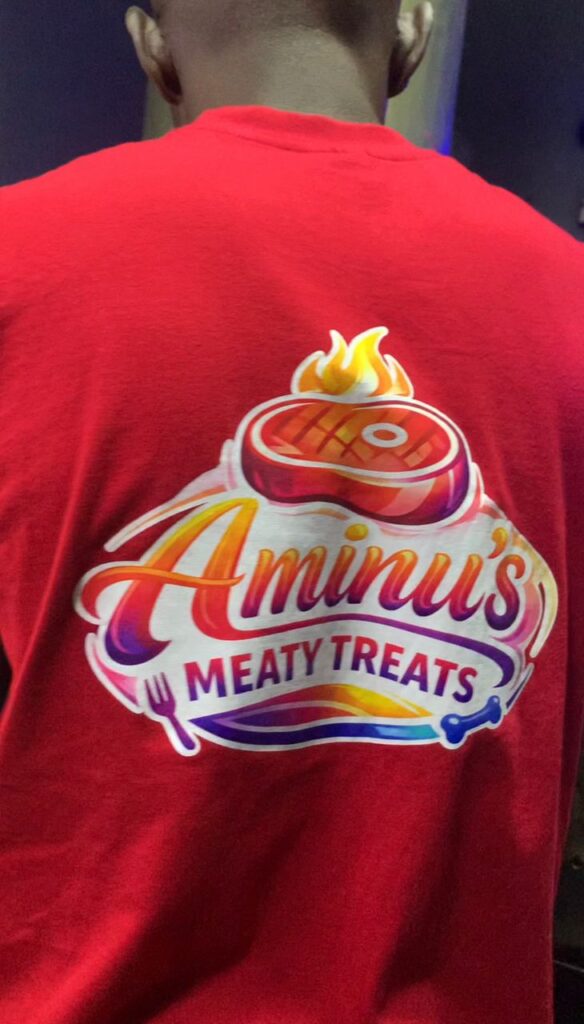
Aminu’s Meaty Treats: Suya Spot WherePrecision Builds Loyalty
Location: Off Murtala Mohammed Way, near Terminus.
Hours: 1:00 PM – Midnight daily.
Specialty: Beef suya, marinated for depth.
Price range: ₦2,000 and above per serving.
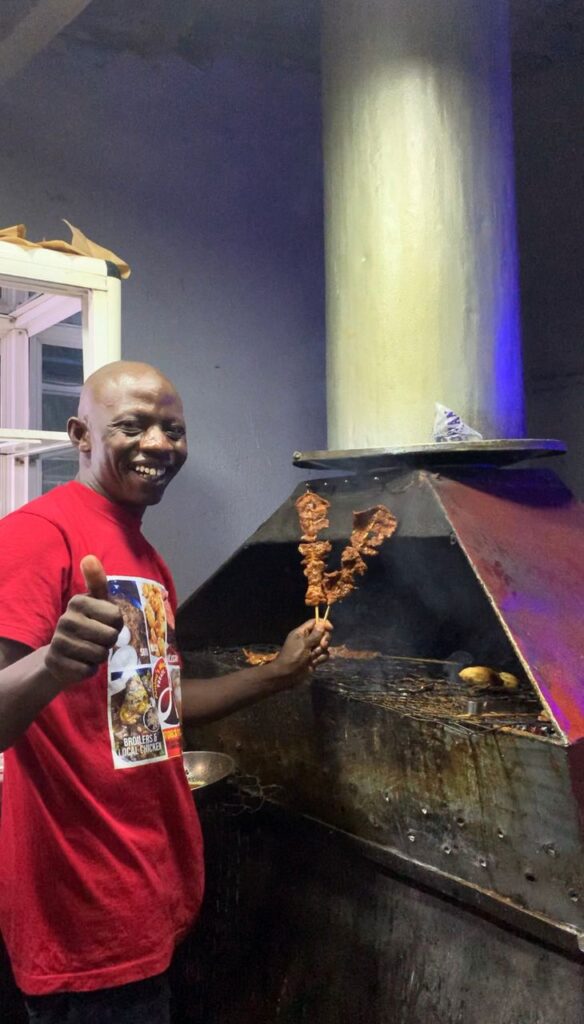
When David Makut returned to Jos after six years in Abuja, one of his first stops was Aminu’s Meaty Treats. “I tried other places in Abuja,” he told me on a Tuesday evening, waiting for his regular order of beef suya with extra yaji. “But nothing tasted right. The spice sat on top instead of going through. Here, Aminu actually lets the meat sit in the yaji mixture before grilling. You can taste the difference in the first bite.”
Also Read: Plateau Potatoes: A Taste of Home, Pride, and Prosperity
That attention to preparation is what sets Aminu’s suya spot apart. While many suya spots season meat as they grill, Aminu Ibrahim—who has been running this spot for over twelve years—insists on marinating his beef for at least two hours before it touches the charcoal. “Suya is not just about the fire,” he explained, adjusting a row of skewers over the glowing coals. “The spice must enter the meat, not just cover it.”
The result is suya with remarkable flavor depth. The yaji—a blend of ground peanuts, ginger, garlic, pepper, and Aminu’s undisclosed additions—penetrates the beef. He does it so thoroughly that even the center tastes seasoned. The exterior develops a nutty, peppery crust that crackles slightly when you bite into it. But the interior remains tender and surprisingly juicy for meat cooked over open flame.
Aminu’s location helps. Set back slightly from Murtala Mohammed Way, the spot has enough space for customers to park and linger. By 7 p.m. on any given evening, you’ll find a mix of regulars: the banker who stops by every Thursday, the group of NYSC corps members who pool their allowance for a shared feast, the older couple who have been coming here since Aminu first set up his grill.
“Consistency,” said Jennifer Gyang, a lecturer at the University of Jos who brings visitors here as part of their unofficial city tour. “That’s why we keep coming back. Aminu doesn’t experiment. He knows what works, and he delivers it the same way every single time.”
The spot opens at 1 p.m., but serious business doesn’t start until evening. Around 6 p.m., when the temperature begins its nightly descent and office workers finish for the day, the real crowd arrives. By 9 p.m., on weekends especially, you might wait fifteen minutes for your order—not because service is slow, but because demand is high.
Watching Aminu at his suya spot work is like watching a chef who has internalized his craft. He doesn’t measure the yaji; his hands know the proportions. He doesn’t time the grilling; he reads the meat by sight and scent, knowing exactly when to turn each skewer, when to move it to a cooler part of the grill, when it’s done. That kind of precision comes from repetition, from grilling thousands of orders until the process becomes instinct.
Auwal Suya Spot: Bold Flavours, Bolder Following
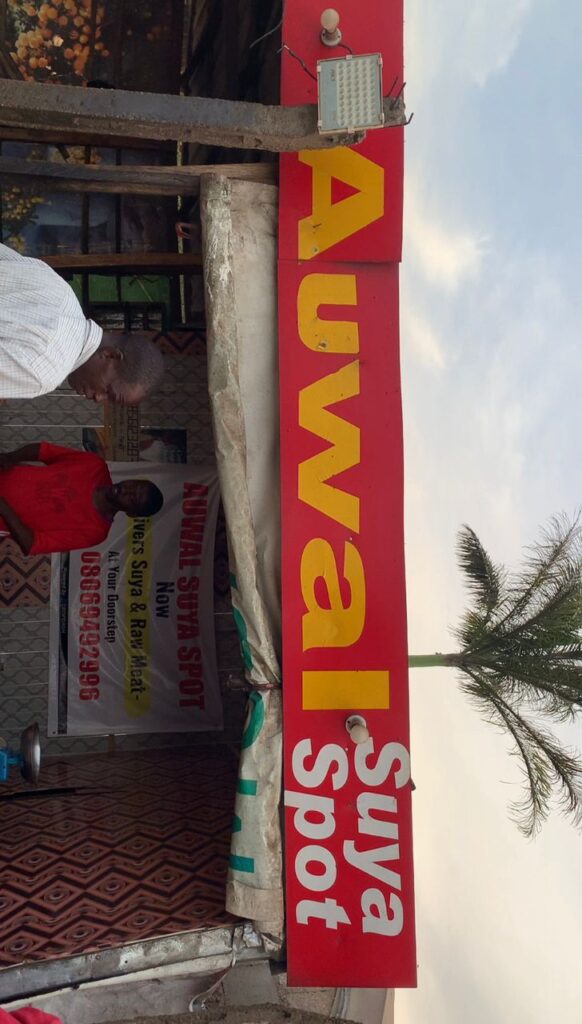
Location: Near Old Airport Junction
Hours: 1:00 PM – 11:30 PM daily
Specialty: Northern-style spice blend, heavily seasoned
Price range: ₦1,500 and above
Auwal Suleiman doesn’t apologize for his spice levels.
Also Read: Farm Fresh: Plateau’s Ultimate Green Market Hub
“If you want mild suya, there are other places,” he said with a slight smile, sprinkling another generous handful of yaji over a fresh batch of grilled beef. “My customers come here because they know what they’re getting: real northern flavor, the way it’s supposed to taste.”
And his customers—a fiercely loyal group—wouldn’t have it any other way.
Fatima Abubakar, a nurse at Jos University Teaching Hospital, discovered Auwal’s spot three years ago when a colleague insisted on stopping there after a night shift. “I’m from Kano originally,” she explained, “and most suya in Jos tastes… adjusted. Softened for people who aren’t used to it. Here, it actually reminds me of home. The yaji has that proper bite—the kind that makes your eyes water a bit but keeps you reaching for more.”
What distinguishes Auwal’s approach is his commitment to a particular northern Nigerian grilling tradition, specifically the Hausa style that prioritizes bold, forward spice over subtle complexity. His yaji blend features more ground calabash seeds and kanafuru (a type of pepper) than typical Jos suya, creating a heat that arrives quickly but doesn’t linger painfully. Behind that initial punch, you’ll detect the earthiness of peanuts, the warmth of ginger, and a slight smokiness that doesn’t come from the charcoal alone—Auwal adds a small amount of smoked paprika to his blend, something he learned from his father, who grilled in Kaduna for thirty years.
The meat quality at this suya spot stands out too. Auwal sources his beef from specific suppliers in Bukuru, selecting cuts from the shoulder and chuck—parts with enough intramuscular fat to stay moist over high heat. When properly grilled, these cuts develop crispy, caramelized edges while retaining enough tenderness to chew easily.
His setup is beautifully no-nonsense: three large grills arranged in a U-shape, a cutting board that has been worn smooth by years of use, plastic chairs scattered in a rough semicircle around the operation. There’s no formal seating area, no decorative elements. The suya itself is the only decoration needed.
“Watch who comes here,” suggested Ibrahim Danjuma, a taxi driver who considers himself an unofficial guardian of Auwal’s reputation. “You’ll see people from all over Jos. But you’ll also see people who drove from Bukuru, from Vom, even from Shendam—just for this suya. Nobody drives that far for average meat.”
On a Saturday night around 10 p.m., just before closing, the crowd reaches its peak: friends meeting up after church programs, couples stopping by on their way home from dinner elsewhere, groups of young men who pile out of cars with loud laughter and easy camaraderie. The cold hits harder at this hour, making the heat from Auwal’s grills feel like a physical presence you can stand close to.
Auwal himself works with an economy of movement that suggests deep familiarity. He doesn’t speak much while grilling—his focus stays on the meat, on maintaining the perfect distance between flame and skewer, on rotating and flipping at precise intervals. But when he hands you your order, wrapped in yesterday’s newspaper (a tradition he refuses to abandon for foil), there’s a brief moment of eye contact that carries a simple message: This is what I know how to do, and I did it right.
King’s Bite Suya Spot, British America: Where Night Life Meets Great Taste
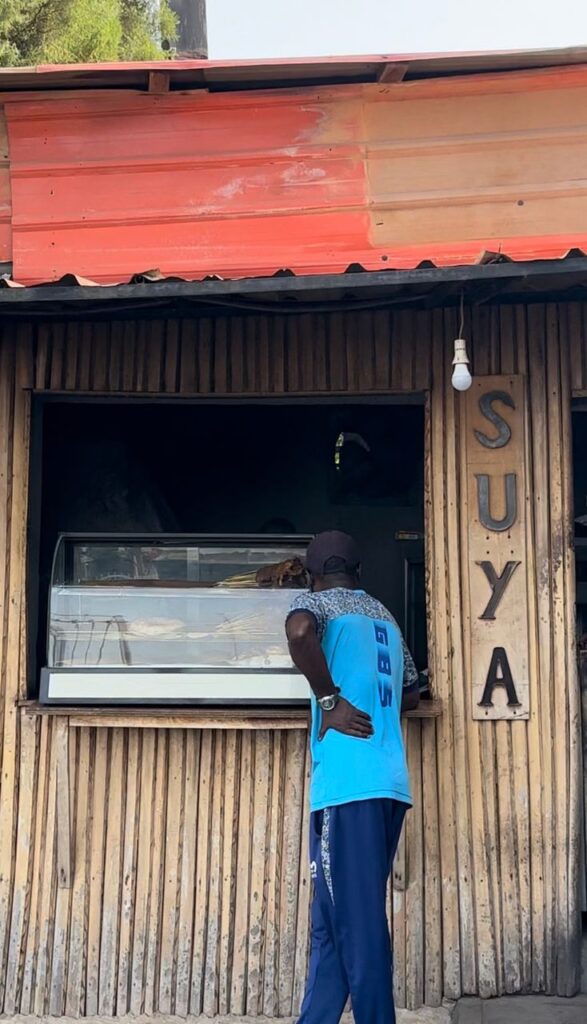
Location: British America junction, near Lamingo Road.
Hours: 1:00 PM – Midnight (1:00 AM on Fridays and Saturdays).
Specialty: Social atmosphere, younger crowd, consistently good quality.
Price range: ₦2,000 – ₦6,000 per serving.
British America comes alive after dark. This neighborhood—named for a long-gone expatriate company—has evolved into one of Jos’s primary nightlife corridors, dense with bars, lounges, and late-night eateries. And right at the junction where most of this activity converges, you’ll find King’s Bite Suya.
The suya spot opened five years ago, making it relatively young compared to Jos’s established suya institutions. But in that short time, it has carved out a distinct identity: the place where social eating meets quality grilling, where suya becomes part of a larger night out rather than the destination itself.
“We usually start somewhere else,”. Explained Chidinma Okafor, a 28-year-old graphic designer who visits King’s Bite at least twice a week. “Maybe drinks at Royal Lemon, maybe a birthday thing at one of the lounges. But we always end here. It’s become the ritual—you haven’t properly finished the night until you’ve stopped at King’s Bite.”
What Sets King’s Bite Apart?
The owner, whose nickname “King” predates the business, understood this pattern when he chose the location. “I knew I didn’t want to compete with the old mallams on pure suya tradition,”. He said, while flipping a row of skewers with practiced ease. “What I could offer was atmosphere. A clean space, good lighting, a place where groups can hang out without feeling rushed. The suya had to be excellent—that’s non-negotiable—but it also had to be part of a whole experience.”
And the suya is excellent. King uses a spice blend that leans slightly less aggressive than traditional northern recipes. He makes it accessible to Jos’s diverse crowd while still delivering the smoky, nutty, peppery flavors that define good suya. The meat tends toward the tender side. It also has less char and more even grilling than you might find at older, more traditional spots. Some purists might call this a compromise; King’s regular customers call it perfect.
The texture hits a sweet spot: crusty enough to provide that satisfying first crunch. It is soft enough that you’re not working to chew through it. And King’s Bite has added a few subtle touches. Including a light brush of vegetable oil on the meat just before it comes off the grill, giving it a slight sheen and helping the final dusting of yaji adhere more evenly.
What really sets King’s Bite suya spot apart, though, is the social ecosystem that has grown around it. Unlike spots where you grab your order and leave, King’s has become a destination in itself. There are benches and tables under an awning, proper lighting that makes the area feel safer late at night, even a small refrigerator where King stocks cold drinks—not just the standard Coke and Fanta, but also water, energy drinks, and Chapman (a fruity punch he mixes fresh).
Testimonies
Michael Gyang, a painter, considers King’s Bite his unofficial office. “I’ve gotten more clients here eating suya than I have anywhere else,”. He laughed, his breath fogging in the 11 p.m. cold. “There’s something about this spot—people relax here, they open up. I’ve had gigs, even met my girlfriend here six months ago. She was with her friends, I was also with my guys. Someone knew someone, and next thing we’re all sharing meat and talking.”
That last hour before closing has a particular energy. The serious partiers have already moved on to wherever they’re ending their nights. They leave behind a more mellow crowd. I mean, couples taking a final break before heading home, friends having those late-night conversations that feel more honest in the cold, solo visitors like Blessing Dung, and night-shift security guards.
“I work 10 p.m. to 6 a.m. at a hotel nearby,” Blessing explained. “This is my dinner spot. King knows my order by now—one portion beef, light on the pepper, extra onions. We usually talk for a few minutes about football, about family. It’s the best part of my shift, honestly. Reminds me there’s life happening outside those hotel gates.”
More Than Meat: What Suya Reveals About Jos
Jos is a city that sometimes struggles with external narratives—headlines about conflict, about religious tension, about divisions. But when you stand beside a suya grill on any given night, you’ll see something else entirely. You’ll see a city of people who share space gracefully and gather around common pleasures. And people who have built small rituals of community around something as simple as grilled meat.
You’ll see Christian and Muslim customers chatting at a suya spot while they wait. You can also see Plateau indigenes and other settlers arguing passionately about football, not religion. You can also see university students and civil servants, rich and poor, all participating in the same cultural moment.
The mallams who run these suya spots: Aminu, Auwal, and their likes—aren’t just cooking food. They’re maintaining gathering spaces, creating nightly opportunities for Jos to be at its best. We may be of diverse ethnicity, but we are united by the understanding that some experiences transcend difference.
Great suya requires patience. The charcoal must burn down to the right heat, not too fierce, not too faded. The meat must be cut properly, against the grain. The spice must be applied with judgment, enough to flavor but not to overwhelm. And the grilling itself cannot be rushed. Each skewer needs its time, its rotation, its moment to become exactly what it should be.
In a sense, that’s Jos too: a city that requires patience to understand, reveals itself slowly. The city offers its best experiences to those willing to stay past sunset. And those who can stand in the cold, while smoke rises and conversations flow and the night settles into its most memorable hours.
The suya, when it finally arrives, is worth the wait. Always.