
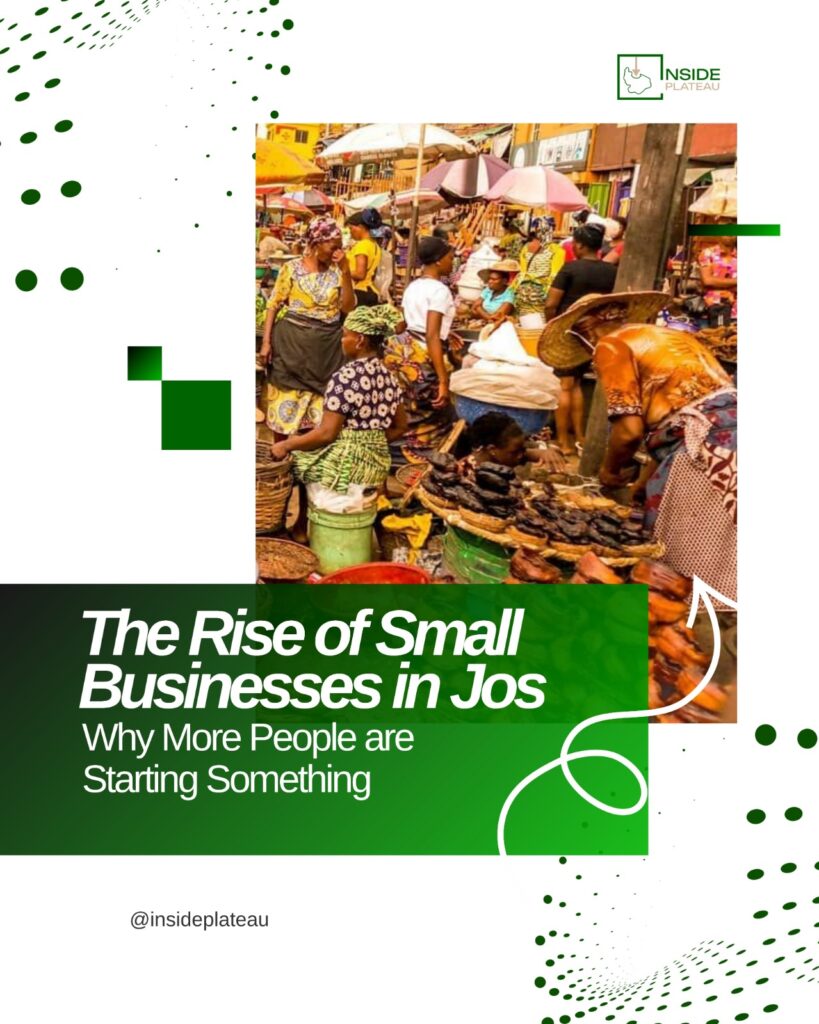
In Jos, “something small” is becoming everything. It doesn’t announce itself loudly or demand attention all at once, but it shows up in quiet, persistent ways: in the smell of freshly baked pastries wafting from a student’s room late at night, in neatly packaged thrift items shared on a WhatsApp status, in the steady hands of someone learning a craft one careful step at a time… These are not grand businesses—not yet, at least—but they are everywhere, quietly taking root in the background of everyday life.
It becomes even more apparent in the little details people often overlook like the increase in “order now” posts; the subtle reintroduction of yourself as someone who now offers a service; the shift from casual hobbies to structured pricing lists. Slowly, almost imperceptibly, everyday skills are being reframed as something of value.
This is no longer just about side hustles or extra income. It is something deeper and more deliberate. Because across Jos, people are finding ways to build with what they have and from where they are; not always out of comfort, and not always with certainty, but with a kind of determination that turns small efforts into something meaningful. What used to be considered as “just something on the side” is now, for many, a necessary extension of survival, creativity, and ambition.
ALSO READ: Side Hustle Plateau: Inside Jos’ 5–10 Evening Economy
When Something Small Finds Its Feet: The Story of Baked’Eat
“I didn’t really start thinking of it as a business,” Victoria said. “I just loved food. I grew up in a home where both my parents loved to cook, so I picked it up from them. I would take what I baked to class, let people try it, and then convince them to buy.”
There’s something familiar in that: the quiet courage of showing up with something you made, unsure of the outcome, but willing to try anyway. No storefront, no strategy, just effort and consistency. In those early days, growth came from proximity. Classmates became customers, the word spread, until slowly, what began as trial started to take shape.
“From the reviews I got, I realized it was actually different… like an upgrade from what people were used to.”
It was this realization that marked a turning point for Victoria’s business. Because at some point, it stops being about trying something out and starts becoming something worth building. Then came the shift, and with that, everything changed. She no longer had to rely on physically moving products around. The internet began to carry her work further than she could.
“I started taking content creation seriously,” she explained. “ I was posting more… and I began to get referrals. Orders started coming from TikTok, from WhatsApp, from people I didn’t even know.”
Somewhere within that process, her perspective began to shift.
“I started to realize this is something I actually want to build… not just for now, but something that can last,” she shared.
That realization led to action. By the end of 2025, she had formally registered the business; taking a step toward structure, protection, and long-term growth. At the same time, she also began investing in her personal and professional growth. It was a quiet but important transition from doing something out of passion to doing it with intention.
“As my business grew, I realized that the key to sustaining that growth and achieving my dreams of becoming an international brand is to become more professional and sell world-class quality. So, I’ve been taking trainings and going for exhibitions. I saw things I was doing wrong… and things I could improve on. And as I continue to improve, I believe that Baked’Eat can be more; like a chain of bakeries, even restaurants… especially if we stop playing small.”
Because in the end, Baked’Eat did not begin as a big dream. It started small but somewhere along the way, that “something small” became something worth growing. In that, her story reflects what is happening across Jos: people may not always start with big visions, but as they stay with it long enough, they are growing into them.
When “Extra” Income Becomes Essential
Beneath this visible rise lies a quieter truth: for many, starting something is no longer optional. The cost of living continues to stretch incomes thin, and traditional sources of earning—whether allowances, salaries, or sporadic support—no longer carry the same weight they once did. What used to be “enough” now feels incomplete.
In response, people are not simply waiting for better conditions. They are adjusting. Students who once relied solely on pocket money are learning to generate their own. Young professionals are supplementing their salaries. Even those with stable income streams are finding reasons to diversify.
But this response is not purely reactive. It is also creative. Faced with constraints, people are beginning to look inward at what they can do, what they can learn, and what they can offer. The result is a growing culture where income is not tied to a single source, but built from multiple small, intentional efforts.
The Rise of the Everyday Entrepreneur
What is particularly striking about this movement is who is driving it. These are not always trained business owners or individuals with formal entrepreneurial backgrounds. They are students, graduates, workers, people navigating everyday life while building something on the side.
They do not wait for perfect conditions, and they rarely begin with elaborate plans. Instead, they start with what is within reach. A baking skill becomes a small food business. A talent for styling hair becomes a service offered within a hostel or neighborhood. An understanding of social media turns into managing pages for brands.
In this space, entrepreneurship is no longer defined by scale or structure, but by initiative. It is less about having a business in the traditional sense, and more about recognizing that what you know, or what you are willing to learn can be exchanged for value.
The Invisible System Making It Work
What makes this ecosystem even more fascinating is how it sustains itself. Much of it operates outside formal structures, yet it is highly functional.
Digital platforms play a central role. WhatsApp has become a marketplace, a catalogue, and a communication channel all at once. Instagram serves as a storefront, where presentation and consistency can attract steady patronage.
Beyond technology, there is the power of proximity. Friends support friends. Classmates become customers. Word-of-mouth travels quickly within tight-knit communities. In many cases, trust is built not through branding, but through familiarity and shared experience.
This informal system allows businesses to start quickly, adapt easily, and grow organically, often without the barriers that traditionally accompany starting a business.
ALSO READ: What Visitors Notice About Jos That Plateau Residents Don’t
A New Way of Thinking About Work
What is unfolding in Jos goes beyond economics. It reflects a shift in how people think about work, value, and opportunity.
Apparently, there is a growing understanding that income does not have to come from a single, predefined path. That skills, no matter how simple they may seem, can be developed, refined, and monetized. That starting small is not a sign of limitation, but a practical and often powerful beginning.
In this emerging mindset, waiting is being replaced with action. Hesitation is giving way to experimentation. And gradually, a culture of self-driven effort is taking root.
But this shift requires a change in perspective. It means taking small ventures seriously; treating them not just as temporary fixes, but as foundations that can be built upon. It means learning, improving, and thinking beyond the present moment.
It also calls for support, both from within communities and from broader systems that can help these small efforts grow into sustainable enterprises.
Where Something Small Begins
In Jos, the rise of small businesses is not loud or dramatic. It does not unfold in headlines or sweeping announcements. Instead, it exists in everyday moments: in effort, in adaptation, and in the quiet decision to try.
What looks like a collection of small, scattered ventures is, in reality, something much more connected. It is people responding to their environment with creativity and resolve. It is a reimagining of what is possible, even within constraints. And perhaps most importantly, it is a reminder that beginnings do not have to be big to matter. Because in Jos today, what seems small is already becoming something more, and for many, it is becoming everything.