
Five years ago, when Mercy Kolawole moved to Jos to begin her medical studies at the University of Jos, finding a place to live felt like a test of endurance. For days, she moved from one “referee” to another, inspecting cramped self-contains and uninspiring single rooms tucked inside crowded compounds. Nothing quite fit. They were all either too small, too uncomfortable, or simply not worth the price.
Then, she found it. It wasn’t perfect as there was no private kitchen, no personal bathroom… But the room was large—large enough to breathe, to cook, to live. The wardrobe was almost walk-in; the compound, though shared by over 20 tenants, had a reliable well that never ran dry; and electricity came straight from the pole, with bills shared among residents. But the best part of this place was the rent. It cost her just ₦30,000 a year.
For someone who had spent most of her life in Lagos—where that kind of space could easily cost five times as much—it felt almost unreal. Like she had stumbled into a housing loophole. But Jos, as Mercy would soon learn, does not stay the same forever.
The following year, her rent jumped to ₦50,000, then ₦80,000, and now, her landlord is already hinting at another increase; this time tied to planned upgrades in the compound.
But Mercy’s story is no longer unusual. It is, in many ways, a quiet signal of something bigger; a trend that was rapidly sweeping through the metropolis: Jos real estate is waking up.
From “Good Enough” to “Well-Designed”
For a long time, housing in Jos followed a simple philosophy: if it works, it works. In this way, a decent room, a functioning toilet, and a reliable water source were simply enough. Summatively, comfort was defined by availability, not necessarily by design, and for many residents, it made sense. And because life was simpler, expectations were modest, and housing reflected that rhythm.
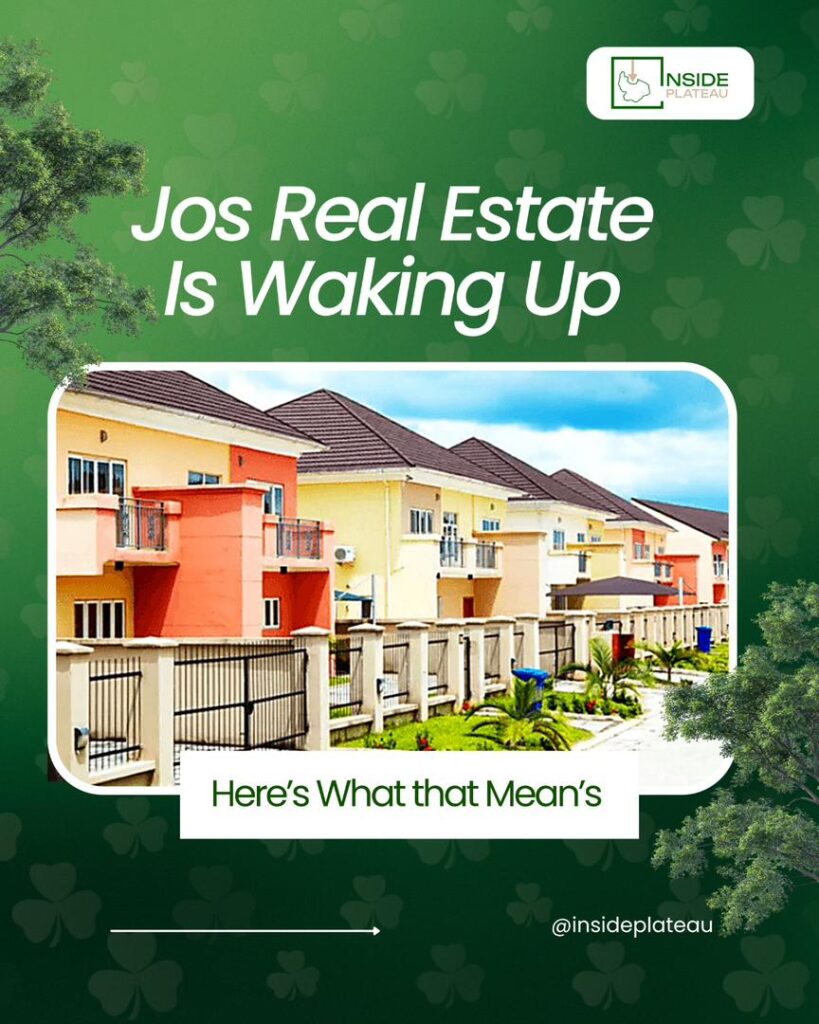
But, when you step into a newly built home in Jos today, you’ll notice a quiet revolution. Floors are no longer just cement; they are fully tiled, polished, and deliberate. Ceilings have evolved from basic boards to POP finishes. Bathrooms now come fitted with water heaters (a thoughtful response to Jos’ signature cold mornings) as well as bathtubs, showers, WC toilets, sinks and faucets. Kitchens are no longer improvised corners but defined spaces with cabinets and running water. Even compounds have changed as wells are being converted into borehole systems, pushing water directly into rooms instead of requiring tenants to fetch it manually.
What used to be considered luxury is steadily becoming standard, and with every added layer of comfort, the market adjusts accordingly.
The Price Tells a Story
If you want to understand just how much has changed, you don’t need a report; you just need to look at the listings. A few years ago, a modest three-bedroom property in Jos could go for around ₦5 million. Today, similar listings comfortably sit at ₦20 million and above. In some prime locations, prices stretch even further, with luxury homes reaching into the hundreds of millions.
Similarly, rental values tell an equally striking story. Self-contained apartments that once felt affordable at around ₦30,000 to ₦100,000 now command ₦300,000 and beyond. In the same vein, one-bedroom apartments in developing areas are approaching ₦250,000, and in high-demand neighborhoods like Rayfield, short-let apartments are quietly redefining the market, fetching as much as ₦90,000 per night.
At first glance, it feels sudden—almost abrupt. But a closer look reveals that these numbers are not random spikes, but signals. Signals of a city being revalued in real time.
The Outsider Effect
One of the most subtle, yet powerful force behind this shift is movement; people are moving into Jos from everywhere. From Abuja, Lagos, and many other parts of Nigeria and beyond, visitors and migrants come with different housing experiences and different expectations of what a comfortable home should look like. And perhaps most importantly, different spending power.
To someone arriving from a more expensive city, a ₦400,000 apartment in Jos may still feel like a bargain, whereas to a long-time resident, that same price might feel like a stretch. This difference in perspective is quietly reshaping the market, because real estate does not just respond to location but to who is willing to pay. And as more people arrive with the capacity to pay more, the market begins to tilt in that direction. Not aggressively, nor all at once, but steadily enough to be felt.
The Rise of the Middle Layer
Alongside this shift is another noticeable change: the growing role of agents and agencies.
There was a time when finding a house in Jos meant following “To Let” signs, knocking on gates, and speaking directly with landlords. The process was informal, sometimes tedious, but straightforward. Today, that experience has evolved. Agents now serve as the bridge between landlords and tenants. They coordinate inspections, advise on pricing, and manage transactions. In many cases, they are the first point of contact, not the landlord.
Consequently, this has introduced new layers to the cost of renting: agency fees, legal fees, and inspection fees. For many, it feels like an added burden and in some cases, it is. But, it is also part of a broader shift; one which consists of the structuring of a market that is becoming more organized, more competitive, and more responsive to demand.
In other words, Jos real estate is no longer just happening. It is being managed.
Where You Live Now Matters More Than Ever
But, what is luxury housing without a secure location? Perhaps this is why the most striking change is how sharply location now defines value. Listings have revealed that demand is increasingly concentrated in areas that offer: better road access, reliable electricity, perceived security, as well as proximity to key parts of the city.
These high demand places include Millionaires Quarters, Rayfield, Gold and Base, Rantya and parts of Jos South where interest has intensified not just because they exist, but because of what they offer.
At the same time, new areas are rising into relevance as well. Locations like Lamingo Kwang, Heipang, and expanding corridors along the Airport Road are now being reimagined as investment frontiers.
To this effect, estate developers and observers agree that one of the reasons behind these prevalent trends is that as the city grows, so does its map of opportunity, and in a waking market, where you buy or rent can matter just as much as what you buy or rent.
Not Just Growth, But Direction
What makes this moment in Jos particularly interesting is that it is not just about growth as it is about direction. The market is not expanding randomly but leaning toward structured housing, serviced environments, and lifestyle-oriented living.
Similarly, short-let apartments are emerging in response to visitors and short-term stays; gated compounds are also rising in response to security preferences; and fully serviced homes are becoming more common as convenience becomes a priority. All these combined indicate a city adjusting itself to meet a new kind of demand.
So, What Does This Mean for Residents?
For residents, the shift brings both challenge and clarity. Yes, housing now requires more financial planning as affordability is changing. But it also opens up new ways of thinking about space and value.
By understanding new market trends, residents are exposed to the more practical advantage of early access. Furthermore, expectations around comfort and quality are being redefined.
In many ways, navigating housing in Jos today requires more awareness than it did five years ago. But with that awareness comes possibility.
And for Those Looking In
For outsiders—investors, developers, or even future residents—the message is unmistakable: Jos is no longer just “affordable.” It is becoming intentional and attentive to foreign needs.
Hence, there is visible demand for modern residential developments, short-let accommodations, and secure, well-serviced estates. And perhaps, most importantly, there is still room to grow, because while the city is waking up, it is not yet fully awake.
A City in Transition
Mercy’s story, in hindsight, was never just about rent increases. It was about timing. She arrived in Jos at a moment when the city was still quietly affordable; just before the shift became visible, before the upgrades became standard, before the market began to stretch.
Today, that same city is in transition. Jos is not losing its identity, but expanding it, neither is she abandoning affordability; she is merely redefining it.
The Meaning Behind the Movement
It is easy to look at rising prices and see only pressure. But sometimes, beneath that pressure lies something deeper: recognition. Through her real estate, Jos is recognition that the city has value, that its spaces can evolve, and that it can attract, adapt, and grow.
Jos is not just becoming more expensive, she is becoming more aware of what she has to offer. And in that awareness lies the real story: Jos is waking up and this is what it looks like.