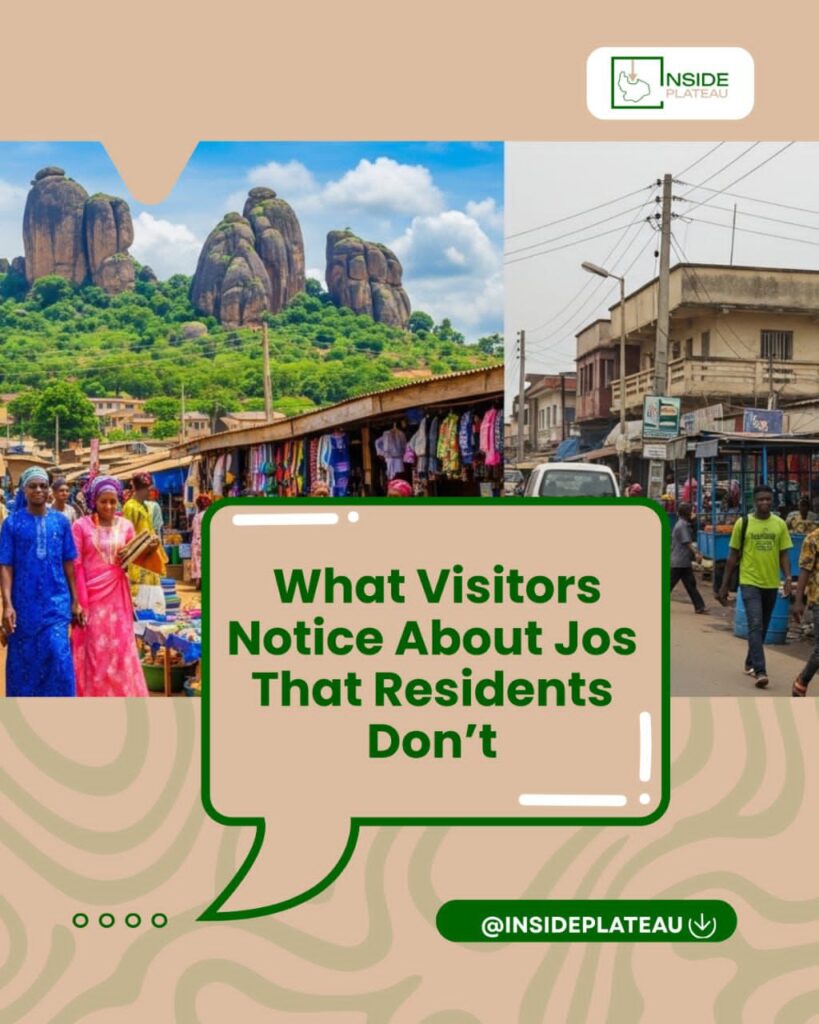
Plateau State, Nigeria, is a place that often feels like a hidden sanctuary. If you live in Jos or anywhere on the Plateau, you know this instinctively: the air is cleaner, the pace is gentler, and the sense of community is deep-rooted. Yet, as many visitors discover, the beauty of Jos isn’t just in what is but in what could be. They arrive, experience the charm, and ask a question that Plateau residents themselves often overlook: why isn’t this potential fully realized?
The State’s First Impression
Visitors to Jos are often struck by the air. At over 1,200 meters above sea level, Jos sits on the cool, rolling expanse of Plateau State. Unsurprisingly, the Nigerian Meteorological Agency (NiMet) consistently lists Jos among the most temperate urban areas in the country. The fresh and unpolluted air is not just a luxury; it is a daily advantage. Yet for residents, this is life as usual; it is so familiar that it fades into the background. Visitors, by contrast, marvel at how the crisp air revitalizes them, how it allows them to breathe easier, and how the calm pace of life makes every moment feel more spacious.
This calm is no accident. The streets of Jos are quieter in comparison to that of its contemporaries, and its neighborhoods more pedestrian-friendly. It is this hospitality which visitors also feel instantly that carves the hallmark of the Plateau life.
The Untapped Potential
While visitors savor the charm of Jos, they also notice a subtle paradox: the abundance beneath their feet is still largely untapped. Plateau’s mining history runs deep as the state’s capital was once the epicenter of Nigeria’s tin boom. And even today, Jos’s mines still buzz with activity.
Yet, the value chain is broken. According to the Nigerian Extractive Industries Transparency Initiative, over 70% of Plateau’s mineral wealth is exported raw. As a visitor, this makes you pause and begs the question: why can’t this wealth be refined here, on the Plateau, where produce begins? Imagine the ripple effects of having mineral refining and processing factories within the state. It would mean more job opportunities, education, industrial growth and so much more. To the average indigene, mining on the Plateau is a mainstay turn tradition; but to the visitor whose eyes are keen to investment, mining could be the start of a great industry.
The same is true for agriculture. Plateau State has long been known as a breadbasket where farmers grow cabbage, carrots, and potatoes, and strawberries have thrived for decades. Yet, recent reports have shown that while 70–75% of the population is engaged in agriculture, the sector is reported to operate at only 20% of its potential, indicating that the total percentage exported is likely small relative to potential output. Hence, the questions emerge: why not scale these farms? Why not build cold storage, packaging plants, and global partnerships? And yet again, visitors see a missed link while residents only see a market.
Tourism Untapped
Perhaps most surprising is Plateau’s tourism potential. For instance, visitors are drawn to Lamingo Dam daily to enjoy the serene, emerald jewel nestled in granite hills. Yet, according to data from the Nigerian Tourism Development Corporation, Plateau State still generates less revenue from this sector than Cross River or Ogun states, despite comparable beauty. Why? Because tourism, like many other opportunities, has remained untapped. The potential is vast: boutique hotels, guided hikes, cultural tours; but this dream is waiting for the first step.
None of these possibilities require dramatic reinvention. In fact, they build directly on the strengths that Plateau already possesses. What visitors notice is not a lack of resources. What they notice is how much potential still remains open.
The Dawn of a New Plateau
It would be easy to interpret these observations as criticism, but that would miss the point entirely. The truth is that Plateau State already has something many regions struggle to achieve: a strong foundation. The environment is clean, the communities are welcoming, and the natural endowments are undeniable. Indeed, those are not small advantages. They are the ingredients from which thriving economies are built.
What this moment offers is not a reminder of failure, but an invitation to possibility. Across the world, regions have experienced remarkable transformations when fresh perspectives meet local knowledge. When people who understand the land collaborate with those who arrive with new ideas and investments, growth begins to take shape in ways neither group could achieve alone.
That is why the story of Plateau today is less about what has been missed and more about what is still within reach. The opportunities that visitors notice are not disappearing. If anything, they are becoming clearer with every passing year. And perhaps that is the real significance of the Plateau sunrise. Because each morning, as the first light spreads across the hills and valleys of the state, it carries the quiet promise of renewal; a reminder that every new day brings with it another chance to see familiar things with fresh eyes.
For residents, it is an encouragement to look again at what surrounds them and imagine what more it could become. For outsiders, it is an open invitation to the Plateau whose story is only just beginning. And sometimes the future of a place reveals itself in the simplest way possible: through the things visitors notice and the possibilities waiting just beneath them.