
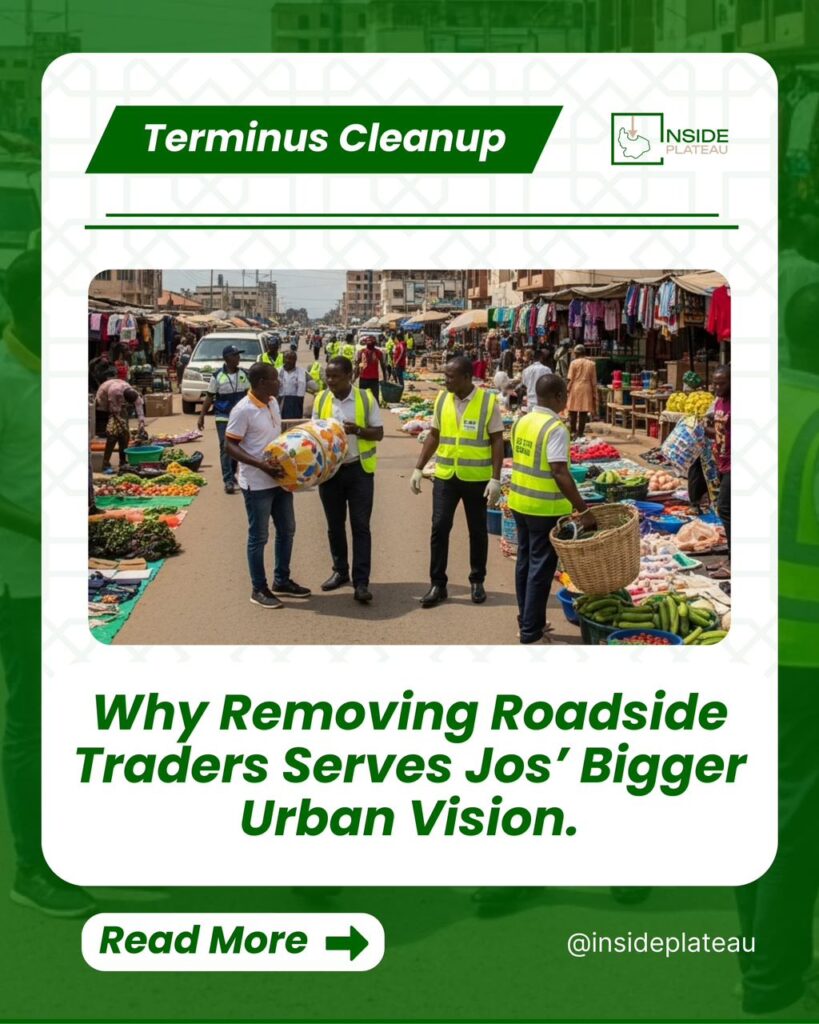
If you’ve been to Terminus recently, you probably noticed something immediately. The roads feel wider. The sidewalks are visible again. And for the first time in years, vehicles can actually move freely without the usual gridlock that once defined the place. That change didn’t happen by accident but from the ongoing Terminus cleanup, a decision that sparked plenty of conversations at first but is now beginning to show its real value.
Terminus has always been the commercial heartbeat of Jos. Anyone who has lived in Plateau State knows that. From the commercial banks and electronics shops to the transport parks and supermarkets, the area connects nearly every part of the city. But over time, roadside trading gradually took over spaces that were never designed for commerce.
Sidewalks were turned into mini-markets, and road shoulders turned into stalls. And before long, a place that was meant to keep the city moving started slowing it down.
This is why the Terminus cleanup was an essential reset because it restores order while also aligning with jos’ urban vision for a modern and functional capital.
And honestly, if you walk through the area today, you can see the difference.
Understanding the Terminus Cleanup and Why It Became Necessary
For many years, Terminus struggled with congestion. It wasn’t just the traffic; it was the combination of traffic, movement, and roadside trading all happening in the same limited space.
Picture this for a second. A two-lane road that already contains taxis, buses, and private vehicles. Still has traders displaying goods right on the roadside. Then add pedestrians that are forced to walk on the road because the sidewalks are blocked. You don’t need to be a traffic engineer to see the problem.
The Terminus cleanup exactly tackled that issue. By removing the unauthorized roadside stalls, the city has finally restored access to sidewalks and cleared the road corridors that vehicles rely on. It’s a simple principle in urban planning: roads are for vehicles, sidewalks are for people, and markets belong in designated commercial spaces.
When those roles get mixed up, cities become chaotic.
But when they’re restored, things begin to work perfectly again. That’s exactly what this Terminus cleanup is doing, and it fits directly into jos’ urban vision of a cleaner, safer, and more organized city.
How the Terminus Cleanup Reduced Traffic Congestion
If you ask the drivers who pass through Terminus on a daily basis, most of them will tell you the same thing: movement is really smoother now.
However, before the Terminus cleanup, buses often had to slow down or stop because traders and customers spilled into the road. Delivery trucks struggled to maneuver. Even emergency vehicles could get stuck during peak hours.
But now, the difference is clear. With the roadside traders gone, the road width is fully usable again. That alone improves traffic flow significantly.
Around the world, urban transport studies show that street encroachments can reduce road capacity by as much as much as 30–40 percent. So when a city clears those encroachments, traffic efficiency improves almost immediately.
That’s exactly what the residents of Jos are experiencing today. The Terminus cleanup has restored the original purpose of the roads, and it supports jos’ urban vision of a city where movement isn’t constantly interrupted by avoidable bottlenecks.
A Cleaner City Environment
But congestion wasn’t the only issue. Waste management also became a major challenge when roadside trading expanded. Temporary stalls rarely have proper waste disposal systems. Plastic packaging, food remnants, and damaged goods often ended up on the roadside. Over time, that created a sanitation problem.
The Terminus cleanup has helped reverse that trend. With trading activities returned to organized markets and designated shop spaces, waste management becomes easier to regulate. Municipal sanitation teams can now access the area properly, and drainage channels are less likely to be blocked by debris.
When you walk through Terminus now and you’ll notice something subtle but important: the environment looks more orderly.
And that visual order is very essential. Clean commercial districts attract customers, encourage investment, and create a stronger impression for visitors. It’s exactly the kind of atmosphere jos’ urban vision is building — a city that feels structured, welcoming, and ready for growth.
Why Organized Commercial Spaces Matter in Jos’ Urban Vision
Every successful city separates the informal street activities from the structured commercial zones.
When you take a look at the modern city centers all over the world, you’ll see that markets operate within defined spaces, not directly on major roadways. That organization protects both businesses and infrastructure. The Terminus cleanup moves Jos closer to that model.
Instead of roadside trading disrupting traffic, commerce can take place in markets, plazas, and properly allocated stalls. That structure helps traders too. When businesses operate from recognized spaces, they gain stability. Customers know where to find them, and authorities can support them with services like sanitation, lighting, and security.
That’s why the Terminus cleanup isn’t just about clearing roads. It’s part of shaping the long-term commercial structure of the city. And that structure is central to jos’ urban vision.
Safety Improvements After the Terminus Cleanup
There’s a major benefit that people often overlook: safety. When roadside trading used to block sidewalks, pedestrians are forced into the road. This dramatically increases the risk of accidents.
Picture this; parents walking with their children, elderly residents, or even office workers during rush hour — they all end up sharing space with moving vehicles.
The Terminus cleanup restored the pedestrian walkways. That single change reduces risk in a major way.
Street visibility has also improved. Before the cleanup, the tightly packed roadside stalls sometimes blocked drivers’ sightlines at intersections. But now, open visibility allows vehicles and pedestrians to see each other clearly.
Urban safety often comes down to simple spatial organization. And when space is used correctly, cities become safer without adding complicated systems.
And that’s exactly what the Terminus cleanup is demonstrating in support of jos’ urban vision.
Investor Confidence and the Cleanup
Investors usually pay attention to how cities manage their core districts. Because, a congested, disorderly commercial center sends one message. While a clean, structured one sends another.
The recent terminus cleanup signals that Jos is serious about urban management. It also shows that the city is willing to protect infrastructure and maintain order in its busiest commercial zones. This matters for businesses considering expansion in Plateau State.
Retail chains, hospitality companies, and service providers all look for cities where planning regulations are enforced. They want to operate in environments where movement is predictable, streets are accessible, and public spaces are maintained. The terminus cleanup strengthens confidence in jos’ urban vision as a practical plan rather than just an idea.
The Bigger Picture
It’s easy to see the cleanup as just another local operation that affects one part of the city. But the bigger picture is very much broader.
Cities evolve. As populations grow and economic activity increases, the urban spaces need to be reorganized to handle new demands. Roads that worked twenty years ago may not function well today if surrounding activities change. That’s where planning steps in.
The Terminus cleanup reflects a broader shift toward structured urban management in Jos. It recognise that the city’s commercial heart must remain functional if the entire system is going to work efficiently. And when the city centre works well, everything else benefits — transport, commerce, tourism, and daily life. That’s the essence of jos’ urban vision.
Also Read – Spotlight on a Popular Cafe in Jos: The Net Cafe Spotlight on a Popular Cafe in Jos: The Net Cafe
A More Livable Future Through the Cleanup
Cities are judged not only by their buildings but by how comfortably people can move through them. When roads flow smoothly, sidewalks are accessible, and public spaces feel organized, everyday life improves. People spend less time stuck in traffic, businesses operate more efficiently, and visitors form better impressions of the city.
The Terminus cleanup contributes directly to that quality of life. It turns a once congested district into a space where transportation, commerce, and pedestrian movement can coexist properly.
And while urban improvements don’t always happen overnight, this step shows the direction Jos is moving.
A city that protects its infrastructure, values order, and is steadily working toward an urban vision.
The Cleanup and the Story of a Changing City
For several years, Plateau State has often been discussed in national headlines for the wrong reasons. Yet the everyday life in Jos tells a different story — one of gradual development, urban renewal, and communities working toward a better future. The Terminus cleanup is a big part of that story.
It further demonstrates that the city is not standing still. Decisions are being made, spaces are being reorganized, and infrastructure is being protected so that Jos can grow in a balanced way.
And sometimes, progress shows up in simple forms: A road that moves freely again, a sidewalk people can finally walk on, and a commercial district that feels open and organized.
That’s what the terminus cleanup represents. And it’s one more step toward realizing jos’ urban vision — a city designed not just for today, but for the decades ahead.