
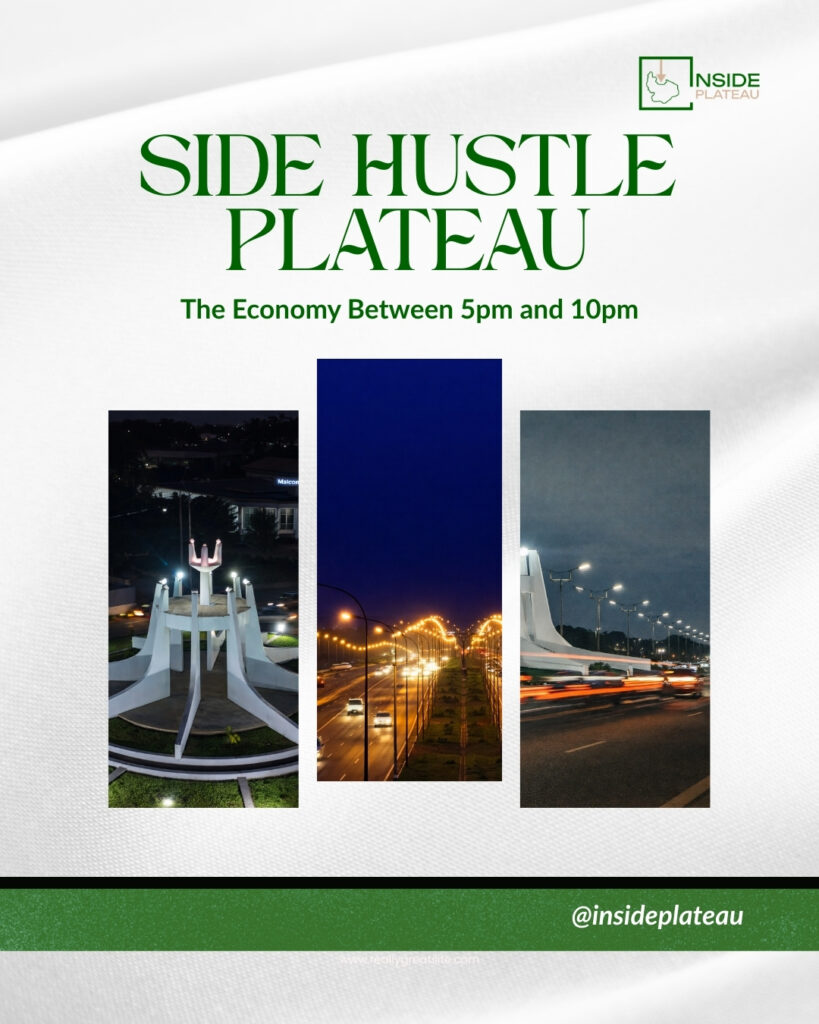
When 5pm Doesn’t Mean Closing Time in Jos
At exactly five o’clock, something subtle happens in Jos. Office chairs slide back, hospital corridors thin out, and lecture halls empty as the formal part of the day folds neatly into files and backpacks. But the city does not exhale the way you expect it to. It shifts.
Here on the Plateau, work does not close at 5pm, it converts. By the time the sun softens over the hills, streetlights flicker on, smoke is already rising from grills across the city, engines idle near food trucks, and WhatsApp status updates begin to advertise evening drops. In Jos, 5pm is not closing time. It is a second opening.
This is the economy between 5pm and 10pm—the Plateau evening economy—and it is one of the most revealing things about life in Jos.
ALSO READ: Built in the Waiting: A Smart Food Spot Is Coming to Terminus
The Food and POS Economy That Comes Alive After Work
If you want to understand side hustles in Jos, start with the smoke. Near a busy junction, skewers are lined in neat rows, suya crackles on low heat, and street food stands glow under streetlights and the scent alone is enough to redirect traffic.
At J City Food Truck Central, a university student tightens his apron and steps fully into chef mode. During the day, he is navigating lectures and assignments. But when evening comes, he commands a kitchen with precision; seasoning, flipping, plating with speed that only repetition can teach. He may not become a professional chef or one day he might. But today as he serves in this metal kitchen as the lead chef, it’s more than just a side hustle to him. It is passion that pays the bills.
Between 5pm and 10pm, this is real work with real customers and real income.
A few streets away, a POS stand is being mounted into position. The operator works a salary job by day. But in the evenings, she becomes the neighbourhood’s financial bridge, aiding transfers, withdrawals, and deposits. The quiet backbone of Jos’ micro-finance hustle hums under fluorescent light and she knows she is not the only one like her. Just a stone’s throw away is another POS stand and another and so many more after that it looks like an exhibition of umbrellas and kiosks, but the competition isn’t with each other. It’s against the cold that gets colder at night and the limitations of earning less than one deserves.
These are not background characters. They are part of a visible, functioning evening economy in Plateau State, one powered by appetite and participation.
Double Lives: Professionals by Day, Creatives by Night
By six o’clock, the city is glowing differently. The graphics designer is changing his clothes and climbing down a ladder he’s been standing on since the crack of dawn. Yesterday he was seated in an office, painting art into digital design for a clients. Today, he painted the exterior of a house for yet another client. He’ll again awake to design briefs by morning and maybe in the evening wrap up the paint job. This is his weekly ritual. It doesn’t matter to him what collar he’s wearing, as long as he gets to manipulate colors and earn his pay.
In a modest apartment, a young woman sits cross-legged, crochet hook moving in steady rhythm. The bright pieces she creates are not hobbies. They are orders. She wears what she sells and sells what she makes. Her brand exists between classes, deadlines, and dinner.
Somewhere else in Jos, a pharmaceutical intern is washing off the day. By night, he becomes something entirely different: a hypeman. Measured speech during hospital rounds transforms into commanding energy on stage. He reads a crowd the same way he reads prescriptions: carefully, intentionally. It is easy to call this hustle culture. But in Plateau, it often feels more layered than that.
The modern Jos professional is rarely one thing: the intern is also the entertainer, the student is also the chef, the banker is also the POS operator, the graduate is also the crocheter, the trader is also a miner and the designer is also a painter. Not because they are confused, but because they are expansive.
The Layered Hustle Culture of Plateau Evenings
By 7:00pm, Jos is fully awake again. Traffic thickens near popular food spots, deliveries move through dim streets, social media vendors post thrift drops with “delivery tonight” captions, while a social media manager closes one laptop tab and opens another, coordinating decor for an event she will supervise throughout the night.
At a roundabout in the capital city, a mass communication student stands with a small team, carefully wiring festive lights onto a metal frame. When the installation finally glows weeks later, it will be photographed, admired, and shared. Few will know it was built between lectures.
As music begins to leak into the air from venues preparing to open, DJs test speakers, event hosts rehearse transitions, and a saxophonist warms up in a quiet corner before joining a live band later in the evening. In this way, Plateau evenings are surprisingly productive. They are not chaotic or frantic; just layered.
Between 5pm and 10pm in Jos, skills are applied in parallel. Creativity overlaps with commerce, while passion overlaps with practicality. There is no hierarchy in these hours. Rather, Plateau State’s evening economy flattens all assumptions about “main jobs” and “side hustles.” It insists that honest work, whether part-time or permanent carries equal dignity. Here, labour is not embarrassed, it is embraced.
What the Plateau Evening Economy Signals About the City
But this evening expansion is not happening in a vacuum. The question lingers quietly beneath the smoke and stage lights: why is Jos working twice?
Part of the answer is economic reality. Across Plateau State, like most of Nigeria, salaries—especially entry-level and public sector wages—often stretch thin against rising food prices, transport costs, rent, and school fees. Inflation has not announced itself loudly in Jos; it has simply settled into daily life. The ₦500 that once bought a modest dinner now negotiates, the cost of fuel alters delivery margins, data subscriptions become business expenses, and for many, the evening hustle is not an indulgence; it is a stabilizer.
Yet, it would be too simple to frame all of this as survival. Because, woven within the tapestry of this reality lies ambition. Many of these night-time ventures are not temporary patches but deliberate experiments. A crochet brand begins as extra income and slowly builds a customer base. A hypeman refines his stage presence into a reputation. A student chef tests a concept that could one day become a restaurant. And if you examine it closely, the hours between 5pm and 10pm serve as proving grounds. They are where risk feels manageable and identity feels expandable.
What this reveals about Jos is not merely economic strain, but economic elasticity.
The city may not always provide enough in one lane, but its people carve additional lanes for themselves. Plateau’s cost of living may demand more creativity than before, but it has also cultivated a culture that refuses singular definition. In Jos, income is rarely linear. It is layered.
ALSO READ: Plateau State Artists Are Making Waves in Music and Visual Art
Built on Appetite, Not Just Survival
It would be easy to frame Plateau State’s evening economy as pure survival instinct. And in many cases, economic pressure plays its part as salaries stretch thin, prices rise quietly, and income fragments. But that explanation alone feels incomplete.
In Jos, many side hustles are not born in panic but in preference. The hypeman did not discover energy because he needed money, he already loved the stage. The decorator did not begin with scarcity, she began with an eye for beauty. The saxophonist did not wait for permission to play, neither did the crochet entrepreneur already loved texture and colour. The chef already loved heat and flavour.
What the evening economy offers is structure. It gives these instincts a timetable. It gives passion a ledger. Between 5pm and 10pm, identity expands and income follows. The result is not just survival. It is appetite—for income, yes, but also for expression, experimentation, and ownership. That appetite is what gives the state’s hustle culture its warmth. It feels less frantic than in other cities. Less performative and more personal.
When the Sun Sets in Plateau State, Ambition Multiplies
By ten o’clock, Jos does not shut down, it recalibrates. At this hour, food stalls still glow, clubs pulse, POS kiosks tally final transfers and the nightlife begins proper. The hills remain steady in the background, serving as quiet witnesses to a city that refuses singular definition. From observation, it knows: five o’clock in Plateau is not a closing hour. It is a change of shift.
And between 5pm and 10pm in Jos, ambition does not fade with the light; it simply changes clothes.