
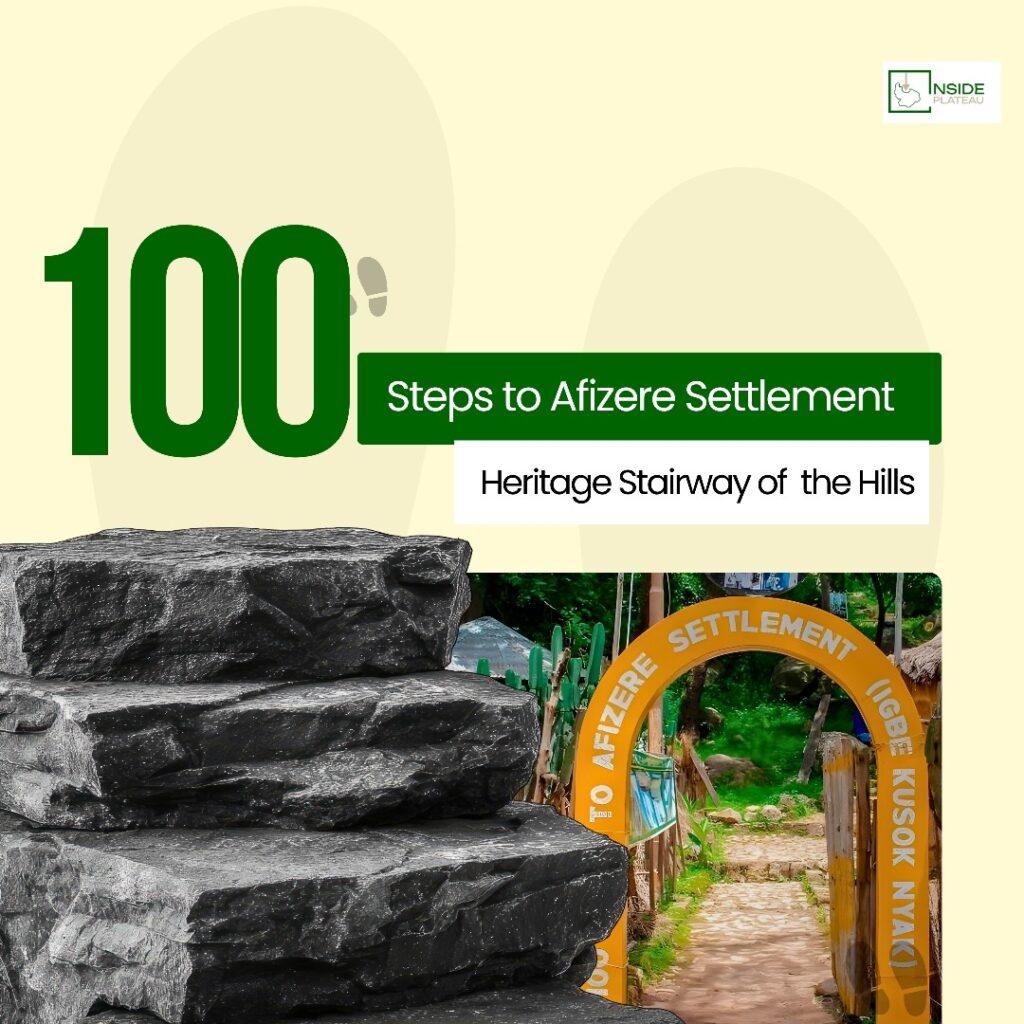
How true is the story of Olympus? Can a civilization truly thrive atop peaks so high, so impossibly commanding, that it begins to feel less earthly and more divine? If you think Olympus is a myth, think again: because, for over two centuries, long before Jos became the bustling capital of Plateau State, the Afizere people carved a civilization into the hills, sculpting life into stone, ridge, and plateau.
Their world was not a story told by poets or painters; it was lived, step by step, as they ascended the sacred heights of what we now call the 100 Steps to Afizere Settlement. This is no legend. This is the Afizere. This is Africa’s answer to Olympus.
At the Foot of History
The journey begins not at the hill, but at the Agwom Palace, where the paramount ruler of the Afizere people reigns. Nestled at the foot of the sacred hill, the palace is both the heart and hearth of the culture: a living testament to a people whose strength was rooted in respect, governance, and tradition. Here, visitors pause, paying homage to the Agwom and acknowledging centuries of leadership that shaped hills and valleys alike.
The palace is modest compared to the mountain it guards, yet it carries a weight no summit could ever surpass. This simple, circular structure made of clay, beaten by human hands is the doorway to history, the threshold before one begins to walk with the ancestors.
First Steps Up, into the Past
And then, the climb begins. The 100 Steps rise before you, each carved from centuries of human touch. The first steps feel familiar, almost gentle, as if welcoming you into the Afizere story. As you ascend, the incline stiffens and your heartbeat imperceptibly syncs with the rhythm of history. Each step is a pulse of the past as your footfall matches the exact spot where a warrior once paused to watch the horizon; take yet another and it’s a mother who once led her children up those same steps in search of safety. The stones are worn smooth by countless feet over generations, yet each retains its individuality, each a chapter, each a heartbeat.
The City that Bows to the Hills
The view begins subtly at first. Plateau State unfurls beneath you in quiet expanses of green and brown, rooftops dotting the plains, roads weaving through valleys, the National Museum standing sentinel around the base of the hills. With every step, the panorama grows grander, more commanding, until it feels as though the city itself bends to the hills. The museum, the capital, the streets… all of it seems to orbit the Afizere legacy, as if the land remembers who first claimed it. Jos is not built on Afizere land; it is built around Afizere history, elevating the people whose courage, vision, and ingenuity made the hills a home and a civilization.
Between Wind and Memory
Halfway up, the climb shifts from physical exertion to meditation. The wind whispers through grasses, carrying scents of distant forests and wildflowers, scents that mingled with the smoke of hearths and the aroma of terrace farms centuries ago. It is here that the Olympian comparison becomes unmistakable. Like the gods of Greek myth, the Afizere lived above the ordinary world, commanding perspectives, protecting their people, and shaping culture from the hills. They were elevated in space, yes, but also in vision, community, and influence. They watched the plains below, and the plains obeyed: rivers, roads, settlements, and later, colonial and modern administrations; all orbiting a civilization older than the city itself.
As you near the summit, the 100 Steps become steeper, narrower, more sacred. Here, every incline reminds you of human perseverance, every plateau, a resting point of reflection. You imagine the Afizere families, their warriors, their elders, standing where you stand now, surveying horizons, strategizing defenses, celebrating harvests, dancing in the early morning light. The climb itself becomes a bridge across time; the steps are not just stone, they are memory, endurance, and culture.
Behold! The Crown of the Hill
At the top, the hills open like a crown. The city stretches endlessly below, and the landscape reveals a grandeur that feels almost supernatural. From this vantage, Olympus does not seem so fantastical. The Afizere were gods of their hills, shaping life, society, and heritage from a vantage point few can imagine. Their terraces, pathways, and fortified settlements were both practical and symbolic; proof that civilization thrives when people meet challenge with ingenuity. Here, myths meet reality: the Afizere were the architects of culture, the keepers of memory, the Olympians of Plateau State.
Returning to Earth
But what goes up must surely come down. Back in those days, the Afizere built their lives on top of those hills, but today, when you visit, you go to enjoy that serenity and righteous feeling of being above it all. But only for what feels like an extended minute. Descending now, one begins to feel the weight of what has been witnessed. The Asharawa dances, still performed, echo centuries of celebration. The language, festivals, art, and social systems all carry the pulse of a civilization that lived elevated, both literally and metaphorically. Plateau State, with its streets, its museum, and its very identity, continues to orbit this ancient culture. The Afizere’s legacy is woven into the landscape, the rhythms of the people, and the pride of a state that has grown around their story.
To ascend the 100 Steps is to traverse time, to walk in the footsteps of warriors, artists, farmers, and rulers. It is to feel the cadence of a people who chose elevation for defense, for vision, and for dignity. And in this choice lies the lesson: to rise above does not mean to dominate. As the Afizere have learnt, it means to protect, to cultivate, and inspire. They settled in the hills not because the plains were undesirable, but because the hills granted them perspective: a stage for their civilization, a theater from which their story could be seen, understood, and remembered.
And Myth Met Reality
The 100 Steps are more than a stairway; they are a testament. A journey through them is a reminder that history is not only written in books but etched into earth, stone, and human endeavor. The Afizere civilization was not merely a settlement; it was a statement. And today, when one looks up at those hills, one sees more than rock and ridge; one sees memory, resilience, and power. One sees gods among mortals. One sees Olympus in Nigeria.
So, the next time Olympus comes to mind, let it conjure more than Greek myth. Let it recall the Afizere, their 100 Steps, their terraces, their dances, their language, and their hills. Plateau State wraps itself around this history, the city of Jos grows at its feet, and the Afizere continue to remind the world that greatness is measured not by the size of the plains one occupies, but by the heights one dares to climb.